Towards an attentional theory of second-language speech perception: Ev… https://t.co/owJ4xmnHSG A cross-language project in collaboration with @HanyangPhonetic
Researchers mapped neuronal building blocks of human language using wide-scale single-neuronal recordings paired with natural language processing models, revealing how the brain constructs complex phrases from microscopic cellular units.
https://t.co/8IkRbh74Bk
Bayesian efficient coding as a theory of perception: progress, controversies, and prospects
Feature Review by Ivan Tomić, Máté Lengyel, & Paul Bays (@BaysLab)
Free access before July 29: https://t.co/M12Qn1pic7
Moving intentions from brains to machines
Opinion by Christian Beste, Heleen A. Slagter, Christian Herff (@HerffC), Yukiyasu Kamitani (@ykamit), Sabrina Coninx (@sconinxphil), Richard van Wezel, & Christian Frings
https://t.co/syz2Qfqzgv
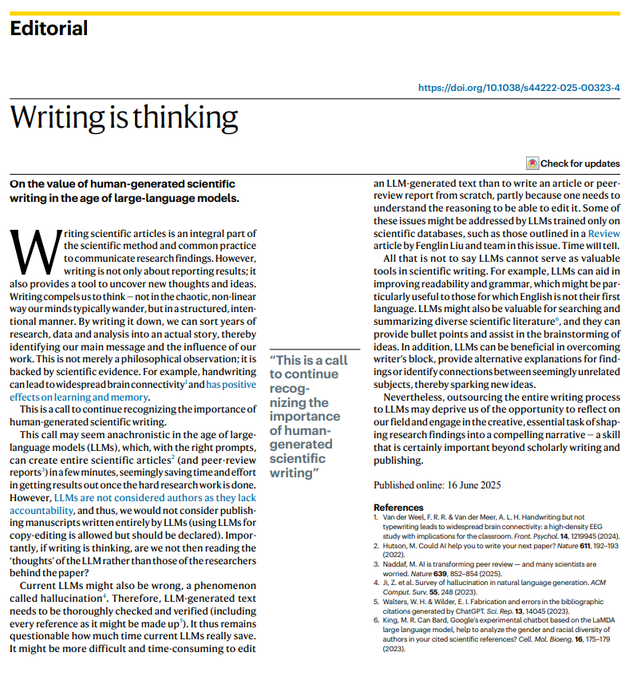
Writing forces your brain to coordinate memory, reasoning, and meaning-making simultaneously.
Every time you write, you rewire toward clearer thinking. Every time you let an LLM do it, you rewire toward consumption.
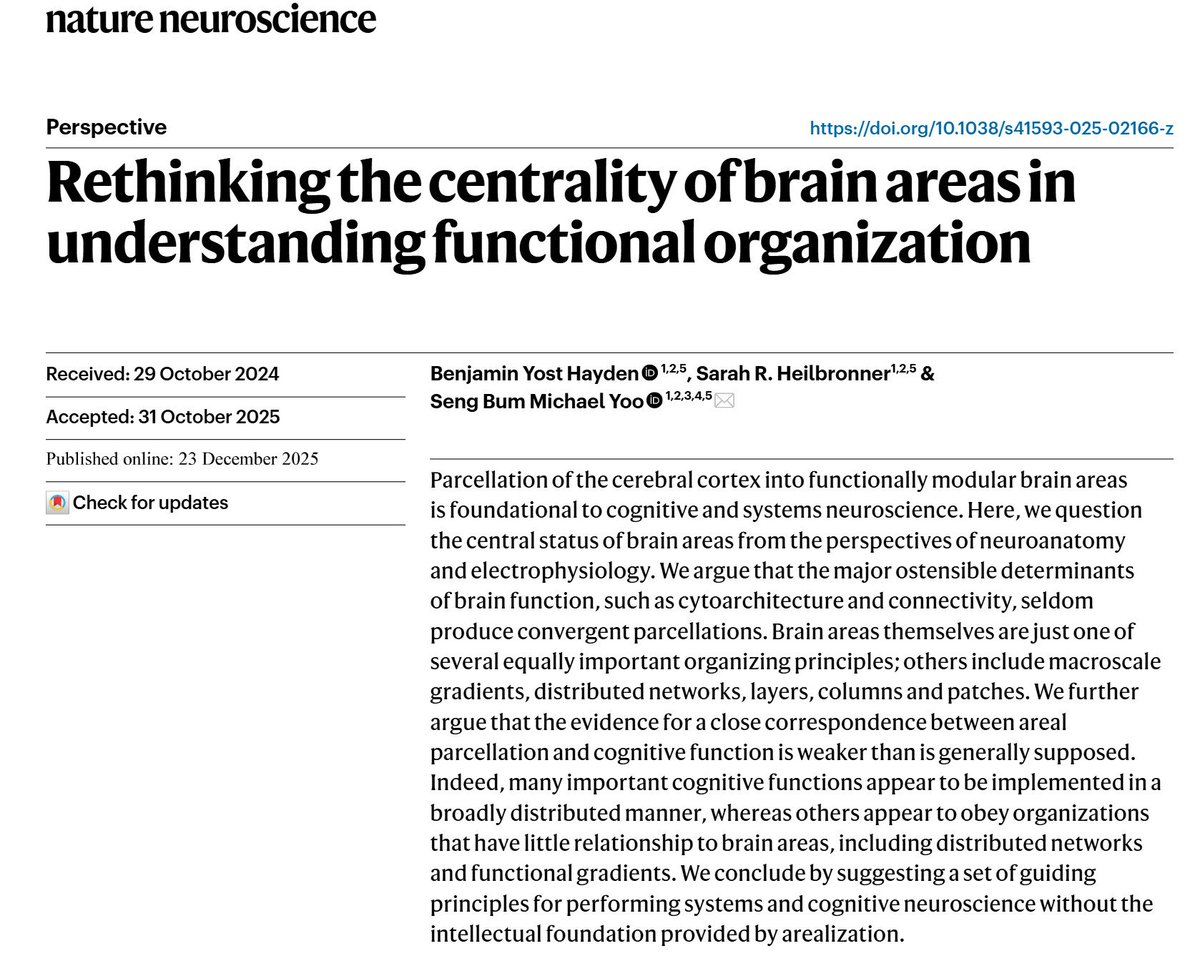
𝗥𝗲𝘁𝗵𝗶𝗻𝗸𝗶𝗻𝗴 𝘁𝗵𝗲 𝗰𝗲𝗻𝘁𝗿𝗮𝗹𝗶𝘁𝘆 𝗼𝗳 𝗯𝗿𝗮𝗶𝗻 𝗮𝗿𝗲𝗮𝘀
New paper I anticipate will become a classic in neuroscience and a must-read for students at all levels.
Understanding brain function beyond brain areas.
https://t.co/OjQPX87cfw
https://t.co/Z42nZpOtsX Our paper on the nature of Changsha Xiang positional sensitive tone sandhi has been accepted for publication in the Journal of Phonetics.
I made a Goodreads for academic papers!
(..and blog posts, substacks, lesswrong, etc)
Paper Trails [https://t.co/dPzhlBgo8E] is something I built because I wanted a place where engaging with research felt fun, beautiful, and personal to you
I hope you give it a try & love it!
I've met tons of researchers who hate stats!
If you're one of these, this book is for you ⤵️
Save (with 𝘤𝘭𝘪𝘱𝘱𝘦.𝘮𝘦) & Repost
The author says it perfectly:
"The most important concepts of statistics can be explained, so that ordinary people can understand it."
— No complex formulas.
— No expensive software needed.
— Just spreadsheets & clear thinking.
The book covers:
— Sample surveys
— Data presentation
— Confidence intervals
— Statistical tests
Written for people who need to collect data.
— Analyze results.
— Present findings.
But don't want to become mathematicians.
Real examples throughout.
— Like the Fitness Club survey with 30 kids.
Shows you exactly how to spot bias.
When to use different tests.
How to avoid common mistakes.
Perfect for public health researchers.
Statistics doesn't have to be scary.
(𝘢𝘵𝘭𝘦𝘢𝘴𝘵 𝘪𝘯 𝘵𝘩𝘦 𝘣𝘦𝘨𝘪𝘯𝘯𝘪𝘯𝘨)
�� Comment if you'd like a link to download this book!
Human auditory cortex integrates information in speech across absolute time (e.g., 200 ms), not phonemes, syllables, words, or any other time-varying speech structure: https://t.co/63T8qdQkUH
Our brain-to-voice synthesis brain-computer interface paper was published in @Nature today! This neuroprosthesis synthesized the voice of a man with ALS instantaneously, enabling him to ‘speak’ flexibly and modulate the prosody of his BCI-voice. 1/7
Paper: https://t.co/STKtfgypAW
We found that Mandarin-speaking preschoolers with typical hearing had acquired the use of duration and pitch to mark word boundaries by age 4. Pitch did not function as a robust cue across lexical tones for this purpose - https://t.co/j1YWZN9oEf


![heyanuja's tweet photo. I made a Goodreads for academic papers!
(..and blog posts, substacks, lesswrong, etc)
Paper Trails [https://t.co/dPzhlBgo8E] is something I built because I wanted a place where engaging with research felt fun, beautiful, and personal to you
I hope you give it a try & love it! https://t.co/PVtgvaUVa6](https://pbs.twimg.com/media/G7lbFSUX0AEdtRl.jpg)


