When Max Schich & Mikhail Tamm invited Carla Scaletti to the CUDAN Open Lab on International Morse Code Day…the discussion took an unexpected turn along the path to 'Ensoniment'. Check out the lecture/discussion on data sonification, analytical listening & life in the "blue box" https://t.co/P1O3rHLtSu
Chicago has been ranked the most dangerous city for migrating birds. Benjamin Van Doren is trying to make the Windy City safer for the estimated 150- 200 million birds that fly over the city by installing acoustic monitors on the tops of buildings (one is 111 floors up on the roof of the Willis Tower).
Since most birds fly at night, the best way to track and identify them is by sound. Audio is downloaded in near real time and processed in Van Doren’s lab and the results are shared on a publicly accessible dashboard.
https://t.co/8LMTQLfBqu
A new kind of bass trap! Low-frequency sound absorption has traditionally relied on Helmholtz resonators in which energy dissipation relies on air motion & the result is inherently narrowband. Replacing the high-stiffness neck of a Helmholtz resonator with a soft, viscoelastic cylindrical shell shifts the energy dissipation to tunable viscoelastic damping. A single unit achieves > 97% absorption of 227 to 329 Hz with deep-subwavelength thickness (λ/15 at 227 Hz).
Join us in celebrating our 2025 Cozzarelli Prize–winning paper for Class III: Engineering and Applied Sciences, “Viscoelastic structural damping enables broadband low-frequency sound absorption.” Read the article here: https://t.co/4bGso3Lbhm
Bumble bees learned to discriminate rhythmic structures; generalized those patterns to slower, faster and intermediate tempos; and transferred learning of two vibrational patterns to their equivalent flashing light patterns. These observations suggest that bumble bees have truly flexible rhythm perception. https://t.co/NBXvOnrKJX
Bumble bees are hardly nature’s most graceful creatures, and their name reflects it. But it turns out these bees show a surprising knack for rhythm.
The fuzzy insects can not only recognize a rhythm but also identify the same pattern when scientists change the tempo, according to new research—the first time this ability has been documented outside of a few mammals and birds.
Learn more: https://t.co/EgOAWT90qk
Researchers design a single-material passive acoustic scattering structure that converts broadband white-noise into an acoustic rainbow — passively decomposing a radiated sound into its spatio-spectral components with “above unity” efficiency.
https://t.co/zMk9RMubhB
"La sonificazione qui non sostituisce le misurazioni, non sostituisce l'analisi quantitativa e non è marketing. Serve a rivelare pattern in serie temporali molto dense... il punto tecnico importante è che l'articolo non si ferma alle 'sensazioni'... Il passaggio dall'intuizione percettiva alla misurazione è ciò che rende il metodo interessante anche per chi non ama le storie evocative."
Una recensione puntuale del nostro lavoro su @SLN_Magazine. Ho apprezzato molto questo riassunto perché cattura il cuore del metodo #AuditoryAnalytics.
https://t.co/cTirHBJIoY
#Sonificazione #DataScience #AuditoryAnalytics
It was a productive and enjoyable collaboration across borders and disciplines with co-authors: Wanlin CHEN (Université Paris-Cité, CNRS), Martina Havenith (Ruhr University Bochum), Martin Gruebele (University of Illinois), and Kurt J. Hebel (Symbolic Sound).
@ChemistryUIUC@PNASNews@WileyAnalytical
Excited to share results from our new paper, published this week in PNAS.
We studied PNIPAM—a shape-shifting polymer that collapses from an extended coil to a compact globule near body temperature — making it a prime candidate for drug delivery systems and soft robotics.
But how does it collapse?
To find out, we didn't just look at the data—we listened to it. By mapping hydrogen bond formation events to sound events, we analyzed hydrogen bond dynamics during the collapse. We expected to hear an increase in direct amide-amide bonds (N-H···O).
Instead, the data told a different story.
We heard that "water bridges"—where a single water molecule connects two parts of the polymer chain—were the true drivers and organizers of the collapse.
PNAS paper: https://t.co/599uTe9sx3
Video abstract: https://t.co/M7fzWeYTzM
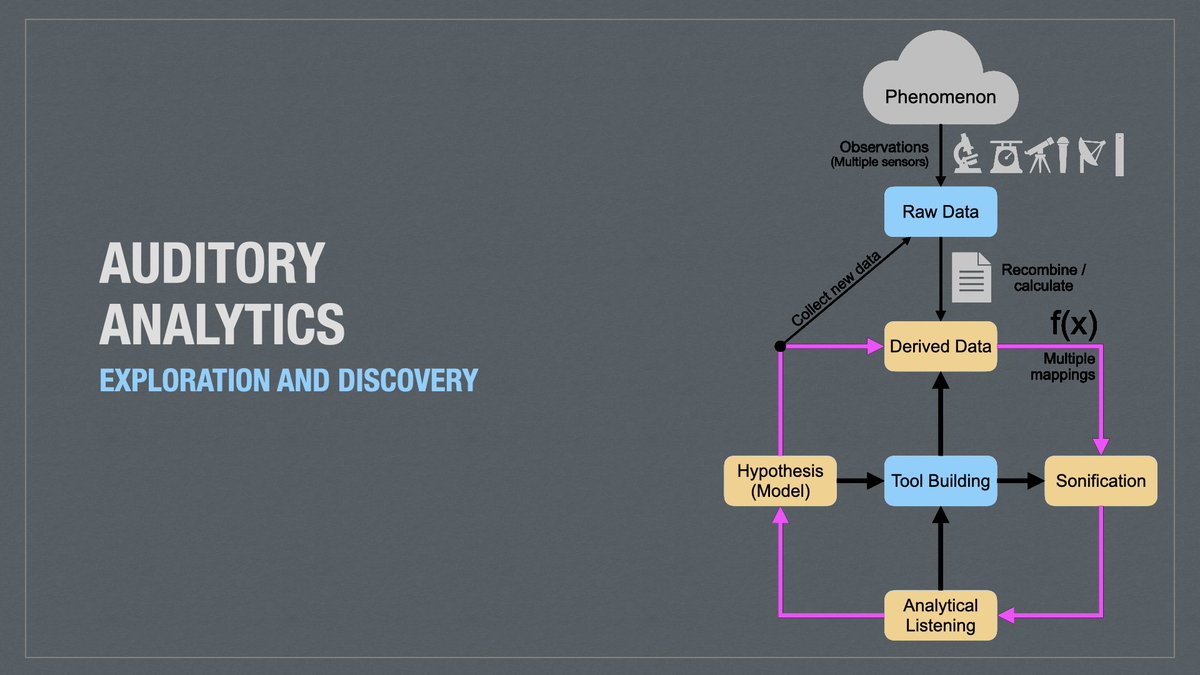
The “Auditory Analytics” methodology used to obtain these results was also published this week, in the Journal of Chemometrics.
Paper: https://t.co/Q7f7w0jWCv
Video abstract: https://t.co/lCOQeLOnpS
@En_formare If anyone is interested in the "Auditory Analytics" method used to analyze this data, the full methodology was just published yesterday in the Journal of Chemometrics: https://t.co/Q7f7w0jWCv
Hearing relies on ear’s ability to enhance its responsiveness. New research shows that a segment of mammalian cochlea ex vivo displays features of the active process—amplification, frequency tuning, compressive nonlinearity & generation of distortion products, operating locally & near criticality at a Hopf bifurcation—a unified biophysical principle that underlies auditory processing across species.
Hearing isn’t passive—it actively amplifies sound. Preserved outside the body, this process operates near a critical physical state, revealing a shared principle across insects and vertebrates.
In @PopMech: https://t.co/3H3bs2j8B4
In PNAS: https://t.co/aQzcrCXgCr
Isn’t it time we added "Analytical Listening" to the scientific method?
In our recent talk @FlatironInst, we make the case for #AuditoryAnalytics—showing how data sonification can drive hypothesis refinement & new model generation.
Watch the 15' presentation by Martin Gruebele, Kurt Hebel, & Carla Scaletti: https://t.co/5zAhdHwpVv
#sonification #DataScience
"[E]very design is a decision, and every decision shapes the future of musical thinking." Andrew Telichan-Phillips interviews the developers of SuperCollider, ChucK, Max, and Kyma, concluding that "symbolic systems do not merely describe the world; they organize it." https://t.co/oGKNelmh2n
Synchronizing movement to music is a hallmark of human culture. New study demonstrates that macaques can spontaneously synchronize to a beat, contradicting the “vocal-learning hypothesis” that only species with learned vocalizations can synchronize. https://t.co/TIsK6j2YGR
Otophysans, known for their enhanced hearing comprise 2/3 of freshwater fish. Recent discovery places their origin ~154 million yrs ago. Their distinctive hearing abilities evolved in conjunction w/ fusion of hearing ossicles & freshwater adaptations. https://t.co/xirdssyouO
The Science is Sound! From acoustic analogs of electron entanglement to using Chladni plates to position heart cells & more, check out the July @shaastramag cover story by @RoyguptaP on the unexpected ways sound is being used to probe nature.
https://t.co/jGeXmi3D1T
SonicBoom autonomous robot uses sound to sense objects in visually cluttered environments. Small differences in signal intensity & phase across an array of contact mics localize the sound source & thus the point of contact with accuracy of ~0.4 to 2 cm https://t.co/eePtWitHYm