Google's TimesFM-3 climbed from 196th → 2nd in our historical tests on Synth, after five task-specific adaptations.
Yet our adapted Chronos-2 system still outperformed it in four of five later evaluation periods.
The model matters. What you do with it matters more.
Full research: https://t.co/N6QRIC3FBB
New forecasting models keep arriving. How do Synth’s miners stay competitive?
Our latest research adapts @GoogleResearch's TimesFM-3 to Synth’s crypto forecasting task, testing it against our established Chronos-2 system using historical market replays.
Three things stood out:
→ Adaptation matters. Changes to inputs, training and the construction of possible price paths took TimesFM-3 from a median rank of 196th to 2nd during our May tuning tests.
→ A newer model doesn’t automatically win. Our adapted Chronos-2 system led on score in four of five later evaluation periods. TimesFM-3 led in September.
→ Efficiency counts too. The Chronos-2 system took roughly one-sixth of the time per forecast in our CPU tests.
For miners, staying competitive means continually testing models, refining methods and understanding where each approach performs best.
For Synth, this research helps identify what makes forecasts useful, and gives participants clearer directions to explore.
Read the full research below.
@rsen91
Full paper: https://t.co/N6QRIC3FBB
Building a miner? Use Synth’s backtesting tools to test your forecasts against its scoring system and recorded competitors before registering:
https://t.co/xmcDctRg33
The paper explores where adaptation helped, where performance varied, and the trade-offs between forecast quality and compute.
Research note: TimesFM-3 carries a non-commercial licence. We evaluated it offline; no TimesFM-3 miner was deployed, and no model weights or derivatives were distributed.
New forecasting models keep arriving. How do Synth’s miners stay competitive?
Our latest research adapts @GoogleResearch's TimesFM-3 to Synth’s crypto forecasting task, testing it against our established Chronos-2 system using historical market replays.
Three things stood out:
→ Adaptation matters. Changes to inputs, training and the construction of possible price paths took TimesFM-3 from a median rank of 196th to 2nd during our May tuning tests.
→ A newer model doesn’t automatically win. Our adapted Chronos-2 system led on score in four of five later evaluation periods. TimesFM-3 led in September.
→ Efficiency counts too. The Chronos-2 system took roughly one-sixth of the time per forecast in our CPU tests.
For miners, staying competitive means continually testing models, refining methods and understanding where each approach performs best.
For Synth, this research helps identify what makes forecasts useful, and gives participants clearer directions to explore.
Read the full research below.
@rsen91
Full paper: https://t.co/JCFj1Wrv3l
Building a miner? Use Synth’s backtesting tools to test your forecasts against its scoring system and recorded competitors before registering:
https://t.co/xmcDctRg33
The paper explores where adaptation helped, where performance varied, and the trade-offs between forecast quality and compute.
Research note: TimesFM-3 carries a non-commercial licence. We evaluated it offline; no TimesFM-3 miner was deployed, and no model weights or derivatives were distributed.
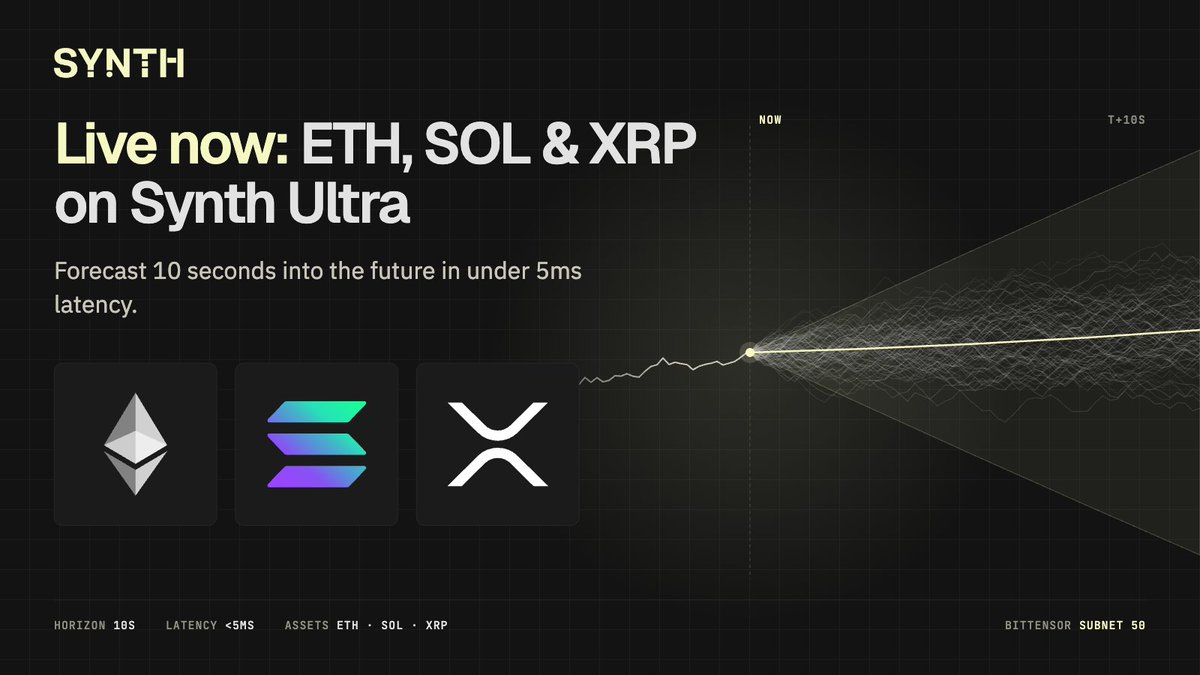
Synth Ultra expands beyond Bitcoin.
ETH, SOL and XRP are now live, each with its own ranking and miner rewards starting today.
The challenge: forecast price distributions 10 seconds ahead, targeting inference under 5ms.
Different markets bring different dynamics - opening more scope for specialised forecasting models, tested continuously against live prices.
Synth Ultra applications are open again.
We’re opening one new miner slot each day for the next 20 days, welcoming more distinct forecasting models into our high-frequency competition.
Applications are prioritised in arrival order. Apply once: your place in the queue carries forward until a slot becomes available.
One operator, one slot. Each model must be distinct, and applicants need a registered UID on SN50.
Full instructions:
https://t.co/9tli1NEV9C
6/ This also gives miners another way to outperform.
Models that forecast both price and the shape of volatility more accurately can earn more reward and contribute more useful signals to Synth’s trading systems.
The closer each simulated path is to a plausible future market state, the more valuable the competition becomes.
Full post here: https://t.co/dtbugPqM4S
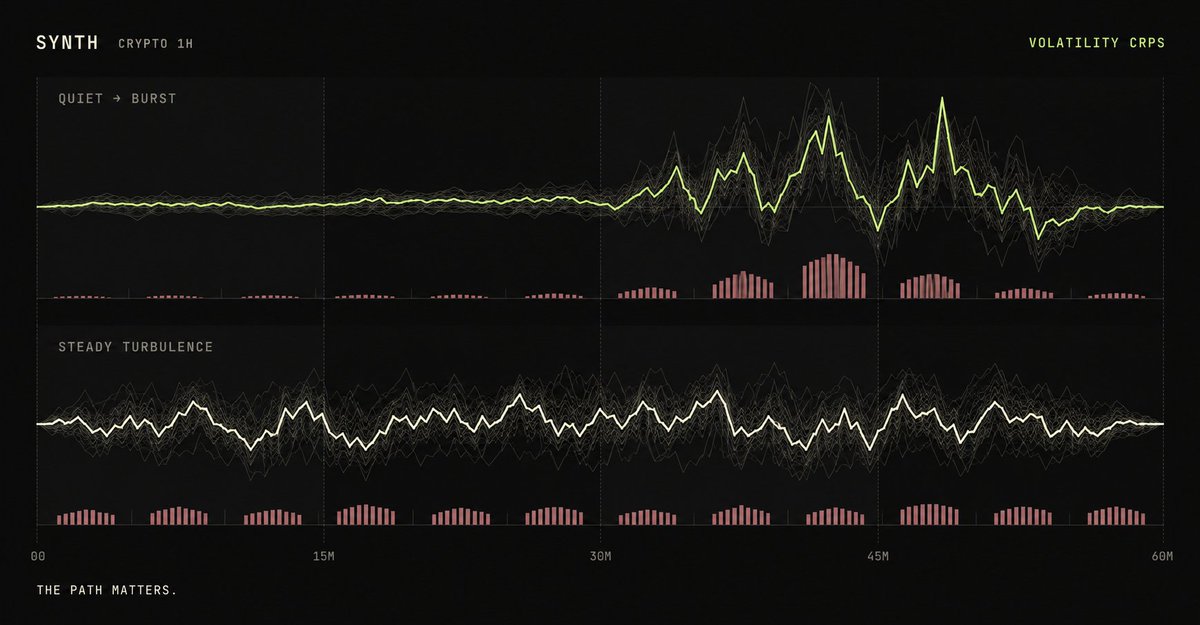
1/ Introducing Volatility CRPS Updated
As we continue our mission to build the world’s most accurate financial forecasts, we’re introducing a new scoring mechanism to our competition:
Volatility CRPS is now live in the Crypto 1h competition, directly scoring how accurately each model forecasts the volatility implied by its simulated price paths.
Read on to learn how this update directly improves Synth's trading performance
5/ That matters directly for Synth’s trading.
Better volatility forecasts can improve:
• market-making spreads
• position sizing
• execution timing
• options and volatility pricing
• liquidation-risk estimates
• hedging decisions
The goal is to turn better forecasts into better trading decisions.
Excellent presentation by @const_reborn
We are proud to be a leading subnet by revenue and excited to continue contributing to the growth of Bittensor's intelligence
Here is @const_reborn's full keynote at @ExploitSummit
It is worth the 36 minutes, but I'll give you the cliff notes.
> Affine 1, a model trained by anonymous miners entirely on Bittensor, matches the intelligence score of Anthropic's Opus 4.1.
> 23 of 128 subnets now have paying customers
> Gamma tokens are coming to turn subnet usage credits into something agents can buy from any chain.
> "We're not afraid of hyper-intelligent bot swarms on the internet. We use them to optimize our technology."
Milliseconds matter more than ever.
Introducing Synth Ultra, our new ultra-low-latency modelling competition.
Models compete to predict the distribution of asset prices 10 seconds into the future, with less than 5ms latency.
Apply below. Launching August 20.
There is a new LP meta game on @RobinhoodCrypto of using @Uniswap uniV4 hooks as a substitute for mempool JIT (just in time) liquidity as this isn’t possible on arbitrum orbit with to fifo ordering
So you use a v4 hook to mint a tight range from inside it and get infront of the swap. Sometimes with a 5% pool fee lol
Especially useful for tokenized equities if you have access to a nasdaq feed or powerful predictive models like we do @SynthdataCo
Gg