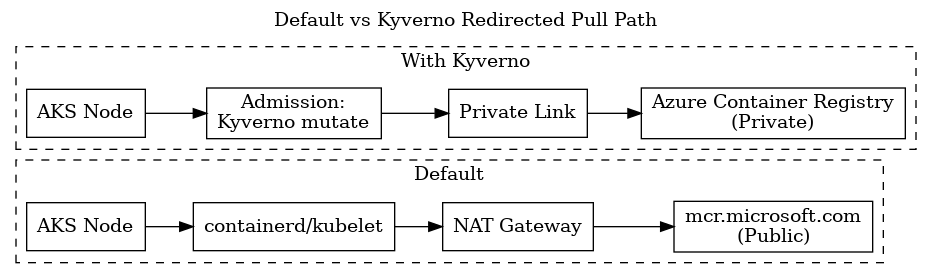
This article shows how to reduce AKS NAT Gateway costs by redirecting Microsoft Container Registry pulls through Azure Container Registry using Kyverno policies
➤ https://t.co/8OmalVjkbb
Once connected with Azure Arc, create amazing dashboards with customized views of your entire ecosystem. Report to management, monitor daily, and keep an eye on everything! #AzureArc
$DOT | The @Polkadot super app is coming
Features 👇
🔹 Identity: On-chain username with an allowance for free transactions, verified by Proof-of-Unique-Device.
🔹 Personhood: Upgrade your username via Proof-of-Personhood by playing the DIM2 videocall gesture game, and earn prizes and collectables.
🔹 Chat: End-to-end p2p encrypted text messaging with media and encrypted video/audio calls.
🔹 Payments: Send and receive payments by username or QR code, and directly in chat.
🔹 Auto-conversion: Top up your wallet and auto-convert it into the tokens you want.
🔹 Built-in dApp support & sandboxing: Explore and use any dApp, and manage its sandbox permissions.
🔹 dApp modalities: Supports SPA and Chat modalities for dApps.
🔹 Deeplinks: Navigate the app and dApps through links and QR codes.
🔹 Remote signing: Connect to Polkadot Desktop and Polkadot Web and use Mobile as a signer.
🔹 Multi-device sync — Sync contacts and chats between Polkadot Mobile and Polkadot Desktop.
🔹 Cloud backups — Back up your account using your iCloud keystore or Google Drive.
🔹 Manual backups — Keep your account stored only in the secure enclave storage locally.
🔹 Customization — Fully customizable UI design system with 5 default themes.
More details 👇
WSL containers ⚡
At #MSBuild, we announced a built-in way to create, run, and interact with Linux containers on Windows.
Watch the demo on demand: https://t.co/NVotUyk1U9
A French engineer who lives quietly in Paris has spent 30 years writing software that the entire internet now runs on without knowing his name.
He wrote the code that streams every YouTube video, every Netflix show, every TikTok clip. He wrote the code that runs the virtual servers underneath AWS, Google Cloud, and Microsoft Azure. He calculated more digits of pi than anyone in history. He has no Twitter. He has no marketing. He just keeps shipping.
His name is Fabrice Bellard.
Here is the story, because almost nobody outside the systems programming world knows what one man has built.
Fabrice was born in 1972 in Grenoble, France. He studied at École Polytechnique, the top French engineering school. He never went to Silicon Valley. He never built a startup empire. He just wrote code.
In 2000 he started a project called FFmpeg, an open-source multimedia framework for encoding, decoding, and streaming video. He was 28. The project did one thing nobody else had done well. It handled every video and audio format that existed, in one library, on every operating system. He led it himself for years.
Today FFmpeg is the invisible engine of the internet. YouTube uses it. Netflix uses it. VLC uses it. Chrome and Firefox use parts of it. Every Android phone, every iPhone, every smart TV, every video editing tool you have ever touched runs FFmpeg somewhere underneath. If you have watched a video on a screen in the last 20 years, Fabrice's code processed it.
He was not done.
In 2003 he started QEMU, a machine emulator and virtualizer. He wrote it solo until version 0.7.1 in 2005. QEMU lets you run any operating system on any other operating system. It became the foundation of modern virtualization. KVM, the Linux kernel hypervisor, runs on top of QEMU. Every major cloud provider, AWS, Google Cloud, Microsoft Azure, IBM Cloud, runs virtual machines on infrastructure built around it. The Quick Emulator is the most cited piece of cloud infrastructure code on Earth.
He kept going.
In 2001 he won the International Obfuscated C Code Contest with a small C compiler that grew into TCC, the Tiny C Compiler. TCC can compile and boot a Linux kernel from source in under 15 seconds. In 2004 he calculated the most digits of pi ever computed at the time, using a personal desktop computer and an algorithm he derived himself called Bellard's formula. In 2011 he wrote a complete PC emulator in pure JavaScript that runs Linux in your browser, a project called JSLinux that engineers still cannot believe is real.
In 2019 he released QuickJS, a small but complete JavaScript engine that fits where V8 cannot. In 2021 he released NNCP, a neural network based lossless data compressor that immediately took the lead on the Large Text Compression Benchmark.
Then he turned his attention to large language models. He built TextSynth Server, a web server with a REST API for running LLMs locally. He released ts_zip and ts_sms, compression utilities that use language models to compress text and short messages at ratios traditional algorithms cannot reach. He released TSAC, a very low bitrate audio compression system. In December 2025 he released Micro QuickJS, a new JavaScript engine for microcontrollers, separate from QuickJS, designed for environments with almost no memory.
Fabrice co-founded a telecom company called Amarisoft in 2012, where he serves as CTO. Amarisoft builds 4G and 5G base station software used by carriers and labs around the world. He has been running it for over a decade while continuing to ship personal projects from his own home page at bellard dot org
He has no Twitter. He has no Instagram. He gives almost no interviews. His personal website is a flat list of projects with no styling, no fonts, no marketing copy. Just titles and links.
A quiet French engineer who never moved to Silicon Valley wrote the code that quietly runs the internet.
He is still shipping.
Microsoft just made Windows way better for devs at Build 2026!
Coreutils for Windows is now GA. Native Linux commands (ls, grep, cat, find, etc.) that run directly on Windows. No WSL needed.
Built on Rust (uutils). Scripts just work across platforms.
Install:
winget install Microsoft.Coreutils
Big win for cross-platform devs.
WSL now has built in Linux container support with both a CLI and an API, announced today and coming soon by the end of the month!
You can read more about it here (While our official docs are building :) )
https://t.co/o9RaROfswP
Microsoft introduces Coreutils for Windows, bringing familiar Unix-style command-line tools to Windows without requiring WSL.
https://t.co/5m4AleDbA7
#Microsoft#Windows#Linux#OpenSource
🚨 LE CRÉATEUR DE CLAUDE CODE BALANCE TOUT
Boris Cherny (Anthropic) explique ENFIN comment écrire des prompts qui marchent vraiment :
- Fichiers CLAUDE.md
- Raccourcis mémoire
- Sessions parallèles
- Patterns de prompting ultra-efficaces
Tout ça en une seule vidéo, gratuit, et sans bullshit.
Si tu utilises Claude pour coder, bosser ou créer… tu vas gagner un temps fou.