Our June issue is out.
Inside:
☑️ The Druze Supervillain: Attempts to securitise Suwayda are ill advised
☑️ The logic behind the madness: Why Trump’s Middle East strategy is not new – and may even be working
☑️ Free the loaves: Syria’s bread economy could benefit from gradual market liberalisation
☑️ Lessons in obedience: How Syria’s schools reproduced authoritarian rule beyond the classroom
☑️ Romance and reality: A review of Robin Yassin-Kassab’s book ‘The Blood Between Us’
https://t.co/ES6pYxTJ8e
In @SyriaTransition, @ajaltamimi notes overheated rhetoric about Hekmat al-Hijri’s role in Sweida from both his followers and his detractors, arguing that the latter paint Hijri as a supervillain to avoid grappling with the real causes of Druze alienation. https://t.co/lMGIbnGSXz
The US/Israel war on Iran is described by some as impulsive, chaotic, and even irrational: a war that the US has already lost. This view might generate clicks, but it overlooks the deeper logic shaping American policy in the Middle East over the past decade and a half. The war in the Gulf is not a rupture from a previous, more enlightened US strategy, but its continuation by harsher means.
https://t.co/NgclTKfTFC
Suwayda is being turned into Syria’s security scapegoat.
@ajaltamimi argues the focus on the Druze risks obscuring the deeper failures driving Syria’s instability.
https://t.co/5pco0gy7la
Suwayda compresses many of Syria’s key challenges into a remarkably narrow space: decentralisation of governance, minority relations, competing victimhood narratives, a lack of accountability and transitional justice, war-economy networks and Israeli intervention. None of these are unique to the province. How they are handled in Suwayda may prove a revealing indicator of the Syria of tomorrow.
https://t.co/fdf74Xmgzb
The US/Israel war on Iran is described by some as impulsive, chaotic, and even irrational: a war that the US has already lost. This view might generate clicks, but it overlooks the deeper logic shaping American policy in the Middle East over the past decade and a half. The war in the Gulf is not a rupture from a previous, more enlightened US strategy, but its continuation by harsher means.
https://t.co/NgclTKfTFC
Does a research team have the right to withhold criminal evidence for years? What of the right of families and relatives of victims to know the fate of their missing loved ones? And if the evidence has been in the hands of official and international bodies for years, who bears responsibility for transforming it into a truth that reaches the families of the disappeared?
https://t.co/O54fAC1XR5
School is where children first encounter state authority in a sustained way: through everyday discipline, hierarchy and the regulation of speech and behaviour. In Assad’s Syria, this meant taking first steps in a system where violence, corruption and opportunistic spying on others were treated as practical virtues. What’s left of it?
https://t.co/0SJcNtfUX5
Timely piece on @SyriaTransition that pushes back against recent vilification of Druze communities in Suwayda opposed to the gove't by pro-Damascus media, especially simplistic claims that the area is a haven for Assad loyalists and a hub for Captagon.
https://t.co/coR1l8NNgy
A new month, a new issue of Syria in Transition.
For those who prefer the good old PDF, you can download the June issue - neatly laid out and easy on the eyes - here: https://t.co/eNU1Yq4qyo
In 'The Blood Between Us', Robin Yassin-Kassab chronicles the emotional experience of liberation and return after decades of dictatorship.
Our review examines where understandable revolutionary romance gives way to analytical blind spots, both in the portrayal of the revolution’s genesis and in assessing authoritarian continuities.
https://t.co/wUSsptY1uK
My latest for @SyriaTransition. On tendency among pro-govt observers & analysts to brush aside Suwayda' massacres & divert conversation towards: 'Hijri is the real villain', with talking points that have some validity but frequently veer into exaggeration https://t.co/Ygnjwc3glW
In the second part of my series for @SyriaTransition , I shift from curriculum to the institution of the school itself: how classrooms under Assad trained authority, surveillance, & corruption as everyday social practice & why that legacy still matters.
https://t.co/hXpGGUVZdZ
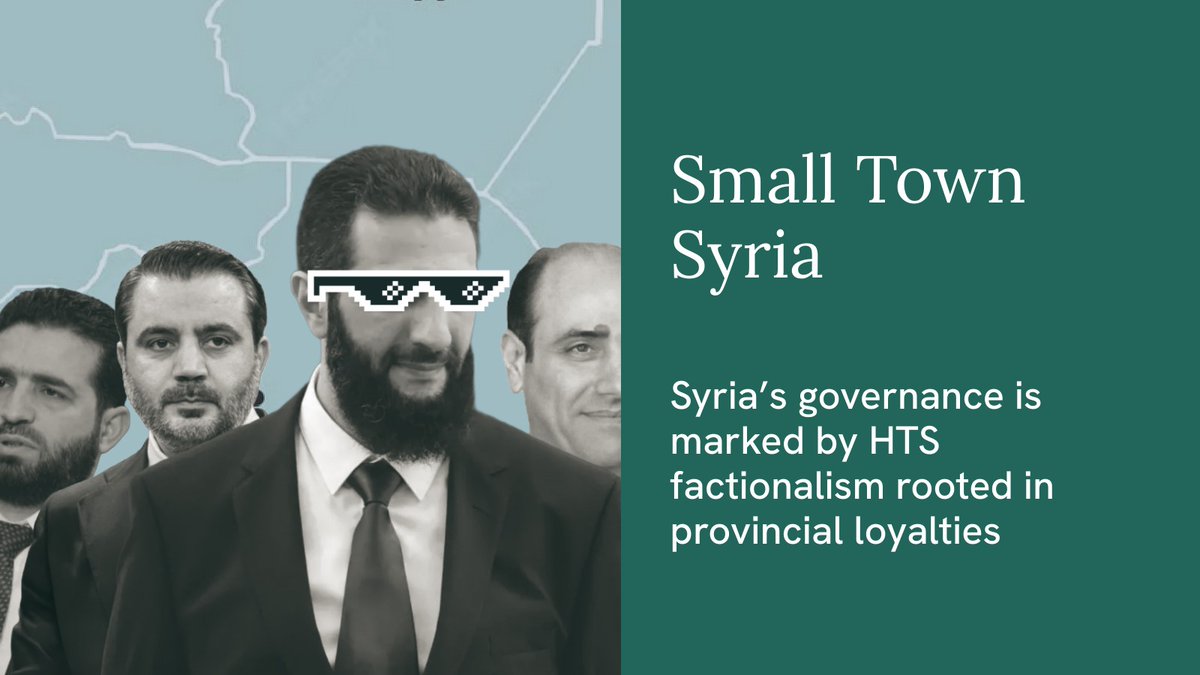
The men who now govern Syria did not rise through formal institutions but through kinship groups rooted in Idlib, Hama and Deir Ezzor. Those provincial loyalties, once useful tools of insurgency, have been transplanted wholesale into the state. What held together in wartime may become harder to manage in peace.
It is not easy to decipher the structure of power within Hayat Tahrir al-Sham (HTS) simply by scanning ministerial titles or reading government communiqués. The visible façade obscures a far denser accumulation of relationships: marriages, provincial loyalties, and patronage networks built painstakingly over years.
To understand the regime now led by President Ahmad al-Sharaa, one must look back to the earliest days of Jabhat al-Nusra, at its consolidation of authority in Idlib, and into the transition that followed Assad’s fall. The organisation’s formative years fixed patterns of influence that continue to define Syria’s power structure.
https://t.co/UAU6YnlIve
Why Syrians still adore a fictional woman played by a man.
Um Kamel was a fictional character created and performed by the Syrian actor Anwar al-Baba in the 1940s. She first appeared on radio during a cholera outbreak in Syria, when public health campaigns urgently needed to reach mothers in particular. Al-Baba invented Um Kamel as a witty, quick-thinking Syrian woman through whom health messages could be delivered gently and effectively to female audiences. She would later become one of the most beloved figures in Syrian theatre and television.
But the timing of her emergence matters as much as the character herself. Um Kamel appeared during a delicate moment in Syrian history: the period immediately following independence from French colonial rule, when the modern Syrian state was still taking shape amid an intensely conservative and socially complex environment — not unlike the Syria of today.
https://t.co/74hFEsvTMW
Syria’s 2026 budget promises recovery but puts pressure on the business sector
Heavy spending on security contrasts with limited public investment. Fiscal reforms create a self-undermining dynamic: the system relies on imports and consumption, even as rising costs and weak demand erode both - leaving consumers and MSMEs under strain.
https://t.co/WgpIpwqWU5