Today’s market strength was textbook. This is exactly what markets do during corrections when they get stretched to oversold levels. As I said just recently, "some of the biggest rallies occur during bear markets and corrections." Today was a perfect example.
Traders rushed in after headlines hit that Iran’s president signaled a willingness to end the conflict with the U.S. The Dow exploded higher by 1,125 points. But let’s not confuse cause and effect. The news may have been the trigger, but the market was already set up for a rally. It was oversold and primed. Now comes the part where discipline matters.
We ignore the first few days of a rally attempt. That’s potential noise. What matters is whether the market can follow through and whether leadership begins to emerge and proper setups develop.
Technically, this is a classic snapback: Indexes that broke below the 200-day are rallying back toward it, while Indexes that held the 200-day are bouncing off it. That’s typical countertrend behavior until proven otherwise.
Expect volatility to remain elevated. That’s not where low-risk money is made, but it's certainly where the risk is. Your job during corrections is simple: identify the stocks showing the best relative strength and the tightest price action. Those are your future leaders when the market finally turns.
On the macro side, nothing has been resolved. Higher crude prices are still a problem. Yesterday’s rally did nothing to materially bring down oil. The bigger issue is still in play and the jury still out. Oil at these levels feeds inflation, pressures growth, and gives the Fed a reason to stay on hold longer. Yields stay elevated in that environment.
To cut through all the noise, I look to the market itself, which has a much better track record of telling us the truth than the politicians, the analysts, the news, and the gurus.
The four steps of the bottoming process are:
1. Oversold – The difference between an ordinary pullback and an oversold condition starts with price, but it does not end there. Poor breadth and and a lack of volume confirmed follow through describe a one-sided market, and one not to trust.
2. Rally – Inevitably, the market bounces from its oversold condition. A high-quality rally is broad-based. A low-quality rally is defined by short covering and driven primarily by the stocks that have declined the most. Again, the character of the rally is important to distinguish. So far, we simply don't have enough data to make a confident determination, so patience is the watch word while we wait.
3. Retest – After the rally, there is almost always a retest. The popular averages approach, and in some cases breach, their oversold lows. The key to a successful retest is less selling pressure, such as fewer stocks below their moving averages, fewer stocks, sectors, and markets making new lows, less total volume, and less downside volume. If the retest fails, the process reverts and we generally start looking for divergences during lower lows. In the event of unexpected news, it is possible for the market to recover in a "V" fashion with no retest. In that case, we look at breadth confirmation and participation.
4. Breadth thrusts – In the final phase, not only do benchmark indices rally sharply with few pullbacks, but they do so with an extremely high percentage of stocks, sectors, and markets participating, or what technical analysts call breadth thrusts. In rare cases, the market has skipped step 3. With strong enough breadth, retests are not necessary. The Covid bottom is an example of a pretty powerful V-shaped recovery.
Bottom line:
This was an oversold rally, sparked by headlines—but not defined by them, and certainly not confirmation of a reliable bottom.
Now we watch:
--Quality of follow-through
--Emergence of leadership
--Market internals and model health
If the rally lacks quality, if economic pressure builds, or if leading stocks begin to deteriorate, then this remains what it likely is—a rally within a correction.
Stay objective. Let the market prove itself. If you are going to trade, do so incrementally.
https://t.co/JXzFFTmMtn
$SPY — The Current Reality
Price is sitting at downtrend channel support, which could allow for a short-term bounce. Moves within this channel can easily reach +2% in upcoming week, making it tempting to turn optimistic if it happens over the course of 3-4 consecutive sessions (eg. Mon +0.4%, Tue +0.7%, Wed +0.5%, Thur +0.3%).
The reality is market structure has already evolved into a an established downtrend with lower highs and lower lows. There could be selective long ideas/trades to be taken but, the downtrend channel supported by deterioration in breadth isn’t an environment where holding with a conventional short term moving average stop is ideal. It is much more advisable to be more proactive with your partial profit taking when they work in your favour.
This is the ideal market to practice 'always look for reasons not to take a trade, not reasons to force one.' We need to preserve our mental capital to capture the low-hanging fruit when bear exhaustion sets in.
If you find yourself repeating self-destructive behavior over and over again in the markets ie. breaking rules, pulling stops, not pre-defining risk before placing a trade, chasing entries, and not understanding why, this will help.
Its due to your belief system.
You do not believe that those things are necessary to accomplish your objectives.
You'd be right.
Because what you THINK your objective is, is almost certainly not your TRUE objective. You are deluding yourself. If your TRUE objective was to keep your drawdowns controlled, then you would ALWAYS trade with a stop loss, cap your risk per trade and always pre-define your risk. How else could you possibly achieve your goal?
If your TRUE objective is to make as MUCH money as possible right NOW then keeping your risk capped to 1% of account equity would make zero sense. Capping risk would be a hindrance, it would be impossible to achieve your objective if you did.
You get exactly what you want... and then the inevitable drawdown hits and it blows you up.
If your TRUE goal is being right. Then you should absolutely pull your stop. Because if you stop out, you are admitting that you were wrong. The only way you can be right is by pulling the stop, holding the loss and hoping it goes back in your favor.
"Everyone gets what they want out of markets." It's true. If you don't see it yet, you are likely not being honest with yourself about what you TRULY want out of markets.
Dan Zanger in Momentum Master:
“Observe and live in the firestorm of the market for a few dozen years, and you’ll learn not to stick your hand in the fire when you see it. I got burned too many times to forget what “chop and slop” truly means, whether long or short. Market behavior follows distinct repetitive patterns that teach clear lessons, so when you see a market starting to act badly, you’ve learned instinctively that it’s time to back off for the required weeks or months. During that time you don’t go on vacation and turn your back on the market; you still need to be watching the market every day so you’ll know when it has calmed down and is back to normal. Diligence even during a choppy market is part of good timing.”
Zanger’s point is that the market has a certain feel when it is healthy and a certain feel when it is not. After enough time watching it, traders learn to recognize when conditions have turned hostile. In those periods, the issue is not just that setups look less clean. It is that the market stops rewarding good decisions. Breakouts fail, reversals stall, momentum fades quickly, and both longs and shorts can get chopped up. Experience teaches that when the market starts acting this way, it is usually better to back off rather than keep forcing trades. But backing off does not mean disconnecting. It means staying close, continuing to watch, and waiting for the market to settle and return to a more normal rhythm.
That idea connects directly to follow-through, because follow-through is really the proof of whether progress is real. A breakout above resistance may look bullish, a strong market bounce may feel promising, and a gap up may grab everyone’s attention, but none of that means much by itself. The real question is always what happens next. Does the stock continue higher? Does it hold its gains? Does it absorb selling and remain in a position of strength? Or does it immediately stall, fade, and slip back into the range? The initial move may create excitement, but follow-through is what confirms intent.
That is why choppy markets are so dangerous. Chop is not just about volatility or noise. It is about the absence of sustained progress. The market may still produce triggers, but those triggers do not lead anywhere. Stocks break out but cannot hold the breakout. Strong candles get retraced. Good entries fail to expand. In that environment, the problem is not always the setup itself. The problem is that the market is not in a condition where follow-through can develop consistently.
Zanger is also pointing to an important truth about corrections. Markets do not only correct through price; they also correct through time. Sometimes the market does not collapse. Instead, it drifts sideways, churns around, and frustrates traders for weeks or months. That kind of correction can be even more deceptive because it keeps traders engaged while quietly destroying follow-through. It creates movement without progress, action without resolution. Traders who feel the need to always be involved often get worn down the most during these periods.
The lesson is that timing is about more than entries and exits. Good timing also includes knowing when conditions are too unstable for real progress to occur. There are periods when the market is calm, constructive, and ready to reward sound decisions. In those periods, follow-through tends to show up more naturally. Then there are periods when the market is unsettled and erratic, where even strong-looking moves struggle to hold. Recognizing the difference is a major part of trading skill and wisdom that no indicator will tell you.
Honored to be interview again by @RichardMoglen. I hope you enjoy it and learn something from it! Learn from the mistakes I've made so you don't make them yourselves.
https://t.co/izlLyP3VJG
This interview with @Clement_Ang17 is epic.
He went through all his key trades from his 140% Year in the Million Dollar USIC Division.
Over 2 hours of in depth trade reviews:
Catalysts, Entries, Risk, Sizing, Sells, Process.
We are posting the full video today at 1pm EST
My Trading Process, Tools, Routine, and Core Beliefs
A 60 pages of experience-based lessons and insights curated from 15 years of my tweets.
1. Glossary – Terms and Expressions I Use
2. Charting – My Approach Using TradingView
3. My Screeners – Workflow of Finviz & Tradingview
4. Process & Routine – Moving Ideas to the Focus List
5. Pre-Market Routine – Situational Awareness
6. Proficient Execution– Trade Design, Stops, % Risk
7. Post-Execution – Trade Management
8. Journaling – Fine-Tuning to Improve YoY % Return
9. Conviction – Internalizing These 6 Graphics
10. Full-Time Trading – What Does It Takes
11. Five Books I Highly Recommend To Everyone
12. Free Productivity Tools & Websites I Rely On
13. How I Delayed My Own Progress by 3 Years
14. Reflections and Experiences for You to Relate To
15. Closing Remarks – A Call to Inspiration
16. FAQ, Paired with Thought-Provoking Questions
17. Subtle Strategies to Attract Institutional Attention
https://t.co/0F5tgGM49z
Managed to finish this project early as a Christmas gift🎄for everyone — enjoy!
Most traders lose money not because they can’t find good stocks —
but because they buy them too late. ⚠️
Here’s what I mean 👇
1. Big Runs Attract Attention: When a stock is already +50% off the base, everyone suddenly wants in. That’s when risk silently explodes.
2. No Structure = No Edge: Once price gets far from EMA21 and volume dries up, you’re not trading structure — you’re trading hope.
3. The Market Punishes Late Entries: Breakouts that fail often look perfect to the crowd. The pros already scaled out.
4. Strong Stocks Give Second Chances: Wait for tight consolidations, pullbacks to the 21EMA, or a proper VCP. That’s where risk/reward resets.
5. Patience Pays: The setup that looks “boring” today often becomes tomorrow’s leader. The key is waiting for structure, not headlines.
🚀💰 Most big winners offered low-risk entries before they went vertical.
I’ve taught this to thousands of traders — you can learn it too.
With all the buzz lately, peace of mind is underrated Alpha.
A Few Reminders :
1. You only need a few Outliers per year to make it big.
Outliers never emerge by selling massively into strength ,they’re born by waiting through weakness, even when it feels uneasy.
2. Waiting for weakness means sitting through volatility and Drawdowns from your Peak Capital. It's inevitable.
3. Never treat your Peak Capital as money you truly own...It’s the market’s money. What you truly own is your principal plus the potential gains you hold through weakness.
4. Volatility from Peak Capital doesn’t always translate into damage. It isn’t always registered. Don't freak out
A few days can pass and you might still be up more than before.
Sometimes you win that battle.... sometimes the market takes back what’s theirs. Either way, stick to your core principles.
5. Understand your portfolio’s dynamics to thicken your skin against that volatility.
Some periods you’ll have a Portfolio ADR of 8.5%, others 5%.
It all depends on your holdings , even if you follow the same exact system.
6. More aggression should come with more defense.
In times like these, it’s easy to go full degen mode, just as easy as becoming overly conservative and missing out. Balance is everything.
Take your shots, cover, assess, then decide what’s next.
7. Don’t deviate from your principles. Bend your rules when needed but follow your core truths.
Accept the realities and normalities that come with them and be prepared for scenarios. Visualize but not expect. That’s how you build mental resilience.
The past 1.5 months have probably been one of the best periods in my career.
Truly the one skill I’ve been trying to master more and more and enhance over the last years is crafting a prioritized universe. It’s one of the best, if not the best, superpowers in trading imo, right after nailing down risk management principles and aspects.
My aim is always one: ''To track a universe where the chance of an asymmetric opportunity is greatly increased.''
My thought process for doing this is the following:
1.Basic filter - scanning from platforms: reduces the list of 6,000 stocks to about 1,000.
2.Separating true momentum elements from simple uptrends: narrows it down from 1,000 to 150.
3.Adding narrative, story, fundamentals, expression of momentum, theme alignment, and behavioral elements as bonus factors: further refines the list to 30–40 names, with added prioritization.
You always see my mention the word ''Phenomena''.
The market can never be contained in a box. There are so many different variations of technical expressions, that’s why, long ago, I shifted from looking for A+ setups to looking for A+ phenomena. A phenomenon is a blend of technical, behavioral, and fundamental elements and truly that's what makes a difference.
The structural, fundamental, and behavioral elements that create asymmetric opportunities remain the same over time, while the ways of capturing these through setups can differ from period to period.
$ONDS, $RR, $OKLO, $IONQ, $RGTI, $IREN, $CIFR, $ABAT etc have been some that have contributed the most so far.
Most traders don’t fail because their setup is bad.
They fail because they can’t repeat it. 🤯
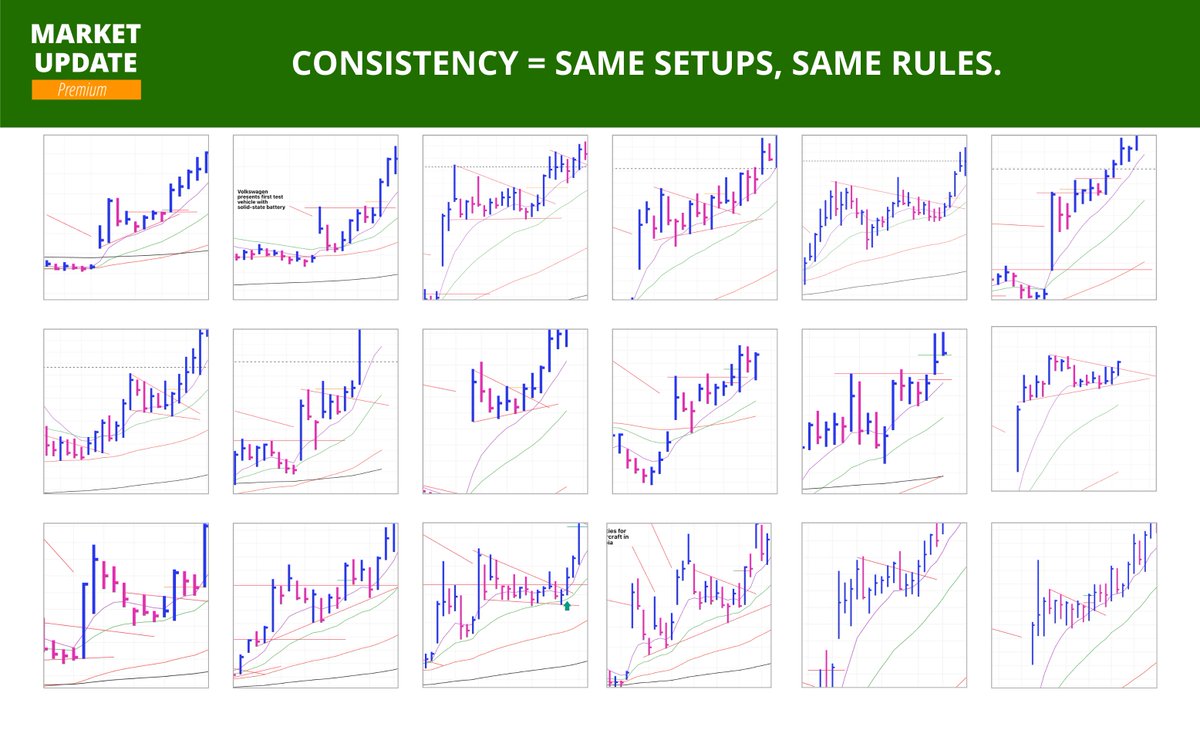
Consistency = Same Setups, Same Rules.
Here’s how to build it 👇