Cologne Cathedral took 632 years.
What kept it rising was a purpose that stayed the same across generations: the glory of God, joined to livelihood, mastery, and the desire to leave something that outlives you. That purpose also made the town steadily richer—and the richness compounded in ways people could see and feel.
In 1164 the relics of the Three Kings arrived. Faith brought the pilgrims. The pilgrims brought money, and the money made a larger church possible. The new cathedral, begun in 1248, answered both the spiritual need and the practical one.
Early traffic paid for the first stages. As the walls rose, more people came. More people meant more demand for food, lodging, and goods. A simple pilgrimage stop thickened into markets, and those markets began supporting far more than basic survival.
Stone-carvers cut finer tracery. Glaziers learned to make larger windows. Metalworkers shaped better tools and fittings. Carpenters devised taller scaffolding. Families stayed because the work continued year after year, and apprentices learned skills their fathers had never possessed.
Farmers who once grew only what they needed began producing surplus grain and wool. Merchants handled larger volumes and traveled farther. Quarry rights, regular fairs, and suppliers from distant regions all became economically viable because the town itself had become larger and more capable.
The larger economy could fund a larger cathedral. The larger cathedral drew still more visitors. Quality of life rose with every stage: steadier work, greater specialization, more varied goods, growing status, transferable skills, and the quiet security of a town becoming something greater than it had been.
Ken Follett's The Pillars of the Earth shows the same process with more human detail.
In the poor village of Kingsbridge, Prior Philip sets out to build a cathedral that will honor God while transforming the village into a town capable of sustaining itself. He secures market rights and a fleece fair. Rents, tolls, and trade begin paying for stone and wages long before the cathedral is complete.
The construction site itself employs hundreds of masons, carpenters, laborers, and suppliers. Prosperity starts before the walls are high. As trade expands, the economy thickens in concrete ways rather than merely becoming larger.
Masons and carpenters become increasingly specialized. Aliena begins by buying fleeces directly from farmers, saving them a day's journey, and gradually builds a wool business that finances her brother's return to knighthood. Horses, armor, and status all become possible because trade created the wealth first.
Jack develops better methods for building higher and lighter. Mastery itself advances. Better techniques allow greater beauty, which attracts more people, which creates more wealth, which funds even greater ambition.
The town acquires more cultivated land, stronger institutions, better tools, reliable markets, and skilled crews capable of sustaining work across decades. Later generations continue not simply because they inherited unfinished walls, but because those walls already meant livelihoods, reputation, and obligations worth preserving.
What compounds is not only money or stone. It is the civilizational operating system itself.
Agricultural surplus supports specialized crafts. Specialized crafts support markets. Markets create merchants who extend credit and move goods farther. Those merchants sustain institutions that organize long projects, train successors, and defend the town's rights. Faith supplies the direction. Livelihood gives people a reason to stay. Mastery supplies the means to reach still higher.
Together they transform a simple economy into one capable of supporting complex crafts, multi-generational families, expanding ambitions, richer everyday life, and projects no single lifetime could complete. The cathedral grows because the town has already grown with it.
The same purpose survives, generation after generation.
They knew strangers would finish it. They laid the next stone anyway—because the work was already feeding families, already lifting the town, and already creating the capacity for the stage that would follow.
This is a model worth repeating.
When aspiration, livelihood, and mastery remain aligned, each generation inherits not only a higher wall but also better tools, stronger institutions, deeper skills, and a richer economy. Civilization scales from survival toward specialization, trade, and the ability to sustain work that outlasts any individual.
The Pillars of the Earth is perhaps the best way to feel this compounding from the inside: the faith that set the direction, the markets that funded the next course of stone, the families who raised the next crew, the winters spent beneath scaffolding, and the quiet confidence that those who came after would inherit both a larger building and a more capable town.
Both the real Cologne Cathedral and the fictional one kept rising for the same reason.
The purpose held. The prosperity compounded. The scale followed.
What long project, in your own time, has the same alignment of purpose and livelihood—so that each generation has a concrete reason to continue, and the work itself creates the capacity for the stage that follows?
Construction of Cologne Cathedral began in 1248. It was finally completed in 1880.
632 years.
The people who laid its foundations could never have imagined meeting those who placed its final stones.
What kind of society begins a project knowing that generations of strangers must finish it?
Friends, you cannot have community without objective value.
In the classical order, friendship only endures in the measure that two people together fall in love with a transcendent third. Without that transcendent purpose, we lose our connection to one another.
Instead, we begin to live on an island of self-regard—a trend we see exacerbated by social media.
If we want to draw people into authentic community, we have to articulate objective value!
String theory is what happens when an intelligent system is starved of sensory input and starts hallucinating. Intelligence needs grounding.
For this reason, intelligence is practically never the bottleneck to solving impactful problems. The bottleneck is iterated contact with reality.
It is not just about RTI that has these delays. There are crores of cases pending in courts for decades. What is the point in boasting about being the largest democracy when the most important function for which a government is actually necessary is the most inefficient?
The best way to fix it is for us to have a new Constitution where people have maximum political, economic, and social freedom, and the government is decentralized and ultra-minimal. Apart from national defense, it should focus on an efficient judiciary and the swift resolution of disputes, and swift delivery of justice for criminal activities.
The reason our judiciary is so inefficient is that the government focuses on things which it should have no business interfering in, but gives the least priority to the limited things where people can agree on the need for a government in the first place.
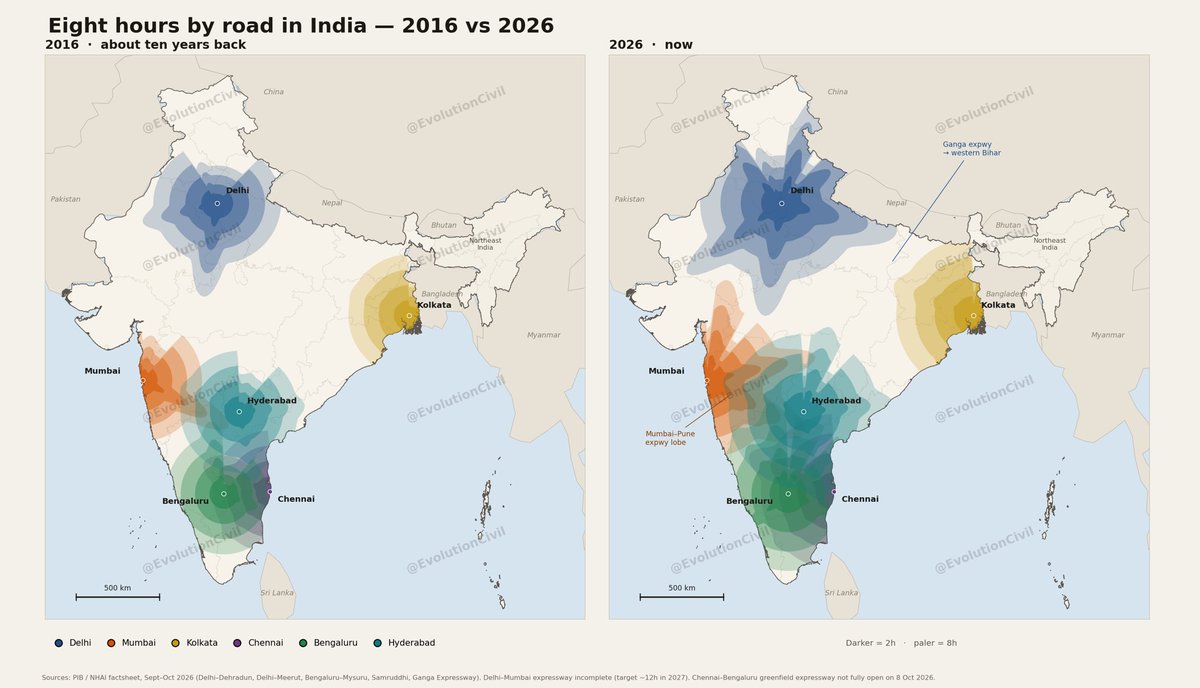
Need a similar map for Indian Railways. Btw, this is how Chinese High-speed Rail grid has shrunk the country 3x the size of India, into a one giant Indian state.
The historical reality of the township economy is that it was once a vibrant, self-sustaining ecosystem built directly by South Africans without state intervention.
It was an informal market driven strictly by local enterprise.
Today, that entire ecosystem has been systematically handed over to external networks.
When a massive chunk of a R900 billion informal market is captured by unregulated, undocumented networks who operate outside the tax framework and externalise their profits, you aren't looking at "community integration."
You are looking at a massive, un-taxed capital drain that leaves the host community structurally hollowed out.
The ultimate tragedy is that Black South Africans remain the poorest, most under-educated, and economically marginalized demographic in South Africa, with the official national unemployment rate sitting at a catastrophic 33.6% and youth unemployment hovering near 50%.
Under the guise of correcting historical injustices, B-BBEE has morphed into a predatory, state-sanctioned protection racket. It didn’t build new industries; it simply legislated extortion.
The only individuals who have truly benefited from these legacy ownership laws are a highly insulated class of ANC politicians, their immediate families, and politically connected elites who trade equity for political access.
These regulatory hurdles didn't punish white corporate capital, they simply suffocated the broader economy.
When you pass trash policies that prioritize racial compliance certificates over raw production, commerce, and meritocracy, you kill the investment climate.
Capital flees, infrastructure collapses, and the millions of dependents at the absolute bottom of the socio-economic ladder are the ones who starve.
You cannot build a modern economy by suffocating trade to feed a political mafia.
China is a massive contributor to human prosperity and global deflation.
China holds a market share of over 50% across all 5,000+ product categories tracked by the Harmonized System (HS) code in global trade, i.e., in more than 320 critical product categories.
China has an average 71.3% systemic control over global raw material processing. It is the world's most voracious importer and processor of raw materials: lithium, silicone, magnets, iron ore, and agricultural yields, unlocking value of simple anywhere materials.
Through investments in over 100 strategic ports across 50+ countries, Chinese logistics networks reduce shipping friction, lowering inventory, demurrage and production costs for firms worldwide. Chinese shipping lines secure preferential berth windows.
This network eliminates international logistics friction, cutting baseline assembly and production costs by 20% to 35% relative to Western or alternative regional hubs.
Consistently ranking in the Top 10 of the Global Innovation Index. Backed by over 7 million R&D professionals.
A third of the world's newly generated wealth and economic activity for the past few decades stems directly from China's marketplace dynamics.
When evaluated globally, over 40% of all intermediate goods—the components required to build other products—originate from or pass through China.
China is a massive contributor to human prosperity and global deflation.
China holds a market share of over 50% across all 5,000+ product categories tracked by the Harmonized System (HS) code in global trade, i.e., in more than 320 critical product categories.
China has an average 71.3% systemic control over global raw material processing. It is the world's most voracious importer and processor of raw materials: lithium, silicone, magnets, iron ore, and agricultural yields, unlocking value of simple anywhere materials.
Through investments in over 100 strategic ports across 50+ countries, Chinese logistics networks reduce shipping friction, lowering inventory, demurrage and production costs for firms worldwide. Chinese shipping lines secure preferential berth windows.
This network eliminates international logistics friction, cutting baseline assembly and production costs by 20% to 35% relative to Western or alternative regional hubs.
Consistently ranking in the Top 10 of the Global Innovation Index. Backed by over 7 million R&D professionals.
A third of the world's newly generated wealth and economic activity for the past few decades stems directly from China's marketplace dynamics.
When evaluated globally, over 40% of all intermediate goods—the components required to build other products—originate from or pass through China.