@loganzuber17 Sometimes I think they know they should sell but they are too sentimental. Have to come up with a reason it wont work. A long drive but worth the shot.
@Erdayastronaut@elonmusk@Tesla I think the roadster was the tech it needed to research for vehicles on a planet/moon in space and he built an expensive car to fund/expense it.
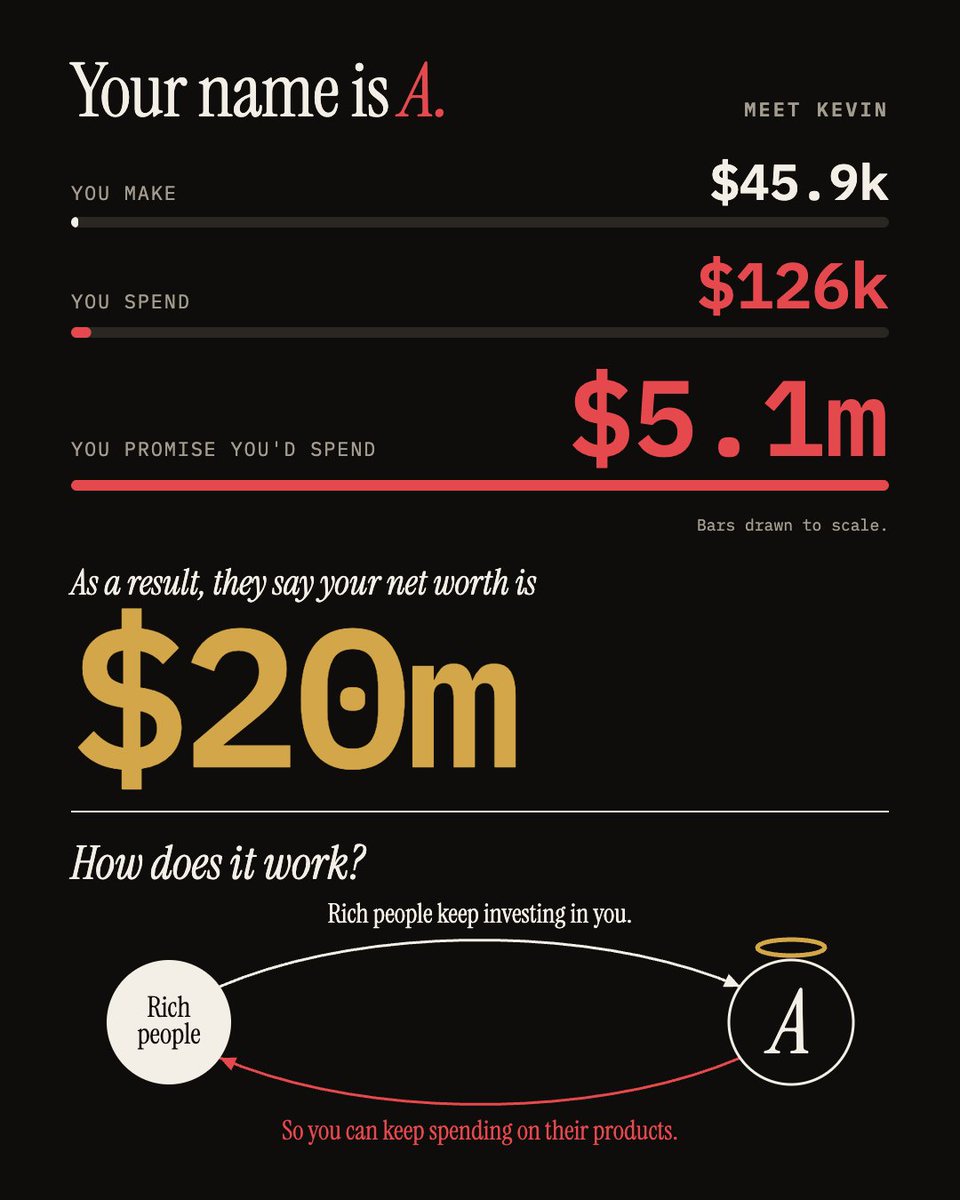
Anthropic's actual numbers divided by 100k (to relate), are insane:
😇 You make $45.9k/yr
😇 You spend $126.5k/yr
😇 Somehow you're worth $20m
😇 & you just promised you'd spend $5.18m
😇 How?
😇 Rich people keep investing in you
😇 So you can keep buying their products
Skeptics aren’t buying the whole “AI is going to kill everyone” talking points.
They believe it’s about limiting competition.
They’re not saying shut the machines off.
They’re saying put a bouncer at the door.
Once there’s a bouncer, only a few companies get into the club.
The club is: you’re allowed to train the most powerful models. Everybody else waits, pays, or doesn’t get in.
Skeptics think this is the actual play:
> Turn “AI safety” into a license
> Make the license slow, lawyer-heavy, and expensive
> Write it so a hosted model like Claude can comply and an open model you download cannot
> Look like the responsible grown-up right before a massive IPO
> Keep a clean story if something blows up later: “we warned you”
Nobody says “please ban my competitors.”
They say the industry needs guardrails.
Then the guardrail costs eight figures a year in auditors, inspectors, delay, and paperwork.
The $100 billion company barely feels it.
The 15-person shop is done.
Who wins:
> Anthropic and OpenAI
> The people who already own the stock
> Whoever buys the IPO
> The evaluators, law firms, and ex-officials who staff the new process
Who loses:
> Open-source labs that publish weights
> Startups trying to reach the frontier
> Companies that want a model they can run themselves
> Anyone selling chips and compute to many labs, not two
> The U.S., if our labs wait for permission and China’s don’t
Some examples:
> Taxi medallions. They didn’t ban cabs. They required a scarce license. Owners got rich. New drivers got crushed.
> The FDA queue. Pfizer can sit in it. A startup lighting money on fire for GPUs cannot.
> A bank examiner with a desk inside the bank.
That’s Dario’s first ask: outside evaluators with employee-level access.
Easy if you already have a safety department and an S-1.
Impossible if you’re training in a garage.
And the timing is not subtle.
An Anthropic safety lead just said he puts the chance AI kills everyone this decade at over 10%.
Days later the CEO asks the industry and the government to slow the race.
The company is in the quiet period on what could be one of the biggest IPOs ever.
If I was buying a company and the seller’s own ops guy told me there was a 10% chance the plant takes out the town, that goes in the disclosure schedules. It doesn’t get branded as thought leadership.
The labs say the engine is getting too fast. Put inspectors in the factory.
Skeptics hear: make the factory license so expensive only we can keep the factory.
Both can be true!
This post looks like the start of a VERY sophisticated and well-funded PR operation to get support for Democrats to regulate AI into oblivion. Let me show you how it works:
1.) This guy, with minimal followers and no previous account activity, goes to the Wall Street Journal which publishes an exclusive with quotes from him on his resignation 18 minutes BEFORE this post goes up. Planning was clearly done in advance.
2.) Within hours, it has tens of thousands of reposts and the account has 100k+ followers. The post is punchy, quotable, it almost seems professionally written. The first three accounts to quote tweet it all do so within 15 minutes of the initial posting. Remember, this account had basically zero engagement beforehand, so an organic reach explanation seems unlikely.
According to Grok those accounts are @_NathanCalvin (General Counsel at Encode AI), @peterwildeford (Head of Policy at the AI Policy Network), and @DKokotajlo (Head of the AI Futures Project), all of which are up-and-coming AI-Doomer policy advocacy nonprofits.
The AI Futures Project website says it is funded “primarily” by the Survival and Flourishing Fund, which says on its own website that it has advised Jaan Tallinn, Skype creator and one of the leading investors in Anthropic, to grant over $2.5 million to the AI Futures Project since 2024.
Encode AI says on its website that it is ALSO funded by the Survival and Flourishing Fund, which in turn says that it told Anthropic investor Jaan Tallinn to grant $516,000 to Encode AI in 2025.
And wouldn’t you know it, the Survival and Flourishing Fund ALSO says it told Jaan Tallinn to grant $2 million to the AI Policy Institute, the 501(c)(3) affiliate of the AI Policy Network, as well.
What are the odds that the first three quote tweets of Coxon’s post would all be major AI-restriction policy advocates funded generously by the same donor, who also happens to be one of the leading investors in, and a board member of, Anthropic, the company Coxon was resigning from? And all within 15 minutes of posting (two within ten)?
3.) Jacob Coxon doesn’t have much of a resume, but we do know that, in 2022, he got a $20,159 scholarship for the “long term future scholarship program” from the Good Ventures Foundation, one of the philanthropic vehicles of Dustin Moskovitz, a notorious AI-doomer who has spent tens if not hundreds of millions on policy advocacy to strictly regulate AI, while also being an Anthropic Investor himself.
It also just so happens that the 14th person to quote Coxon’s post was @MaxNadeau_ (27 minutes after posting) who is the program officer for the Technical AI Safety team at Coefficient Giving, another of Moskovitz’s philanthropic spending vehicles. Max is not a frequent poster, his last posts before quoting Coxon were before Labor Day, but he was remarkably quick off the mark for this one.
4.) Basically every major Democrat politician and candidate has suddenly glommed on to this post, and conveniently, as the people cry out foe answers, Bernie Sanders already has a bill written to “ban super intelligence” and regulate AI into oblivion, and will be releasing later this week. The bill, among many other things, will create “a new cabinet-level federal agency to safeguard the public from the dangers of artificial intelligence” that will be “advised by an Artificial Intelligence Advisory Board comprised of experts on artificial intelligence.” Do you think, perhaps, Anthropic and its many investors who fund AI policy advocacy might have interest in getting to place a pet “expert” on the board of an entity that dictates what AI is and isn’t allowed to do? And isn’t it fortuitous that this whistleblower came forward with his oh-so scary stories so close in proximity to the release of the most radical piece of AI legislation ever introduced?
@kittenaround_51 In my experience you can't get enough people to volunteer to even vote for someone. Your lucky to just get enough people to volunteer to have a board.
@BasedMikeLee Im for voter ID, I just wish we could you our Real ID'S for it. Not bringing along marriage certificates, birth certificates or whatever else.
Our nation was founded on the recognition that moral virtue and a steadfast faith in God are necessary preconditions of freedom. Yet under the Biden Administration, U.S. foreign policy belittled Christianity and weaponized government against faith.
That era has ended.
Under @POTUS’s leadership, the State Department will eradicate practices that devalue and demean the Christian faith.
https://t.co/RYEzFVrpim
This is how it’s done!🔥🔥🔥
Veteran, along with a group of patriots, organized a counter-protest against Elon Musk and Tesla haters in front of a Tesla dealership.