As of July 13, 1.2 million Korean leveraged retail accounts triggered margin calls; of these, 320,000–360,000 accounts were fully forcibly liquidated by brokers (some had partial negative balances owed to brokers).
‼️South Korean retail investors are betting on stocks with borrowed money at a record pace:
Margin loans in South Korea have surged to a record 38 trillion won, or ~$24.8 billion.
This is more than DOUBLING over the last 12 months and well above the previous peak of ~24 trillion won set during the 2021 retail frenzy.
Meanwhile, the KOSPI index fell as much as -9% on Friday, forcing the Korea Exchange to trigger a 20-minute circuit breaker, the 5th activation this year out of just 11 total episodes since 2000.
This also follows the KOSPI's -10% crash on Tuesday, its 3rd-largest single-day decline in history.
Margin calls are surging in Korea.
Abrazos de gol.
Abrazos de victoria.
Abrazos en la derrota.
Abrazos de campeones. ⭐⭐⭐
¡Feliz cumpleaños al conductor de #LaScaloneta, @lioscaloni! 🇦🇷🏆
#CopaMundialFIFA
🚨 PEPSICO ANUNCIÓ EL FIN DE LOS CAMIONEROS
🤖 La compañía ya usa 41 camiones sin conductor para repartir Doritos y Cheetos en EEUU en alianza con la startup Gatik, con una tasa de entregas a tiempo del 99%.
📦 Los camiones realizan trayectos cortos entre centros de distribución, depósitos y tiendas como Walmart y Dollar General en Arizona, Texas y Arkansas.
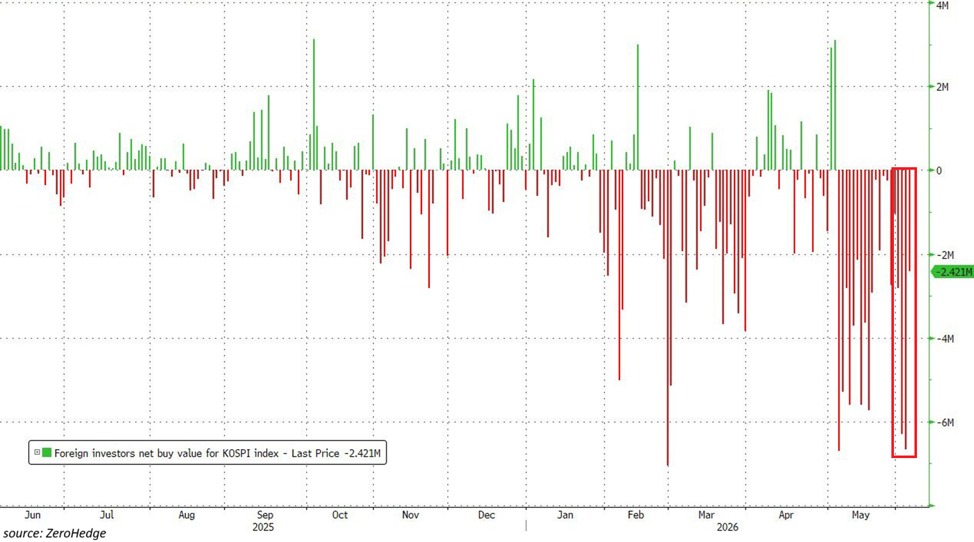
Global investors are dumping South Korean stocks at an unprecedented pace:
Foreign investors sold -$801 million of Kospi-listed shares on Monday.
This follows -$10 billion in outflows recorded last week.
Foreign investors have now offloaded South Korean stocks in every trading session over the past month.
This brings total year-to-date sales to -$75 billion, according to Goldman Sachs.
By contrast, domestic retail and institutional investors bought +$69 billion over the same period.
South Korea's stock market is making history.
🚨 EVERYTHING THAT COULD GO WRONG FOR MARKETS WENT WRONG TODAY.
S&P 500 down -1.65%, wiping out $1.14 trillion.
Nasdaq down -2.60%, wiping out $1.11 trillion.
Gold down -3.38%, wiping out $1 trillion.
Silver down -6.9%, wiping out $280 billion.
Bitcoin down -6.31%, wiping out $80 billion.
In total $2.5 TRILLION wiped out in a single session. These were not isolated moves. Everything started breaking at the same time.
It started with the jobs report this morning.
The US economy added 172,000 jobs in May. Wall Street expected 88,000. That is almost double.
On any normal day, strong jobs is good news. But inflation is already at 3.8% and oil is sitting at $90. A labor market this strong tells the Fed it cannot cut interest rates and may actually need to raise them.
The probability of a rate hike this year went from 40% to 57% in a single day. That spooked every investor holding tech and growth stocks because higher rates mean those stocks are worth less today.
Then the AI trade started cracking.
Yesterday Broadcom reported record earnings: revenue up 48%, AI chip sales up 143% and the stock still crashed 12.6%. The reason was simple.
Broadcom did not raise its AI revenue targets for the year. Investors had expected it to. That single miss made people ask a question they had been avoiding for months: are we paying too much for AI stocks?
That question got louder today when a research firm called SemiAnalysis revealed that Nvidia's next-generation AI chips will need significantly less memory than everyone assumed, roughly half of what the market was pricing in.
Memory chips are what companies like SK Hynix and Samsung make. SK Hynix fell nearly 10% today. Samsung fell over 6%.
South Korea's entire stock market crashed 5.5% in a single session. Japan's semiconductor stocks did the same.
And then Anthropic added fuel to the fire by publishing a report warning that AI is getting close to the point where it can improve itself without human help and calling for a global pause in AI development.
Coming on the same day as the memory demand news and Broadcom's miss, it fed a single growing fear across the market: what if the AI boom is moving faster than the business models can keep up with?
Underneath all of this, there is a liquidity problem nobody is talking about.
SpaceX goes public next week at a $1.75 trillion valuation. Anthropic just filed to go public. OpenAI is next.
These three companies together are worth $4 to $5 trillion. Fund managers need cash to buy into these listings.
But cash levels are already at their lowest since early 2024. The only way to raise cash is to sell what they already own. That selling is happening right now.
The new Fed Chair Kevin Warsh will also hold his very first policy meeting in 11 days. He was appointed by Trump with the expectation of cutting rates.
He is now walking into a situation where inflation is high, oil is high, and the job market is running hot. Investors do not know what he will do.
When nobody knows what the most powerful central banker in the world will decide in less than two weeks, the safest move is to reduce risk today.
Everything that could go wrong, went wrong at the same time. A hot jobs report, a collapsing ceasefire, a crack in the AI trade, a trillion dollar liquidity drain, and a Fed meeting with no clear outcome.
🔴Leveraged bets on South Korean stocks are SKYROCKETING:
Margin loans in South Korea surged to a record ~$24.7 billion (38 trillion won) on May 29, up +39% from ~$17.8 billion (27.3 trillion won) at end-2025.
Margin debt in South Korea has more than DOUBLED over the last 12 months.
This figure likely understates the full picture, as many stock-backed loans are recorded under different categories or extended by smaller lenders outside the official reporting scope.
Margin loans carry annual interest rates of 7% to 9%, meaning if stock prices fall, brokerages can forcibly liquidate positions to recover their loans, setting the stage for a rapid and self-reinforcing selloff.
Leverage this extreme can turn a market correction into a margin call cascade.