Ethics and Workplace Surveillance Tools:
Technology will continue to progress, and companies will capitalize on it said Emory Law Professor @iajunwa. “I think we owe an ethical responsibility to think about how a product will affect society.”https://t.co/JUK634lnqW
President Biden convened a meeting of artificial intelligence experts to discuss its risks, opportunities and to consider the role of the federal government in its regulation.
@rcalo of the University of Washington is following all of this closely. https://t.co/x2wbLMyl6O
In “Net neutrality and the future of the internet,” @vanschewick of @StanfordLaw, talks about how the companies we pay to access the internet want control over what we do online and they want to charge more for #data we are already paying for.
Learn more: https://t.co/88Q5U3LuAz
In “Automation and the Workforce: A Firm-Level View from the 2019 Annual Business Survey,” @DrDaronAcemoglu (@MIT) examines #data on firms in the U.S. — revealing links between the adoption of robotics and #AI on patterns of #automation and employment: https://t.co/XO91oG5udd.
#Economics professors @DrDaronAcemoglu (@MIT) and Pascual Restrepo explain why the U.S. and many industrialized countries are seeing rising wage inequality go hand in hand with modest productivity gains: https://t.co/bJNvMGLBL8. #TechPolicy#TAPscholar
Professors @zittrain (@Harvard_Law) and James Mickens examine many issues associated with the #security of our society’s interconnected systems in online discussion: https://t.co/nH0D0KdLJd. #TechPolicy#TAPscholar
@nyuniversity Professor @robseamans and Michael Impink provide key takeaways from this year’s #Economics of #Robots Conference.
Topics discussed include trends in robot adoption, generative #AI, and the impact of robots on human labor: https://t.co/JhSWdr8dMy. #TechPolicy
ICYMI — Professor @vanschewick of @StanfordLaw, an expert on net neutrality, explains net neutrality on Stanford Engineering’s podcast, "The Future of Everything".
Learn more: https://t.co/88Q5U3M2q7
#TechPolicy#TAPscholar
@Harvard_Law Professor @zittrain shares key takeaways from his Tanner Lecture, titled “Gaining Power, Losing Control;” he reflects on how #technology has empowered humanity, and yet in many ways, provides less and less control: https://t.co/KYhpxsdveL. #TechPolicy
@Stanford economists @Susan_Athey and Matthew Gentzkow used #GPS#data to create a new method for measuring racial segregation and found that people’s day-to-day experiences are more racially diverse than traditional measures would suggest.
Learn more: https://t.co/wybh1fG9Gf
In “New Laws of Robotics: Defending Human Expertise in the Age of AI,” @brooklynlaw Professor @FrankPasquale explores the myriad ways that technological advances affect how we work, what media we consume, and how the law is made and enforced: https://t.co/zY3esBmLL2. #TechPolicy
Professor @ericgoldman (@santaclaralaw) discusses the United States’ legal framework governing Internet platforms that publish third-party content in a recent article, “The United States’ Approach to ‘Platform’ Regulation.”
Read more: https://t.co/MW0To2zXHg #TechPolicy
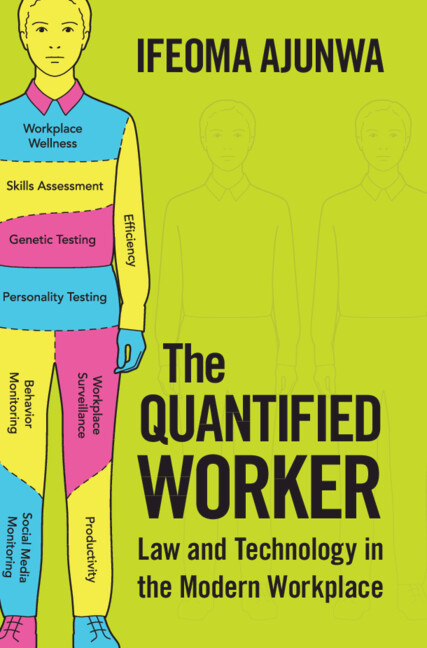
#TAPscholar@iajunwa’s, new book, “The Quantified Worker: Law and Technology in the Digital Workplace,” is now available on Amazon.
This book explores how the workforce #science of today goes far beyond increasing efficiency and threatens to erase individual personhood. (1/3)
Ifeoma Ajunwa is an award-winning tenured law professor at the @unc_law and an adjunct professor at the @kenanflagler.
Ajunwa is the Founding Director of the #ArtificialIntelligence Decision-Making Research Program and a Faculty Associate at the @BKCHarvard. (2/3)
Net neutrality law limits Internet Service Providers’ (#ISPs) control of Internet uses and users. Federal net neutrality rules were repealed, but states should be able to enact their own net neutrality rules. (1/2)