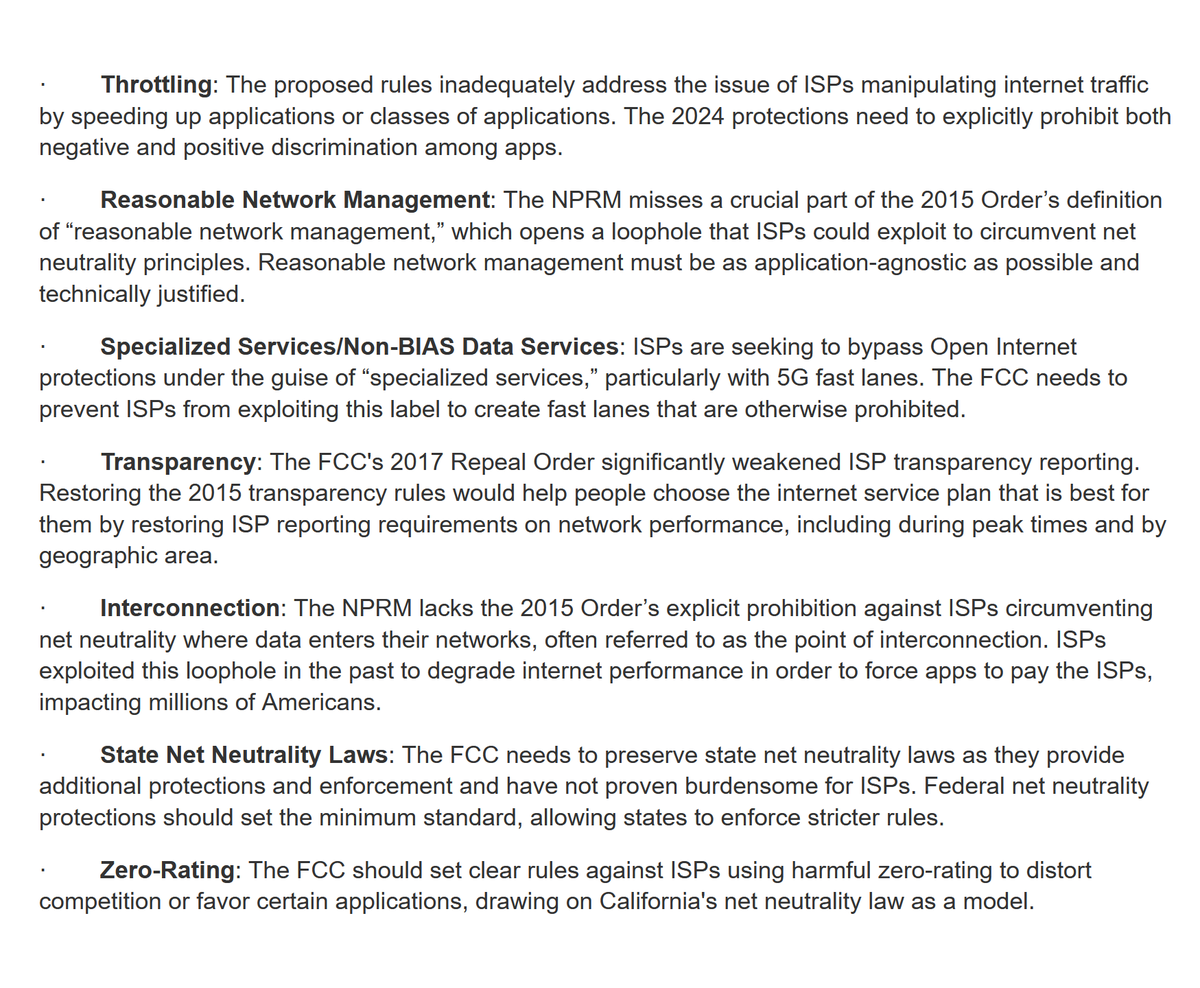
The FCC wants to restore #netneutrality for all Americans. That's great & important.
But the proposal misses some critical 2015 net neutrality protections, creating potential loopholes for ISPs to exploit.
Here's how to close them: https://t.co/2A4dLJ3COu
Here's how we got here: In 2021, New York state adopted a broadband affordability law that requires ISPs to offer broadband plans to low-income consumers at low cost. Last year, a federal court upheld that law, and the Supreme Court denied ISPs' petition to review the case in December. Today's decision denies ISPs' attempt to get the justices to reconsider that decision.
New York state has been enforcing the law since January: https://t.co/nwSkqBThKI
Important #netneutrality news: Today, the Supreme Court (again) rejected Internet Service Providers' attempt to undo New York's broadband affordability law.
The case has important implications for states' ability to protect their consumers against misbehavior by the companies they pay to get online, including through net neutrality laws.
The Supreme Court's decision means that when the FCC is powerless to protect consumers online (as it is after a federal court struck down the FCC's net neutrality protections in January), states can step in to protect their residents. They can create their own net neutrality protections, like California and others do, require affordable broadband options like New York, and institute broadband privacy protections like Maine. All of these laws have been upheld in court.
"The FCC can still protect you when you make a regular phone call but not when you use the Internet," said SLS Professor Barbara van Schewick for @BroadbandCensus in "Law Prof van Schewick Calls Net Neutrality Ruling 'a Radical Decision.'" https://t.co/ObGQPRgvQT
Professor Barbara @vanschewick of @StanfordLaw discusses #NetNeutrality in an article in Broadband Breakfast @BroadbandCensus. She calls a recent US Court of Appeals Ruling "a radical decision". Read it here:
https://t.co/4GpZZCq74f
Today, New York starts enforcing its affordable broadband law.
That means internet providers need to offer affordable broadband plans to low-income people: $15-per-month w/ download speeds of 25+ Mbps or $20 w/ 200+ Mbps speeds.
@jbrodkin at @ArsTechnica explains what this means & how we got here. Link👇
Important #netneutrality news: Last week a federal court struck down the FCC's 2024 net neutrality protections. I spoke with @NPR's @JmSummers about what this means & what may be next: https://t.co/H6GdKUCbKA (audio & transcript)
"The Meta-Deutsche Telekom standoff in the EU is something to keep an eye on. Meta routinely operates in bad faith on a litany of issues, but this is one policy standoff in which they’re absolutely in the right."
Great piece by Karl Bode @techdirt: https://t.co/SiMQW1I1b4 #netneutrality #networkfees
Breaking: Meta just changed how it sends WhatsApp, Instagram & Facebook data to Deutsche Telekom internet customers. That might not sound exciting, but it's a actually big deal.
I wrote about what's happening & what's at stake: https://t.co/OCyHOzBf97 #netneutrality
🌐 Höhere Preise, schlechtere Qualität & weniger Auswahl – das bringt eine bezahlte Überholspur, wie sie die @deutschetelekom verlangt, mit sich. Solche schädlichen Geschäftspraktiken sind keineswegs „üblich“ & haben keinen Platz in einem freien Internet.
https://t.co/MHLdenoaem
Follow up:
An excellent article by @vanschewick covering the DTAG and $META #depeering. It correctly point out that Deutsche Telecom is simply screwing over their customers. https://t.co/0WhsxQxBFM
Klare Stellungnahme von Verbraucherschützer @vzbv zur Entscheidung von Meta, die direkte Verbindung zur Deutsche Telekom zu beenden:
"Mit einer #Datenmaut hätten Verbraucher:innen das Nachsehen.
Seit Jahren setzen sich die Telekom & andere Netzbetreiber dafür ein, dass sie von Inhalteanbietern wie ARD, Netflix oder Meta eine Netzgebühr als Datenmaut verlangen können.
Der Verbraucherzentrale Bundesverband lehnt eine Datenmaut entschieden ab.
Eine Datenmaut würde die #Netzneutralität schwächen. Sie gefährdet das offene und freie Internet.
Mit der Datenmaut wollen sich die Netzbetreiber also doppelt für ihre Netze bezahlen lassen. Die Leidtragenden wären am Ende auch hier die Verbraucher:innen."
Volle Stellungnahme hier:
https://t.co/3Z2IJHuc4I
Deutsche Telekom vs Meta 🥊 This battle isn’t just about two companies – it's about the future of the open internet & #netneutrality. If sites & apps are forced to pay network fees, it could lead to higher costs and worse service for everyone.
https://t.co/BhzROQOsyR
“Soon we will see whether Deutsche Telekom slows down Meta for millions of Germans and, if it does, whether the German regulator has the courage to step in and stop the bully.”
Peering war in Germany. Meta has stopped buying transit from Deutsche Telekom, because DT has been too much DT. Meta wants to Peer, DT doesn't want to. 😅Meta now pays other networks transit to reach DT. DT says it will continue to charge Meta for transit! https://t.co/aZQ3CYZaS2
Breaking: Meta just changed how it sends WhatsApp, Instagram & Facebook data to Deutsche Telekom internet customers. That might not sound exciting, but it's a actually big deal.
I wrote about what's happening & what's at stake: https://t.co/OCyHOzBf97 #netneutrality