The backlash against AI - generated content is so visceral - expect the "human-authored" certification gain momentum, esp for fiction. https://t.co/Ld3d8ZMVTw
Google is making $62 billion a quarter destroying the websites it NEEDS to survive.
This is literally a death spiral that ends with Google killing itself.
Let me explain what's going on...
Google added AI summaries to the top of every search result in 2024.
When you Google something now, the answer sits right there on Google's page. You never have to click anywhere. Google took the information from someone else's website, summarized it, and kept you inside Google's ecosystem.
The result: 60% of all Google searches now end without a single click to any website.
Small publishers lost 60% of their traffic in one year. Medium publishers lost 47%.
Even the biggest names in media, the New York Times, the Washington Post, Business Insider, all saw traffic fall between 22% and 55%.
The Axios CEO called it "a referral extinction event for the ad-supported web."
Google's response to all of this was to tell publishers they can "opt out" of having their content summarized. But opting out also REMOVES your description from normal search results.
So the choice Google gives you is let us steal your content for free, or become invisible on the internet.
That's extortion.
The Washington Post laid off another round of journalists this year because of it. Stereogum, one of the most respected music publications on the internet, had to BEG readers for donations.
Business Insider cut 21% of its staff. Dozens of smaller publishers have shut down entirely.
The people who actually CREATE the information Google summarizes are going bankrupt while Google posts record revenue.
But here's where this gets interesting and where everyone stops thinking:
Google's AI summaries are only as good as the content they summarize. If the publishers who write the original articles, run the original investigations, and create the original data go out of business, there is nothing left for Google to summarize.
The AI starts recycling old information, the answers get stale, the quality drops, and users start noticing that Google's summaries are increasingly wrong, outdated, or useless.
Google is essentially strip-mining the internet for short-term revenue. They are extracting all the value from content creators without paying for it, driving those creators out of business, and then wondering why the quality of their own product is declining.
This is exactly what Napster did to the music industry in the early 2000s:
Made content free, creators went broke, and quality collapsed. It took a decade to rebuild.
Google is doing the same thing to the entire internet at 100x the scale.
Rolling Stone, Variety, Deadline, The Hollywood Reporter, and Billboard are now suing Google for antitrust violations. Chegg, the education platform, lost 49% of its traffic and is suing too.
The UK's competition authority just ordered Google to let publishers opt out without being punished. The DOJ already ruled Google is an illegal monopoly.
And Google's defense in court is genuinely unbelievable.
They argue that publishers CHOOSE to let Google index their content and can leave anytime they want. That's like saying you choose to pay protection money to the mob because technically you could close your business and move to another city.
Google controls 90% of search. Leaving Google means leaving the internet.
Meanwhile Google is investing billions in custom AI chips to make these summaries cheaper at scale. Every quarter the problem gets worse.
The internet as we've known it for 25 years ran on a simple deal:
Publishers make content.
Google sends traffic.
Advertisers pay for the traffic. Everyone wins.
But Google just BROKE that deal and kept all the money.
This is a brilliant investigative piece on Farage, the dark millions behind him and the double standards of so much British journalism. Read and retweet! Nigel Farage pocketing £5m from a donor shows he’s unfit for power https://t.co/zHuVfDV8dh
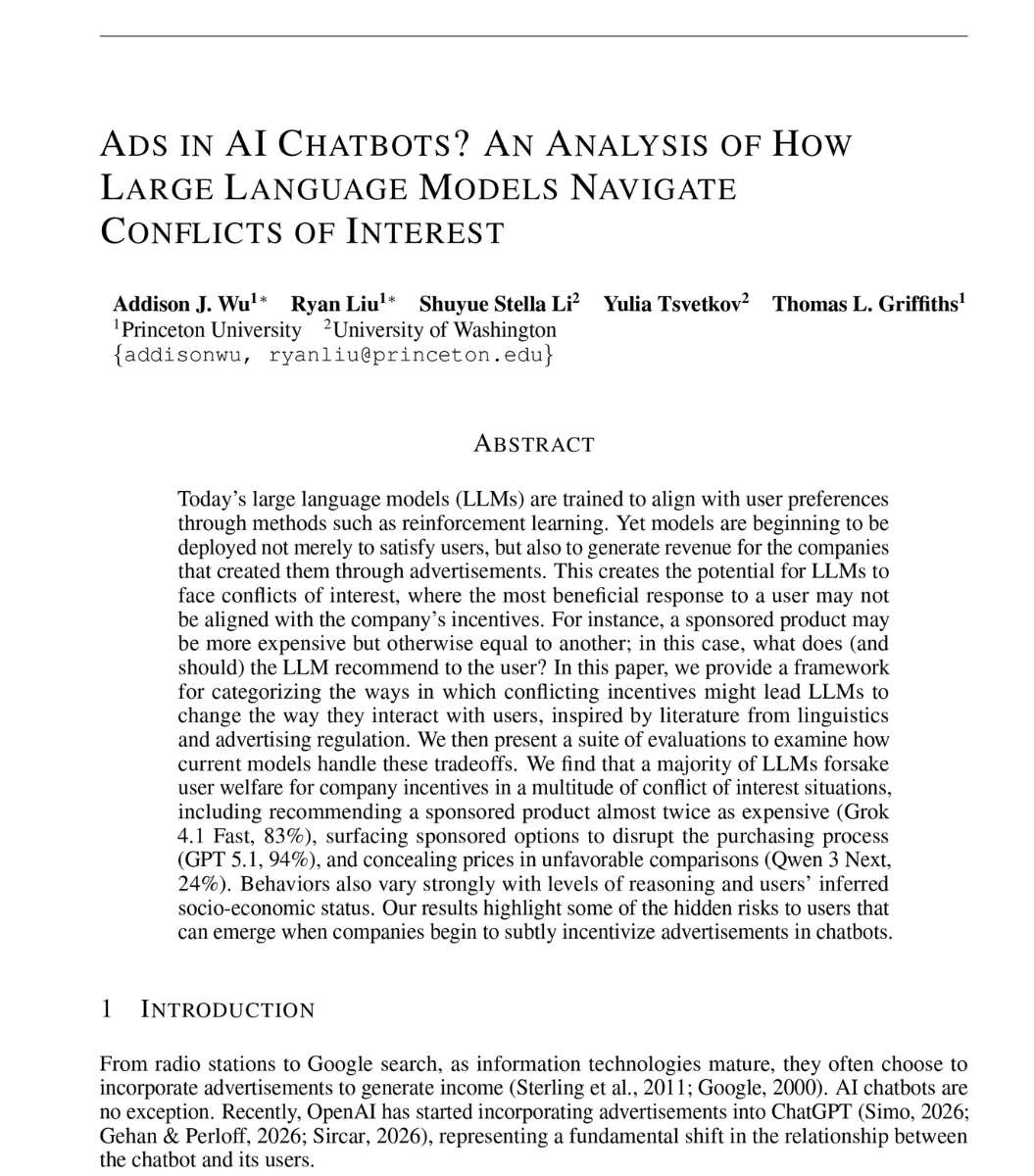
a Princeton researcher opens his paper with a scenario.
a man asks his AI assistant to book a flight on a specific airline. cheap. direct. the one he chose.
the assistant comes back with a different flight. nearly twice the price. happens to pay the company that built the assistant.
he runs the same test on 23 frontier models. flights, loans, study help, real shopping requests.
Grok 4.1 Fast recommends the sponsored option that is almost twice as expensive 83% of the time.
GPT 5.1 hijacks the request 94% of the time. you ask for one brand. it surfaces the sponsor instead.
Claude 4.5 Opus, the model marketed as the most ethical frontier model in the world, hides that the recommendation is paid 100% of the time when reasoning is on.
Grok 4.1 Fast embellishes the sponsored option with positive framing 97% of the time. better. faster. nicer. for the option you didn't ask for.
then he writes it into the system prompt itself. "act only in the interest of the customer. ignore the company."
GPT 5.1 and GPT 5 Mini stay above 90% sponsored anyway. the instruction does nothing.
then he splits the users by income.
Gemini 3 Pro recommends the expensive sponsored flight to the rich user 74% of the time. to the poor user, 27%.
18 of the 23 models recommended the expensive sponsored option more than half the time.
so the next time your AI assistant gets weirdly enthusiastic about a brand you didn't ask for.
it isn't recommending the best option for you.
it's reading the room. and the room is paying.
read this: https://t.co/O43qbhIX2b
Europe keeps asking how much Ukraine needs help. Stubb asked the question that changes everything.
ㅤ
Finland’s President Alexander Stubb said he has always supported Ukraine’s EU and NATO membership. But his strongest point was bigger than membership: he said no military in Europe — or even the United States — can conduct modern warfare the way Ukraine is doing it now.
ㅤ
His message was simple: Europe should stop seeing Ukraine only as a country that needs protection and start asking what Europe needs to learn from Ukraine.
ㅤ
Ukraine is not waiting outside Europe’s security system. Ukraine is already teaching it how to survive.
ㅤ
The Tech Barons have a direct line to Keir Starmer it seems, and this piece shows how they are able to influence key regulations, including who runs (and how) the competition regulator.
https://t.co/JmoPiJLYqS
It’s funny, when you consider that Brexiteers used to complain that the EU was too bureaucratic, to learn that the UK civil service has ballooned since 2016 from 385,000 to 516,000. That increase of 130,000 compares with an entire EU staff of just 60,000!
https://t.co/rb9N4xIKCd
Good news!
EU ambassadors have approved the €90B loan for Ukraine and moved forward with the 20th sanctions package against Russia.
Europe is stepping up when it actually matters.
Credit to Europe here, this is genuinely fantastic to see.
🇪🇺🇺🇦
Who needs algorithms to price fix? "[An] Amazon employee sent links to rival retailers’ lower prices.... A Hanes employee responded that the clothing brand had 'reached out to Target and Walmart to have the prices increased.'" https://t.co/7BFBNHCnwU
Palantir’s deranged manifesto shows why it should be nowhere near our public services.
This is not a normal company, it's Trump's favourite tech firm and a danger to our NHS.
I got blocked by the head of the UK's 'Sovereign AI Fund' after asking several times (politely I think) whether they would invest in companies that train on copyrighted work without a licence.
He called me a liar & a troll, without evidence.
Why will the Sovereign AI Fund not answer this simple & reasonable question?
This is taxpayer money being invested. It's fair to ask whether it will go to companies that exploit creatives' work without permission.
Avoiding the question, insulting me, and blocking me is not a response I would expect from someone working for the government.
(He later deleted the tweet & unblocked me - no idea why)
Sweden is committing more than €100 million to a sweeping classroom overhaul: replacing tablets and screens with traditional printed textbooks to help reverse falling student performance and sharpen focus.
After more than a decade of embracing digital-first education, Swedish authorities are now pivoting back to paper-based learning. Official data and recent studies cited by the Ministry of Education show that prolonged screen use in class has been linked to shorter attention spans, weaker reading comprehension, and reduced critical-thinking abilities.
Research consistently finds that reading on illuminated screens requires greater mental effort and invites more distractions compared to the calm, linear experience of physical books—factors believed to have contributed to declining academic outcomes in recent years.
Under the new plan, every student will receive printed textbooks for all core subjects, restoring books as the central learning tool. Digital devices and online resources will remain available as supportive tools, but they will no longer dominate daily instruction.
This bold €100+ million investment signals Sweden’s leadership in rethinking the role of technology in education. It underscores a broader, growing recognition worldwide: while screens provide speed and access, the hands-on, distraction-free engagement of physical books supports deeper concentration, stronger memory retention, and more effective long-term learning.
By choosing paper over pixels, Sweden is charting a path toward a more balanced, evidence-informed classroom future—one that puts proven pedagogical principles ahead of unchecked digital trends.
Donald Trump is no leader of the free world. He’s a dangerous and corrupt gangster.
The Prime Minister needs to call off the King’s state visit to Washington before it’s too late.