@neilmwhite I'd like one of these. They look cool and their utilitarian simplicity is very appealing. The cost puts me off though. My 16 year old Toyota is £20 a year tax, does 55mpg and touch wood it still passes every MOT without repair. It's a low miler though and I only do 4k or so a yr.
Debunking the Cooling Constraint for Space Data Centers ❄️🛰️
We tackled one of the most persistent objections to orbital compute: “How do you cool data centers in space?”
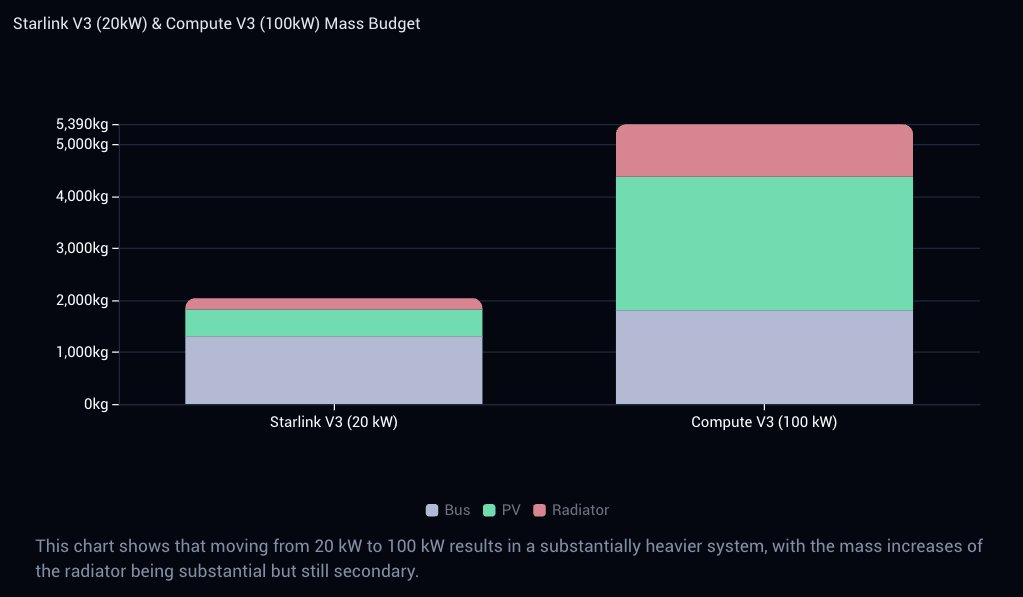
Using first-principles and Starlink V3 scaling (20kW > 100kW) as a reference, we show the cooling problem is widely misunderstood.
Key takeaways…
🌡️ Operating temperature is the dominant lever: small increases in radiator temperature drive large reductions in required area and mass.
📐 As Starlink-class platforms scale from communications-optimised @ 20 kW to compute-optimised @ 100 kW, solar dominates planform area growth; radiators remain a small, single-digit % of footprint. Theres a reason the @starcloud_ 5GW concept is dominated by a massive solar array, not a massive radiator.
⚖️ Mass is a more substantial trade. Even then, radiator mass stays secondary to solar arrays. At 100kw, radiators are only 10-20% of mass. Though, pushing toward lighter radiators materially increases system cost due to more advanced materials and designs.
🛠️ Radiator outcomes are an architectural choice: kg/m² and operating temperature swing mass and cost by multiples for the same thermal job.
🔫 It's time to retire cooling as a primary objection of orbital data centers. If you can launch the power, you can launch the cooling.
Full analysis and model here 🧐
https://t.co/7Jqfq1gedl
@AndyatAuto@jefferinc@SMMT Elon, Tesla co-founder and the Tesla board fired Martin Eberhard for cost overruns and the concealment of them. Then Elon took over as CEO, and now Tesla is a trillion dollar company- The "Elon effect" 😂
@DrSteveTaylor@ZackPolanski The alternative companies in the running were IBM and Oracle.
When focusing strictly on real and proven metrics like fines, settlements, successful lawsuits, or documented breaches, Palantir is not demonstrably worse than IBM or Oracle.
2021 > PHEV BMW iBMUCP 21F37E Post-Crash Recovery — When EU engineering becomes a synonym for “unrepairable” + "generating waste".
If you own a BMW PHEV — or if you’re an insurance company — every pothole, every curb impact, and even every rabbit jumping out of a bush represents a potential €5,000 cost, just for a single fuse inside the high-voltage battery system.
This “safety fuse” is designed to shut the system down the moment any crash event is detected. Sounds safe — but extremely expensive.
Unfortunately, that’s not the only issue.
BMW has over-engineered the diagnostic procedure to such a level that even their own technicians often do not know the correct replacement process. And it gets worse: the original iBMUCP module, which integrates the pyrofuse, contactors, BMS and internal copper-bonded circuitry, is fully welded shut. There are no screws, no service openings, and it is not designed to be opened, even though the pyrofuse and contactors are technically replaceable components. Additionally, the procedure requires flashing the entire vehicle both before and after the replacement, which adds several hours to the process and increases risk of bricked components which can increase the recovery cost by factor 10x.
But that is still not the only problem.
Even after we managed to open the unit and access everything inside, we discovered that the Infineon TC375 MCU is fully locked. Both the D-Flash sectors and crash-flag areas are unreadable via DAP or via serial access.
Meaning: even if you replace the pyrofuse, you still cannot clear the crash flag, because the TC375 is cryptographically locked.
This leaves only one method:
➡️ Replace the entire iBMUCP module with a brand-new one. (1100€ + tax for faulty fuse)
And the registration of the new component is easily one of the worst procedures we have ever seen. You need an ICOM, IMIB, and AOS subscription — totalling over €25,000 in tools — just to replace a fuse. (even we managed to activate this one with IMIB, it will be necessary in some situation)
Yes, you read that correctly, 25,000€
Lot of vehicles designed and produced in Europe — ICE, PHEV, and EV — have effectively become a missleading ECO exercise. Vehicles marketed as “CO₂-friendly” end up producing massive CO₂ footprints through forced services, throw-away components, high failure rates and unnecessary parts manufacturing cycles, overcomplicated service procedures, far larger than what the public is told. If we are destroying our ICE automotive industry based on EURO norms, who is calculating real ECO footprint of replacement part manucfacturing, unecessary servicing and real waste cost?
We saw this years ago on diesel and petrol cars:
DPF failures, EGR valves, high-pressure pumps, timing belts running in oil, low quality automatic transmissions, and lubrication system defects. Everyone calculates the CO₂ footprint of a moving vehicle — nobody calculates the CO₂ footprint of a vehicle that is constantly broken and creating waste.
ISTA’s official iBMUCP replacement procedure is so risky that if you miss one single step — poorly explained within ISTA — the system triggers ANTITHEFT LOCK.
This causes the balancing controller to wipe and lock modules.
Meaning: even in an authorised service centre, system can accidentally delete the configuration and end up needing not only a new iBMUCP, but also all new battery modules.
Yes — replacing a fuse can accidentally trigger the replacement of all healthy HV modules, costing €6,000+ VAT per module, plus a massive unknown CO₂ footprint.
This has already happened to several workshops in the region.
The next problem: BMW refuses to provide training access for ISTA usage. We submitted two official certification requests — both were rejected by the central office in Austria, which is borderline discriminatory.
One more next problem: Battery erasal can happen in OEM and can happen in our or any other 3rd party workshop, but if procedure was started in workshop 1, it cant be continued in workshop 2. If battery damage happens in our workshop during fuse change, and than battery swap needed, we or even OEM workshop do not cover costs of completely new battery pack. Which increases heavily ownership costs.
All of this represents unnecessary complexity with no meaningful purpose.
While Tesla’s pyrofuse costs €11 and the BMS reset is around 50€, allowing the car to be safely restored, BMW’s approach borders on illogical engineering, with no benefit to safety, no benefit to anti-theft protection — the only outcome is the generation of billable labour hours and massive amounts of needless electronic/lithium waste.
Beyond that, we are actively working on breaking the JTAG/DAP protection to gain direct access to the D-Flash data and decrypt its contents together with our colleagues from Hungary. The goal is to simplify the entire battery-recovery procedure, reduce costs, and actually deliver the CO₂ reduction that the EU keeps missleading— since the manufacturers clearly won’t.
Part number: 61 27 8 880 208
Faults: 21F2A8 High voltage battery unit, terminal
High voltage battery safety: capsule Defective trigger/control electronics
21F35B high voltage battery unit,
voltage and electric current sensor, current: Counter for the reuse of cell modules exceeded (safety function)
21F393 High voltage battery unit, fault
cumulative: Memory of faults that prevent the
active transport
3B001D High voltage battery unit,
contactor excitation controller circuit breakers: Double fault
21F37E Collision Detection: Collision
detected due to ACSM signal
21F04B High voltage battery unit,
Safety function: Reset command units executed
OEM Service cost: 4000€+tax (aprox - if you have bmw quote, send)
OEM iBMUCP : 1100€+tax
Labor hours: 24h - 50h
EVC: 2500€+tax (full service)
https://t.co/cj0f8cvYwi
2021 > PHEV BMW iBMUCP 21F37E Post-Crash Recovery — When EU engineering becomes a synonym for “unrepairable” + "generating waste".
If you own a BMW PHEV — or if you’re an insurance company — every pothole, every curb impact, and even every rabbit jumping out of a bush represents a potential €5,000 cost, just for a single fuse inside the high-voltage battery system.
This “safety fuse” is designed to shut the system down the moment any crash event is detected. Sounds safe — but extremely expensive.
Unfortunately, that’s not the only issue.
BMW has over-engineered the diagnostic procedure to such a level that even their own technicians often do not know the correct replacement process. And it gets worse: the original iBMUCP module, which integrates the pyrofuse, contactors, BMS and internal copper-bonded circuitry, is fully welded shut. There are no screws, no service openings, and it is not designed to be opened, even though the pyrofuse and contactors are technically replaceable components. Additionally, the procedure requires flashing the entire vehicle both before and after the replacement, which adds several hours to the process and increases risk of bricked components which can increase the recovery cost by factor 10x.
But that is still not the only problem.
Even after we managed to open the unit and access everything inside, we discovered that the Infineon TC375 MCU is fully locked. Both the D-Flash sectors and crash-flag areas are unreadable via DAP or via serial access.
Meaning: even if you replace the pyrofuse, you still cannot clear the crash flag, because the TC375 is cryptographically locked.
This leaves only one method:
➡️ Replace the entire iBMUCP module with a brand-new one. (1100€ + tax for faulty fuse)
And the registration of the new component is easily one of the worst procedures we have ever seen. You need an ICOM, IMIB, and AOS subscription — totalling over €25,000 in tools — just to replace a fuse. (even we managed to activate this one with IMIB, it will be necessary in some situation)
Yes, you read that correctly, 25,000€
Lot of vehicles designed and produced in Europe — ICE, PHEV, and EV — have effectively become a missleading ECO exercise. Vehicles marketed as “CO₂-friendly” end up producing massive CO₂ footprints through forced services, throw-away components, high failure rates and unnecessary parts manufacturing cycles, overcomplicated service procedures, far larger than what the public is told. If we are destroying our ICE automotive industry based on EURO norms, who is calculating real ECO footprint of replacement part manucfacturing, unecessary servicing and real waste cost?
We saw this years ago on diesel and petrol cars:
DPF failures, EGR valves, high-pressure pumps, timing belts running in oil, low quality automatic transmissions, and lubrication system defects. Everyone calculates the CO₂ footprint of a moving vehicle — nobody calculates the CO₂ footprint of a vehicle that is constantly broken and creating waste.
ISTA’s official iBMUCP replacement procedure is so risky that if you miss one single step — poorly explained within ISTA — the system triggers ANTITHEFT LOCK.
This causes the balancing controller to wipe and lock modules.
Meaning: even in an authorised service centre, system can accidentally delete the configuration and end up needing not only a new iBMUCP, but also all new battery modules.
Yes — replacing a fuse can accidentally trigger the replacement of all healthy HV modules, costing €6,000+ VAT per module, plus a massive unknown CO₂ footprint.
This has already happened to several workshops in the region.
The next problem: BMW refuses to provide training access for ISTA usage. We submitted two official certification requests — both were rejected by the central office in Austria, which is borderline discriminatory.
One more next problem: Battery erasal can happen in OEM and can happen in our or any other 3rd party workshop, but if procedure was started in workshop 1, it cant be continued in workshop 2. If battery damage happens in our workshop during fuse change, and than battery swap needed, we or even OEM workshop do not cover costs of completely new battery pack. Which increases heavily ownership costs.
All of this represents unnecessary complexity with no meaningful purpose.
While Tesla’s pyrofuse costs €11 and the BMS reset is around 50€, allowing the car to be safely restored, BMW’s approach borders on illogical engineering, with no benefit to safety, no benefit to anti-theft protection — the only outcome is the generation of billable labour hours and massive amounts of needless electronic/lithium waste.
Beyond that, we are actively working on breaking the JTAG/DAP protection to gain direct access to the D-Flash data and decrypt its contents together with our colleagues from Hungary. The goal is to simplify the entire battery-recovery procedure, reduce costs, and actually deliver the CO₂ reduction that the EU keeps missleading— since the manufacturers clearly won’t.
Part number: 61 27 8 880 208
Faults: 21F2A8 High voltage battery unit, terminal
High voltage battery safety: capsule Defective trigger/control electronics
21F35B high voltage battery unit,
voltage and electric current sensor, current: Counter for the reuse of cell modules exceeded (safety function)
21F393 High voltage battery unit, fault
cumulative: Memory of faults that prevent the
active transport
3B001D High voltage battery unit,
contactor excitation controller circuit breakers: Double fault
21F37E Collision Detection: Collision
detected due to ACSM signal
21F04B High voltage battery unit,
Safety function: Reset command units executed
OEM Service cost: 4000€+tax (aprox - if you have bmw quote, send)
OEM iBMUCP : 1100€+tax
Labor hours: 24h - 50h
EVC: 2500€+tax (full service)
https://t.co/cj0f8cvYwi
@ValueAnalyst1 Over the past six months you've made 143 negative comments about Elon Musk.
Posting nearly one negative message per day about a single person for six months straight suggests a level of fixation that many would label as obsessive
@GBNEWS Based on the number of each vehicle type and statistical data on car fires, the probability that a petrol or hybrid car caused the fire is 99.92%.
@simonmaechling What are you talking about? The scope is limited to import and processing. It specifically states: "the scope excludes cultivation". How does that address it's safety for the environment?
This type of dishonesty is why people don't trust "scientists".
@3Luser@GBNEWS A young driver has a five times higher risk of being involved in a fatal crash when they have two or more passengers in their car.🤷♂️
One hit me a couple of years ago whilst I was riding my motorbike. He had two young passengers and was obviously distracted.
@WesthamVan1 @LBC China’s new generation capacity from 2022–2024 was overwhelmingly renewable, with solar (270 GW in 2024, 216.9 GW in 2023) and wind (86.5 GW in 2024, 76 GW in 2023).
@DaleVince@TiceRichard You're against it because you'd lose money.
Your business doesn't have the technology to implement zonal pricing and your wind farms benefit from constraint payments.
@Number10cat Per the Bureau of Labor Statistics (May 2024) the median hourly wage across all occupations is about $24.76 in the US.
The median hourly wage for factory workers is approximately $22.95.
About 44% of the US working population would be financially better off working in a factory