Monitoring markets from space
Last week on VoxDev, @TCarnap (@UniOslo) & Anna Tompsett (@Stockholm_Uni) showed how tracking rural markets using satellite imagery offers a new way to monitor economic conditions in remote and data-scarce regions: https://t.co/b3LKAObH6j
Tracking rural markets using satellite imagery offers a new way to monitor economic conditions in remote, data-scarce regions – as demonstrated by a new research paper and online dashboard.
Building on the method presented in the paper, we’re also launching https://t.co/v9jWkqcRwd. This dashboard allows users to see where we have detected marketplaces (>8,000 across Africa and Asia!), and to explore their activity patterns, including for very recent periods.
Our paper “Using satellite imagery to map rural marketplaces and monitor their activity at high frequency” is now published in Nature Communications, and VoxDev has published a summary.
🆕 Monitoring markets from space
Today on VoxDev, @TCarnap (@UniOslo) & Anna Tompsett (@Stockholm_Uni) show how tracking rural markets using satellite imagery offers a new way to monitor economic conditions in remote and data-scarce regions: https://t.co/b3LKAObH6j
🆕 Monitoring markets from space
Today on VoxDev, @TCarnap (@UniOslo) & Anna Tompsett (@Stockholm_Uni) show how tracking rural markets using satellite imagery offers a new way to monitor economic conditions in remote and data-scarce regions: https://t.co/b3LKAObH6j
🚨Hiring a research assistant to work with me at the @UniOslo_SVfak 🇳🇴 starting asap.
You'll be working on the Marketplace Activity Index, using 🛰️imagery to track economic activity in remote rural areas.
Please reach out with any questions!
https://t.co/hp5VAwL11N
🚨Hiring a research assistant to work with me at the @UniOslo_SVfak 🇳🇴 starting asap.
You'll be working on the Marketplace Activity Index, using 🛰️imagery to track economic activity in remote rural areas.
Please reach out with any questions!
https://t.co/hp5VAwL11N
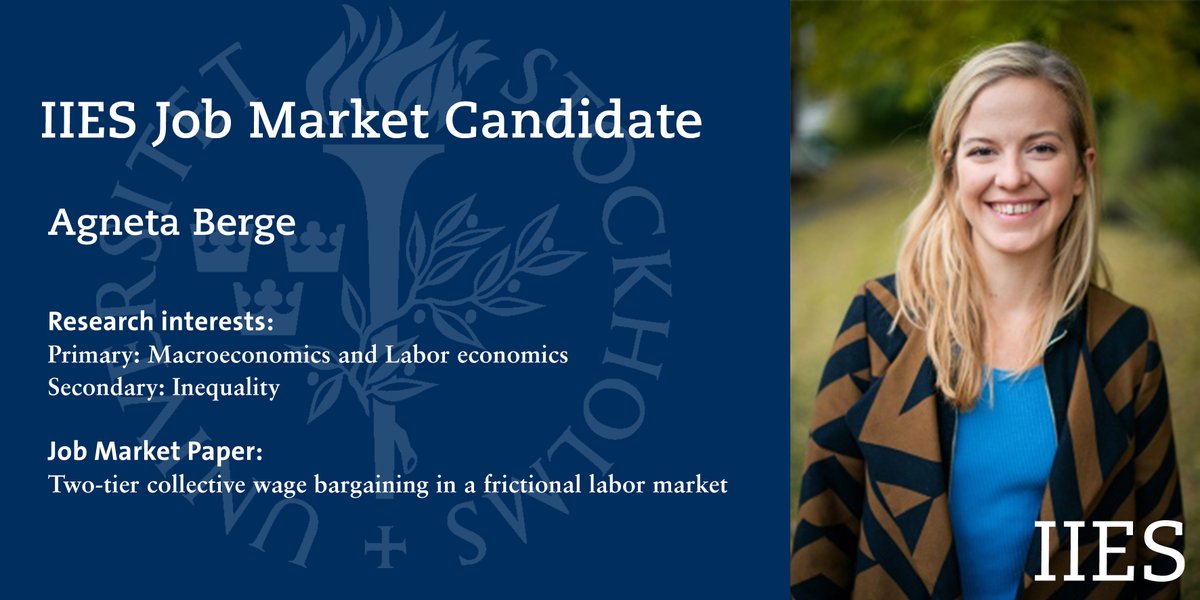
Introducing our #EconJMC@agnetaberge. In her #EconJMP “Two-tier collective wage bargaining in a frictional labor market” she develops a general equilibrium model of two-tier bargaining, where central negotiations are supplemented w local adjustments https://t.co/yIVAERvILE 1/6
Check out the fascinating work by the talented job market candidates from @SU_Economics!
Jakob's JMP on debt restructuring programs:
https://t.co/4g0hJg9jK5
Ossian's JMP on carbon pricing and fuel switching by firms, joint work with @MaijaKaartinen:
https://t.co/GsJxA7lwIV
Hiring ‼️ 🚨I am looking for 1-2 PhD students and 1 postdoc to join my group at
@stonybrooku in Fall 2025. Positions fully funded. We use data, statistical, and physical models to study climate change and air quality to inform global policies! Details: https://t.co/PkIoyGYKTa
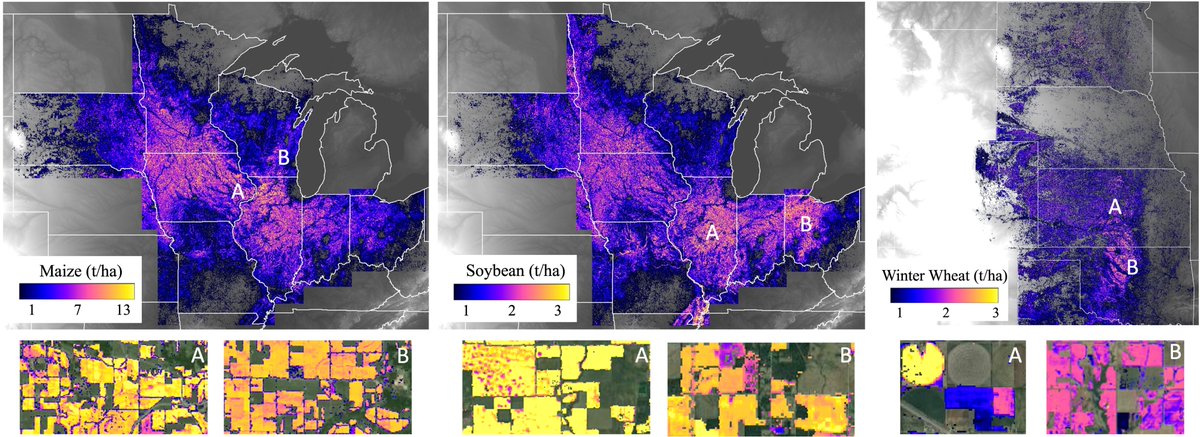
I'm excited to announce that we've published the first-ever public-available 30-meter crop yield maps for the U.S., using Landsat data and a new scale transfer framework. You can explore the details in our newly released paper in #RSE (https://t.co/IoWbsvHYE0) @FoodSecurity_SU.
Akademien belönar forskning kring låginkomstländer, ADHD och autism samt genetisk variation 🌟
Vid gårdagens sammankomst beslutade Kungl. Vetenskapsakademien att utdela priser till Tillman von Carnap, Christoffer Gillberg och Hugo Zeberg.
🔹 Arnbergska priset
Tillmann von Carnap, Stanford University, tilldelas Arnbergska priset 2024 på 105 000 kronor
🔹 Hilda och Alfred Erikssons pris
christopher gillberg, professor vid Göteborgs universitet, tilldelas Hilda och Alfred Erikssons pris år 2024 på 395 000 kronor
🔹Flormanska belöningen
Hugo Zeberg, Karolinska Institutet, tilldelas Flormanska belöningen år 2024 på 105 000 kronor
Läs mer: https://t.co/1Eiv9l6NPU
Please RT: I'm very excited to launch @malengo's new Kenya–Germany Vocational Training Program for Refugees! We provide one year of intensive language training in Kenya, followed by 1–3 years of vocational training in Germany to become e.g. a nurse. 1/3
https://t.co/wPIRehUydW
@noelladart As with any other data, however, it will be important to consider who might be impacted in what way by its publication, especially in conflict settings and with real-time applications
We've posted a new version of our working paper "Using satellite imagery to monitor remote rural economies at high frequency".
We track economic activity by measuring attendance in open-air marketplaces with near-daily imagery.
Three key takeaways:
https://t.co/NJSIjaOXzJ
@noelladart That's an important question. We are deriving information from commercially available imagery that is acquired globally, about a public phenomenon. We're not tracking anything private.
@DogmaticPrior The activity measure is essentially the difference between an individual image taken on a market day and an average of many other images taken on adjacent days. That way, we purge the day-to-day differences from seasonal variation
Comments welcome!
We are currently working to derive activity measures for more marketplaces in more countries. Please reach out if you think there might be an interesting overlap!
3. The method can be used to learn about economic activity trends even when other data sources dry up, such as. We show an application to recent conflict in Ethiopia