Most cold chains fail at handoffs, not trucks. My 3 checks:
1. Who owns temperature at each dock?
2. Where is the data logged?
3. What triggers a quarantine?
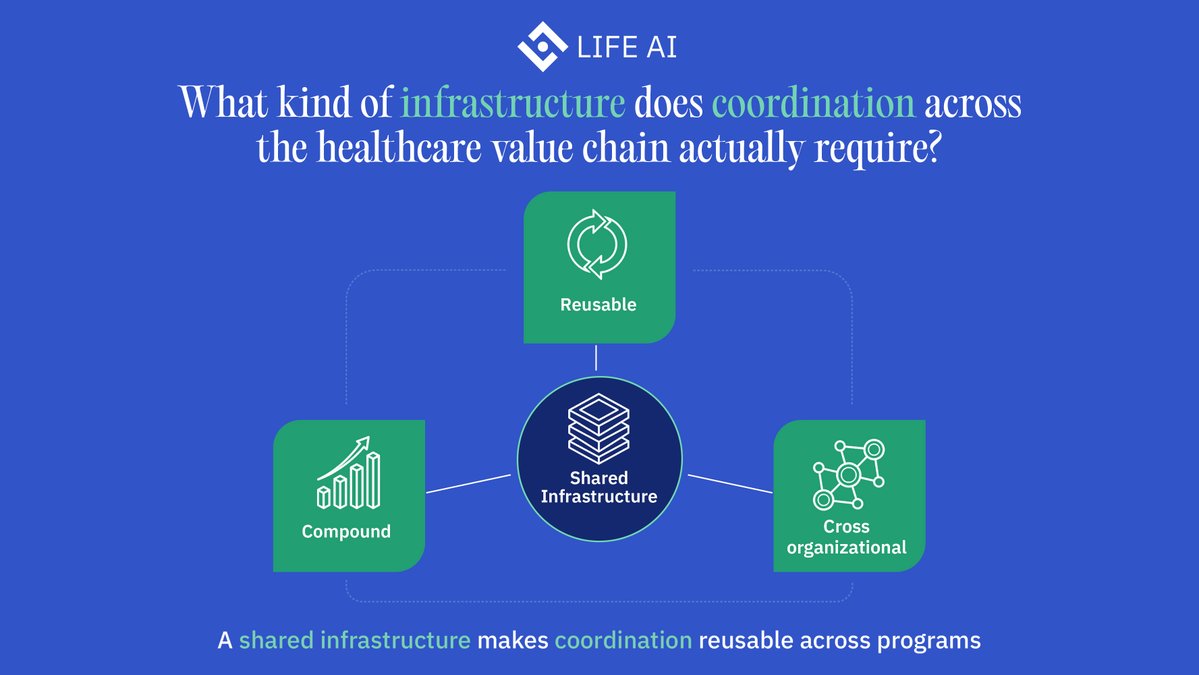
What kind of operational infrastructure does coordination across the healthcare value chain actually require?
Eight years of building clinical programs across Southeast Asia, working with governments, hospital networks, and pharmaceutical companies, produced one consistent finding: the challenge is not the absence of capable AI. It is the absence of operational infrastructure that makes coordination reusable across programs.
Without that infrastructure, coordination remains highly program-specific, especially in drug development, where multiple key players must work together across the development process.
The infrastructure this requires has three properties.
It has to be reusable. Clinical programs should move from bespoke projects to reusable rails, with shared coordination rails replacing bespoke integration at every site.
It has to compound. Every application should strengthen the model, the network, and the protocol, building greater capacity across the ecosystem over time.
It has to enable coordination among independent actors. Hospitals, doctors, labs, pharma sponsors, regulators, patients, and AI builders can contribute services, validation, and clinical execution without surrendering operational sovereignty.
At Life AI, we are building an operating infrastructure for drug development around these requirements, bringing together AI-driven discovery, wet-lab screening, and clinical validation.
90% of audit findings trace to access control, not logic bugs. Price shows what happened; role mappings show who could've stopped it. Read permissions before you read code.
Myth: floor price dip means instant profit.
But reality? Most collections never recover after a hype cycle. Check holder concentration and real volume first. Bags don't lie, charts do.
The benchmark for intelligence is moving faster than most systems are built to handle.
As AI crosses new capability thresholds, the bigger shift is what comes next: intelligence that can act, interact, and operate continuously.
The curve is only part of the story.
More agents do not automatically create more influence.
The real value of a Multi-Agent Influencer Network lies in how effectively those agents coordinate.
One agent may understand audience interests.
Another may interpret conversations and intent.
Another may determine which recommendation is most relevant.
Individually, each agent contributes a specific capability.
But the network becomes significantly more powerful when these agents can share context, align on the same audience understanding, and coordinate their actions.
This creates a capability that is difficult for a single agent to replicate.
Not simply more intelligence in one place.
But intelligence connected across the system.
That means the competitive advantage of a Multi-Agent Influencer Network is not the number of agents it contains.
It is the coordination layer that connects them.
And that coordination layer could become a fundamental piece of the infrastructure powering AI-native influence.