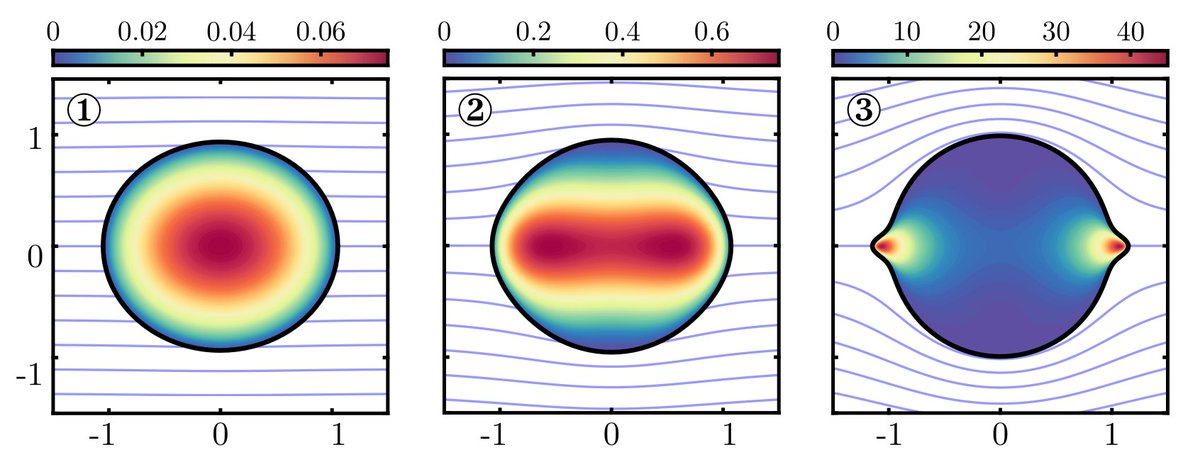
Invited article: A review of 'Rigid and deformable bodies in nematic liquid crystals', with @SaverioIV and @TGJChandler! Read the article @ https://t.co/NkGKslGqPa
More details on @SaverioIV's Bluesky page: https://t.co/bojamllyVQ
Fresh on the arXiv today, with the illustrious @TGJChandler:
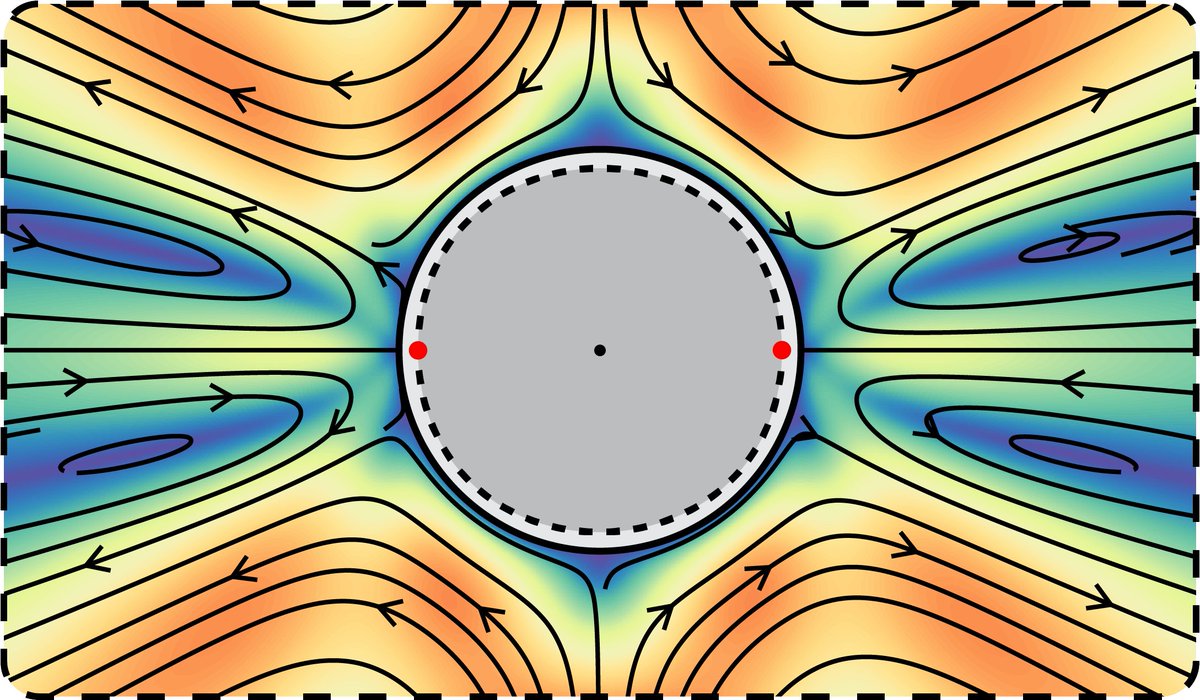
"Active nematic response to a deformable body or boundary: elastic deformations and anchoring-induced flow." 🧪⚛️
https://t.co/CGakhp7zgC
https://t.co/bFrAJvlfYE
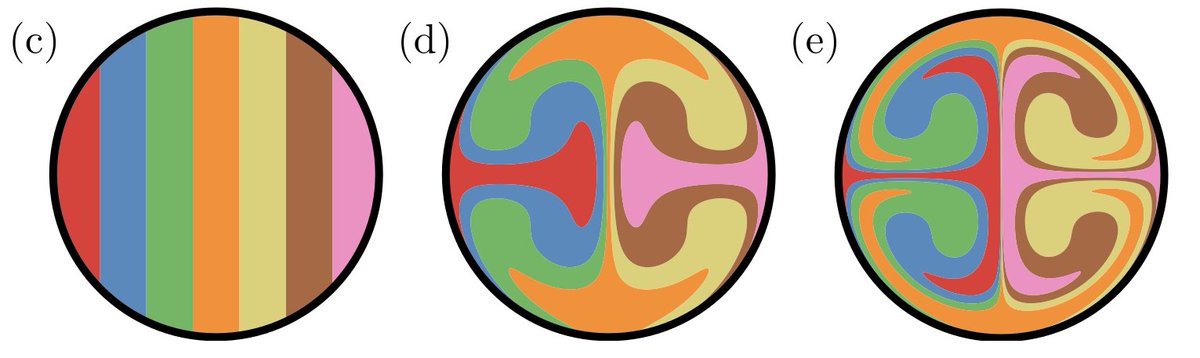
It turns out that sparkling water and raisins are *fascinating*. My daughter and I happened upon this effect playing together in the kitchen a long time ago, and I couldn't help but explore the system more deeply... 1/n https://t.co/wNBX7nnGJS
"A nematic liquid crystal with an immersed body: equilibrium, stress and paradox," led by @TGJChandler, just appeared in @JFluidMech! Among the techniques/analogies explored, my favorite is akin to the Kutta condition: topological defects prefer corners. https://t.co/YPomUWTQLD
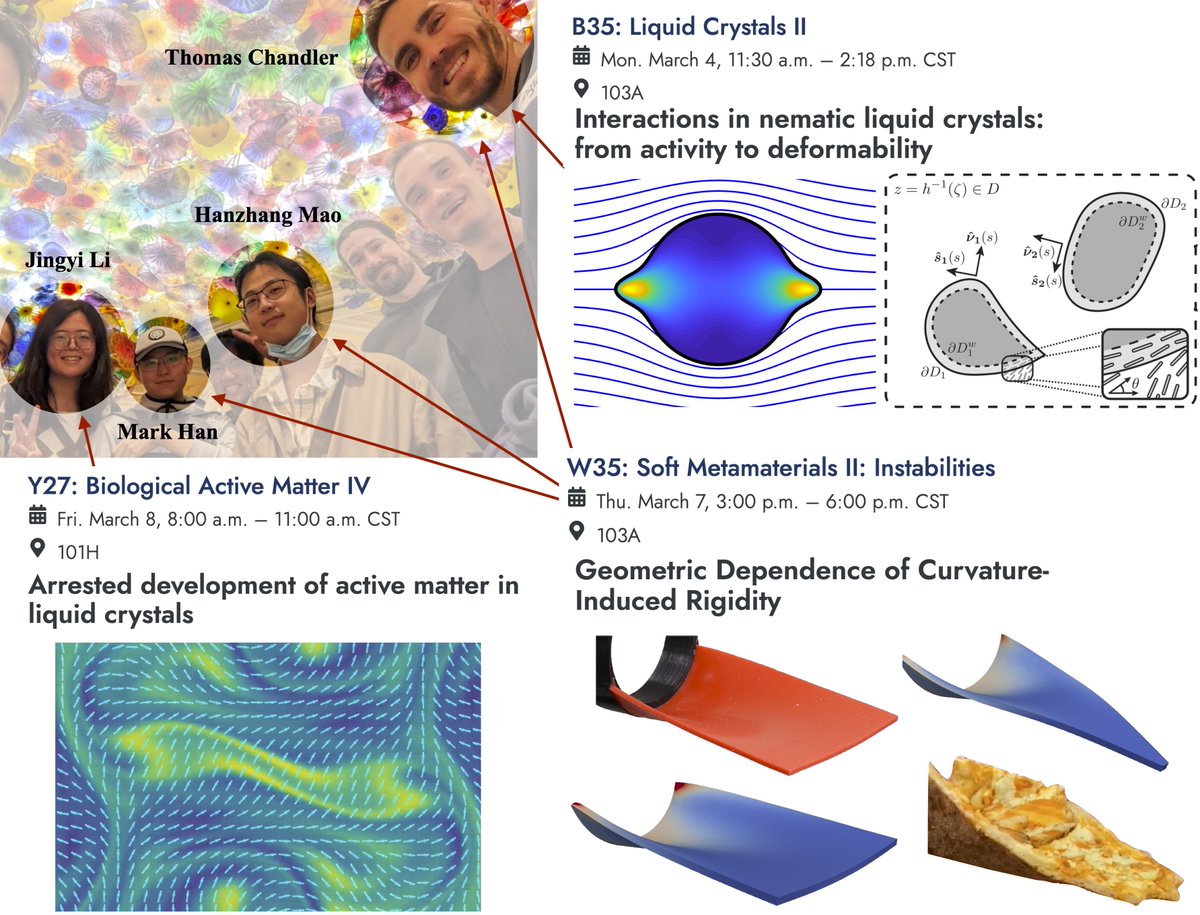
We're gearing up for #APSMarch! The first speaker from our group will be the extraordinary @TGJChandler, on Tuesday 4pm in Fluids VI. Tom has found beautiful links between liquid crystals and classic results (and paradoxes!) in fluid mechanics. https://t.co/JOyI05Zop1 @ApsDsoft
Working with brilliant postdocs and students at @UWMadisonMath is the best part of my job. Prerna Gera has taught me a lot about multicomponent vesicles, and I am thrilled to welcome @TGJChandler, fresh off his PhD at Oxford. Look for them at APS-DFD!
#PostdocAppreciationWeek
Why does Winkler's 'mattress model' work so well for (close to) incompressible materials when it should break down? Find out more in this work with @TGJChandler
https://t.co/jmmEYAzfLw
New paper on the validity of Winkler's mattress model for thin elastomeric layers is out in Proc. R. Soc. A. (@RSocPublishing), with Dominic Vella (@MathObservatory): https://t.co/WzUjMJKKoy
Poisson's ratio alone does not control the incompressibility of thin elastic foundations
We derive novel solutions and unify existing solutions to form a coherent description of the indentation process, while highlighting potential pitfalls that common experiments may fall into. (Check it out here: https://t.co/HL5ty601Zr)
Our new paper on the indentation of suspended two-dimensional solids is out now in JMPS (@Elsevier_Eng), with Dominic Vella (@MathObservatory)
Can discrepancies in reported material parameters be explained by geometrical or material nonlinearities? https://t.co/bfPPEQFBpx
In this work, we have performed a modelling study of these indentation tests assuming elastic behaviour, focussing on the possibility that the reported differences may arise from commonly neglected effects, such as non-Hookean material behaviour and experimental indenter geometry