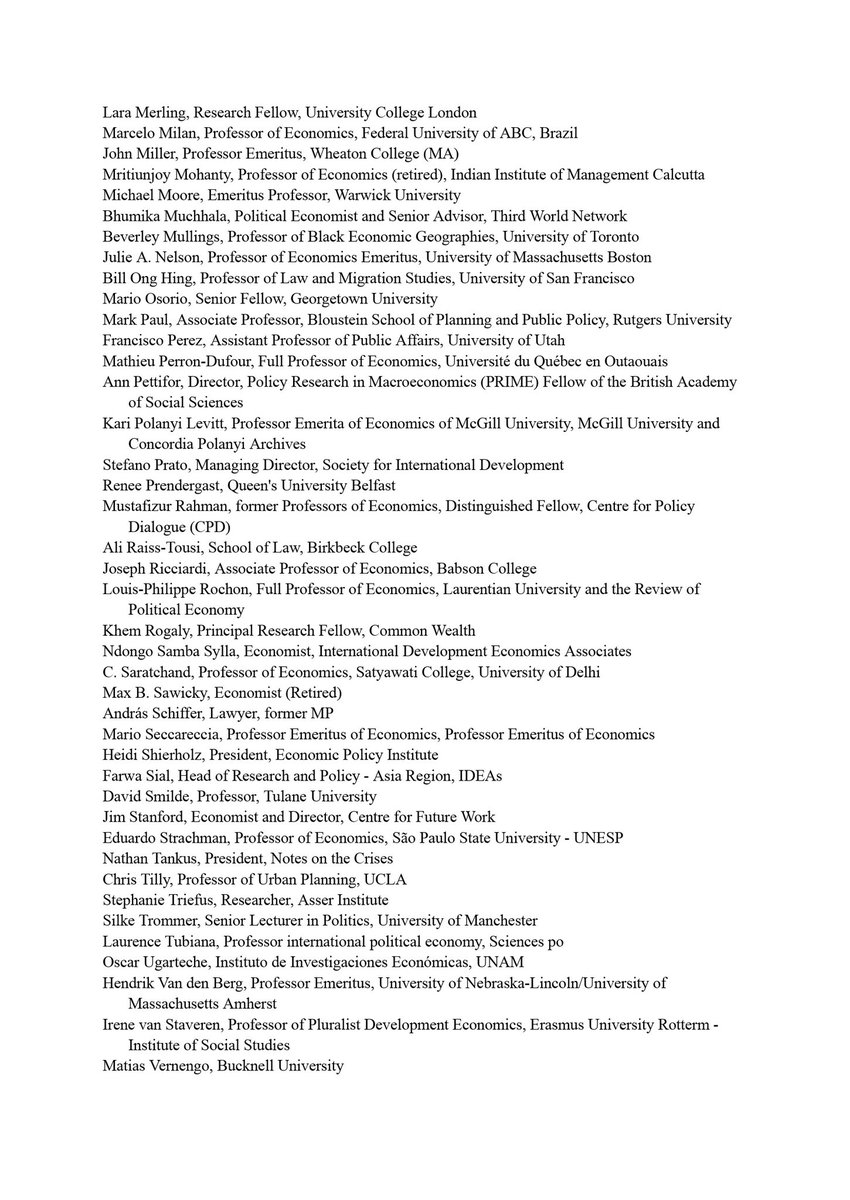
Today, I join more than one hundred economists and social science scholars in calling for the United States to lift all remaining economic sanctions on Venezuela to aid relief and reconstruction efforts from last month’s devastating earthquakes.
#EnVideo📹| La presidenta (E) Delcy Rodríguez ofreció anuncios económicos importantes y precisó que el fondo "Venezuela Renace" anunciado el pasado jueves #25Jun con recursos que estaban bloqueados en el FMI y otros entes financieros del mundo estará destinado a la reconstrucción de las zonas afectadas por el doble terremoto del #24Jun.
Venezuela is in a state of emergency after devastating earthquakes.
The US, the UK and the IMF should be lifting sanctions, providing debt relief, and unfreezing state assets.
Instead, we're talking about sprinkling some aid, as per usual.
This is outrageous.
Why did our ruling class not invest in decarbonising faster to avoid this acceleration in deadly heatwaves that scientists warned would come? Because of the capitalist law of value.
Capital invests in what is most profitable to capital, rather than what is most necessary for humanity, so our ruling class keeps ploughing investment into fossil fuels and SUVs, while we get far too little in renewables and public transit, even while the world burns around us.
We have more than enough capacity (labour, factories, technology) to address the climate crisis, but as long as capital controls investment and production we are prevented from doing it.
We are trapped by the capitalist law of value, living in a miserable shadow of the world we could have.
We should not forget that for more than 7 years, US sanctions barred the Venezuelan government from purchasing the heavy machinery that is needed to dig people out of the rubble today.
Sanctions are not the only cause of Venezuela's collapse, but they have done irreparable harm.
This is an important new paper.
When we allocate responsibility for emissions, it's normally in terms of consumption. We tally up direct household emissions (eg, from household energy use) plus the emissions embodied in all the stuff that a household consumes.
But this creates a problem, because households do not control the conditions under which that stuff is produced. The energy and production techniques, which determine the emissions content of goods and services, is decided by those who own the means of production - mostly the capitalist class, and to some extent governments.
Scholars have argued that owners should therefore be held responsible for emissions from production they control, given they have the power to produce differently, such as by using renewable energy, or by investing in less damaging forms of production.
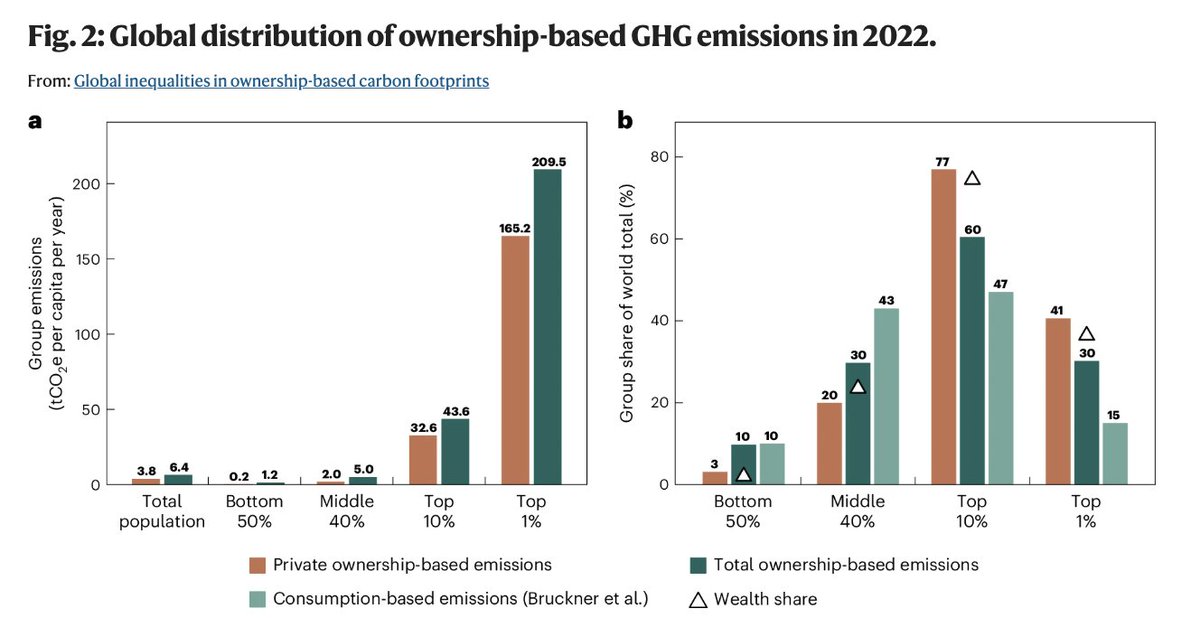
When we account for private ownership-based emissions, together with government ownership-based emissions and direct household emissions, the richest 1% are responsible for 30% of global emissions, and the richest 10% are together responsible for a staggering 60%.
These are the people who are driving climate breakdown. Climate change is class war.
But these results should be understood as conservative. I would argue that even direct household emissions should be assessed at least in part in terms of energy-system ownership. When households cook or heat water for showers, they usually have little control over the source of the energy, i.e., whether it is fossil fuels or renewables. That is decided by the people who own the energy system.
The fact that so much of our energy system is still provided by fossil fuels is not the fault of the working classes, it is the fault of those who own and control the energy system - which is mostly capitalists, and to some extent governments (which are in turn often captured by the capitalist class).
So households may be responsible for the quantity of energy they use, but they cannot reasonably be held responsible for the additional emissions produced by fossil-fuel sources if renewable sources could be provided instead. Perhaps one methodological solution here would be to allocate emissions to households *as if* their energy use was provided by currently available renewables, and allocate the rest to the owners of the energy system.
The paper is by @lucas_chancel and Yannic Rehm in Nature Climate Change: https://t.co/iLIO9vnBvR
Mearsheimer: War is the predictable consequence when one great power establishes itself on the border of another great power. What was previously common sense has now become controversial...
LEARN THE NEW ALPHABET
“Mr. Trump, never imagine that by exploiting the calm we are showing today, you will enter Beijing triumphantly. First, learn the alphabet of the new geopolitical order in West Asia."
“We defeated you on the battlefield; therefore, never imagine that you will be victorious in diplomacy.”
Ali Akbar Velayati, former Iran FM, top adviser to Leader Mojtaba Khamenei
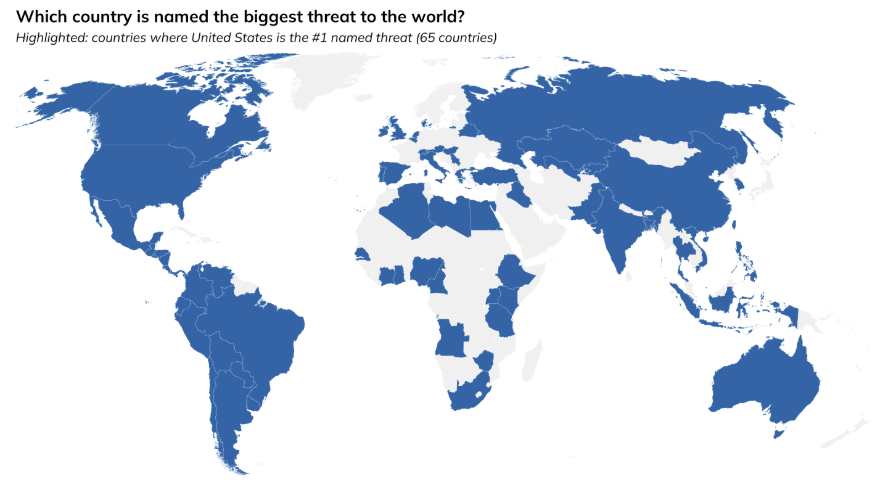
"Which country do you think poses the greatest threat to the world?"
According to the new Democracy Perceptions Index report, the US is named as the top threat by people in 65 out of 84 of surveyed countries. In fact, the US is the top named threat even within the US itself.
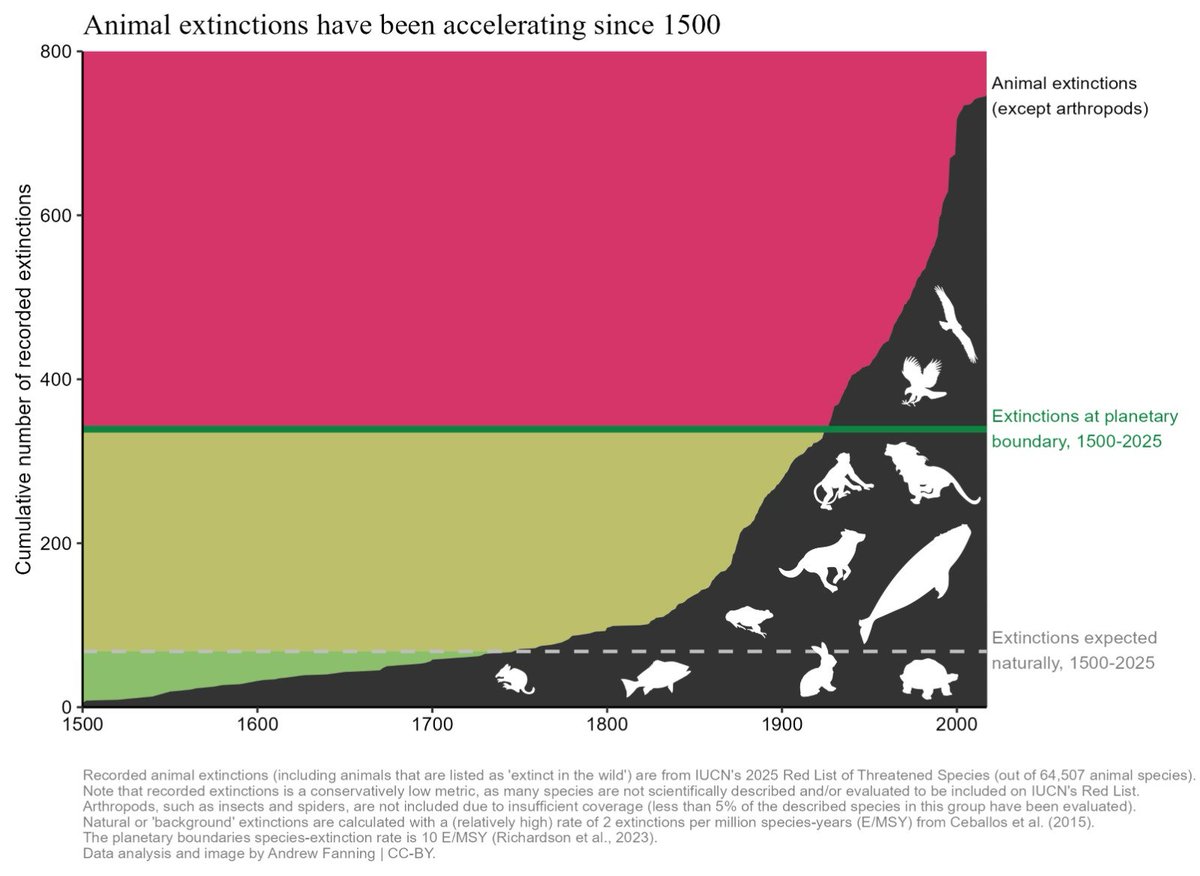
A striking figure by Andrew Fanning, showing cumulative extinctions from 1500 to 2025, against the numbers that would be expected naturally over this period, and against what would be consistent with the planetary boundary.
STRATEGIC IMPASSE REDUX
Tehran:
No uranium whatsoever leaves Iran.
Strait of Hormuz and whole Persian Gulf under new management following Supreme Leader's "historic command."
Trump: blockade continues; and he may resume war without Congress approval.
War and No-War.
Perm was attacked today, about 1500-1800km from Ukraine. It is ridiculous to believe that these attacks on Russia are done solely by Ukraine. We are led by lunatics who will surely scream "unprovoked" when a powerful retaliation comes.