Happy to share our new paper in @ScienceTM from Yingjun Cui, Erol Fikrig and @aaronmring, where we built a yeast display library of 3,000+ I. scapularis proteins to profile antigens recognized by tick-resistant hosts, and developed a new anti-tick vaccine. https://t.co/AfseBxqAtF
We found 199 tick antigens recognized by immune sera, including many proteins with histamine binding domains-key proteins secreted by ticks during feeding. Further, we developed a novel anti-tick vaccine of antigens from tick cement, and found this vaccine inhibited tick feeding.
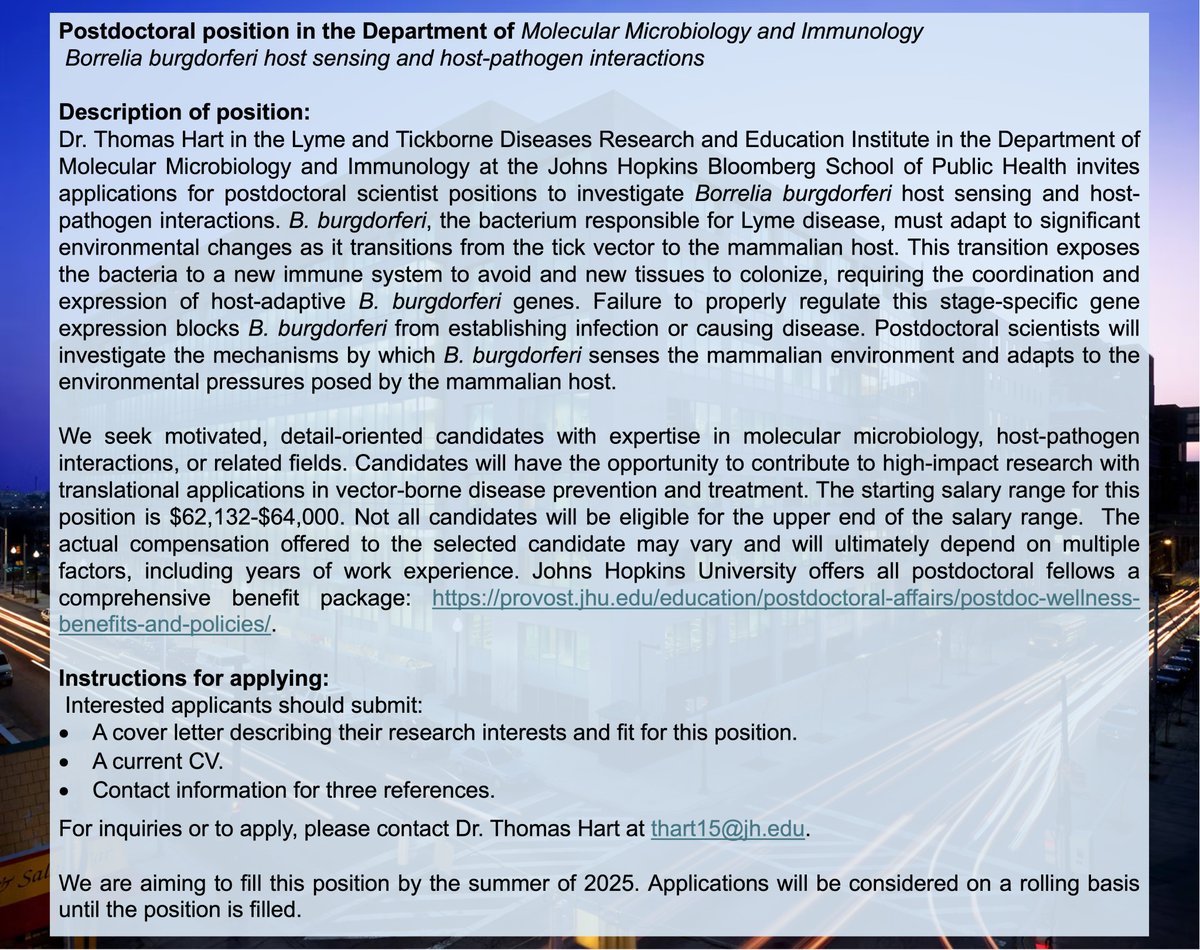
We're looking for a postdoc to join my group @JohnsHopkinsMMI investigating host-pathogen interactions in Lyme disease!
If interested, please email a cover letter, CV, and contact information for three references to me at [email protected].
I'm excited to share that I will be starting as an assistant professor this September in the Lyme and Tickborne Diseases Research and Education Institute @JohnsHopkinsMMI@JohnsHopkinsSPH to study how Lyme Borrelia sense and adapt to the host environment https://t.co/jFnNnMV1ZR
I’m excited to share our story in @CellCellPress from @aaronmring, Erol Fikrig, Noah Palm, @CarlyonLab, and all the amazing collaborators! We used an interaction profiling system to map interactions between the human exoproteome and microbial pathogens. https://t.co/H7L08WY8XQ
If this interests you, stay tuned as we’ve developed a similar library expressing extra cellular and secreted proteins of Ixodes scapularis, the vector of Lyme disease and other tickborne diseases!
For example, we found epidermal growth factor influences transcriptional regulation of Lyme disease bacteria, Borrelia burgdorferi, and protein disulfide isomerases facilitate cell invasion for a range of Rickettsial pathogens.