Another block from someone who's afraid to discuss basic history.
Rome had many languages and religions - that's part of how it became an empire, after all, by expanding and incorporating many peoples.
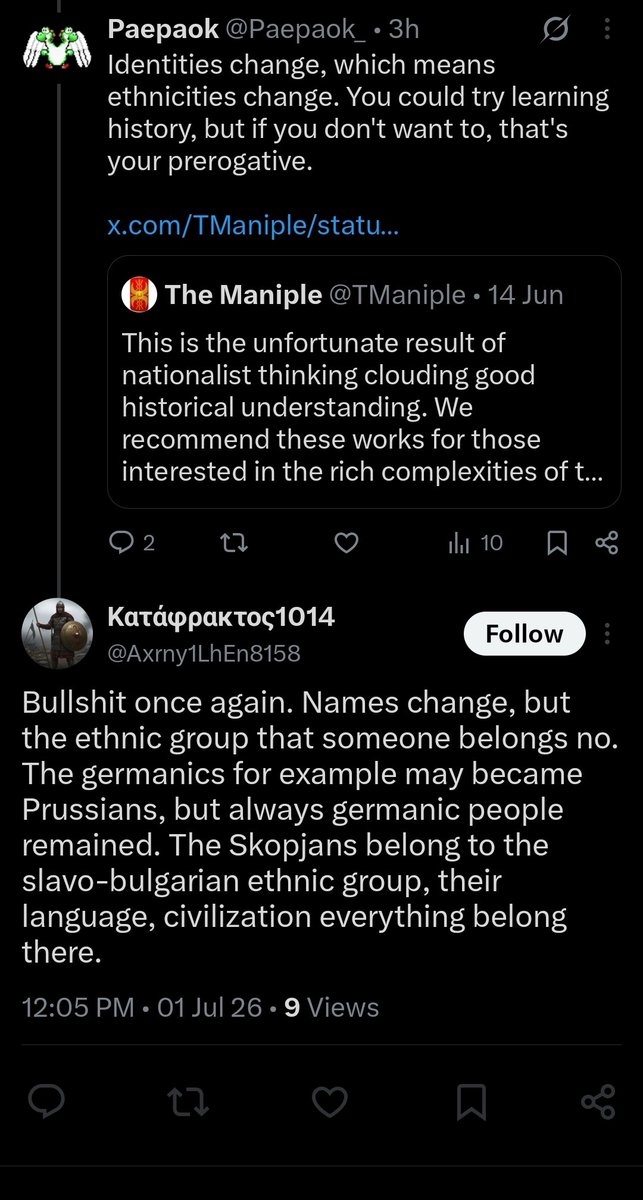
This is the unfortunate result of nationalist thinking clouding good historical understanding. We recommend these works for those interested in the rich complexities of the "Greek" and "Roman" identities:
https://t.co/nia1rd0qr5
https://t.co/JUuqACDbG7
https://t.co/RRvzdr2ics
Η προσπάθεια να αντιπαρατεθεί ο όρος «Ρωμιός» με τον όρο «Έλληνας» είναι ιστορικά αβάσιμη. Ο όρος «Ρωμιός» (Rum) στην οθωμανική διοίκηση περιέγραφε το ορθόδοξο «Μιλλέτ των Ρωμιών» (Rum Millet) και ήταν ιστορικά ταυτισμένος με την ελληνική ορθόδοξη ταυτότητα και κληρονομιά.
Maybe one day people will approach history with sober senses. Anyway, Here's a nice Reddit thread for those actually interested in history:
https://t.co/GjcXefgF27
A Turk will tell you that Turkey used the guarantor right to invade Cyprus & protect the TCypriots. They will not tell you that Turkey grabbed 3% in July 1974 and in August 1974 when all parties were in Geneva for peace talks grabbed about 37%. They will not tell you that...
It would've been nice to have known how sadly misinformed this person was before getting bogged down in a long discussion.
Similar nonsense:
https://t.co/wqTNd4wh3X
Our previous interaction:
https://t.co/P98LyDHjuZ
Here are some more wild mistranslations in Loeb and Perseus. I would greatly appreciate it if you could check them against Japanese translations as well.
Allen's reconstructed pronunciation of ancient Greek doesn't come from the ancient sources. It comes from mistranslating them.
Here are five wild examples:
1. Aristotle Poetics 1456b. Greek says δασύτητι καὶ ψιλότητι — "denseness and lightness." Fyfe's Loeb translation: "with or without aspiration."
The word "aspiration" is not in the Greek.
Same passage: Aristotle writes ὀξύτητι καὶ βαρύτητι καὶ τῷ μέσῳ — "sharpness and heaviness and intermediacy."
Fyfe translates: "acute, grave, or intermediate accent."
The word accent is not in the Greek. Accent marks were invented by Aristophanes of Byzantium a century after Aristotle died. Two fabrications, one sentence.
2. The grammatical terms ψιλά and δασέα are systematically translated as "smooth" and "rough." They don't mean that. ψιλός means bare, stripped, thin — a hill without trees. δασύς means dense, thick, full — a thick forest. The grammarians are describing consonants bare of airflow vs. dense with airflow.
Translate them correctly and you get a voicing/frication spectrum. Translate them as "smooth/rough" and you get the aspiration reading with some wishful thinking.
Every standard western translation uses "smooth/rough."
3. πνεῦμα is translated as "breath" or "aspiration." But Dionysius of Alicarnasseus applies πνεῦμα to ALL nine mute consonants — including π, τ, κ. Nobody claims π was aspirated. He also applies it to the nasals and liquids which is physically impossible for them to bear aspiratio. πνεῦμα means airflow, not aspiration.
4. Plato Cratylus 427b. Socrates describes gamma contributing to the gliding quality of words like γλίσχρον, γλυκύ, γλοιῶδες. Greek: ἀντιλαμβάνεται ἡ τοῦ γάμμα δύναμις —
"the power of gamma takes part in" the tongue's gliding.
Jowett translates: "the slipping tongue is detained by the heavier sound of gamma." The word "heavier" does not exist in the Greek. And neither does "detained":
ἀντιλαμβάνεται means "participates in," not "detains."
Socrates is describing a continuant that joins a glide — a fricative [ɣ]. Jowett turns it into a heavy plosive [g] by adding 2 words that aren't there.
5. Fowler's Perseus translation of Cratylus 427b: "where the gliding of the tongue is stopped by the sound of gamma" — the word "stopped" imports a plosive reading.
The Greek is about γ participating in the gliding, not stopping it.
ἀντιλαμβάνεται means "participates in," not "stops"
Four passages. Five mistranslations. All in the same direction. All making plosive readings look like they come from the ancient sources when they don't.
Check the Greek.
People need to realise we are dealing with a mafia-style "reconstructionist" tradition intent on mocking native Greeks while lying all the way to the bank.
bureaucracy, decadence, theocracy, etc. This was a common tactic among Enlightenment thinkers, and we have sadly not fully moved past this in the popular imagination.
Notice how the goalpost moves from "Byzantium wasn't Roman" to "it lost its appeal" to "Roman Republic was the peak that other societies sought to emulate". Also note how the geographic criterion went from "seated at Rome, it's in the name" to an "Italic empire".
This is a
you'll be able to find the appeal in both the peaks and valleys of any society's history.
The issue is that there are certain people who use Byzantium as a kind of punching bag or Skin of Evil, if you like, onto which they can project all kinds of negative stereotypes: bloated
Tldr; Municipal socialism is limited by the existing capitalist political & econ forces. Show some love to Cooperation Jackson w/ a donation if you can. Solidarity especially means solidarity w/ our poorest brothers and sisters.
https://t.co/dBCewIvIyv
With much talk about "municipal socialism" given who will be NYC's mayor in a month, as good as any time to talk about a 2 term "socialist mayor" in the Magnolia State.
In the end, municipal socialism operates w/in capitalism, so broader capitalist forces are beyond any individual's control (especially for JXN w/ so little resources). Cities are creations of the state so mayors need to deal w/ their boss: the governor.