UAI 2026 paper: A genetic perturbation can change the connectome, a new policy can rewire economic links between firms. In each case, interventions change the graph itself which standard SCMs treat as fixed.
We tackle this in Partially Observed Structural Causal Models (POSCMs).
The above stated positive and negative identification results are mathematically formalized and proven in the full paper: https://t.co/6b12rirDiV
I thank my co-authors Jordan Matelsky, Martin Butz, Charley Wu, and Konrad Kording (@KordingLab).
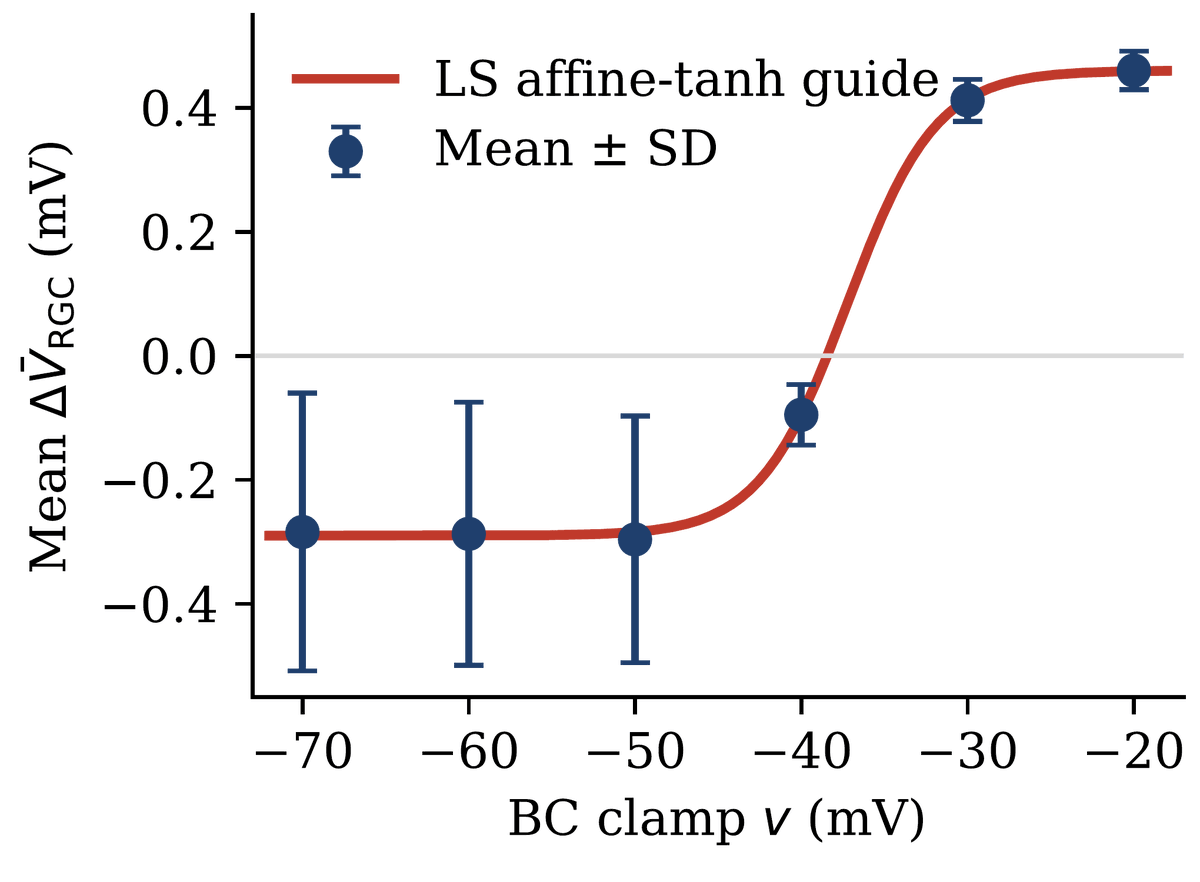
We use eccentricity (distance from the center of the retina) as a stand-in for β, and recover the sigmoidal BC (bipolar cell) → RGC (retinal ganglion cell) transfer curve (stand-in for mechanism f) with the help of β and V interventions.
Positive result: with observational + β-node + V-node interventions, the kernels α, {φ_i}, Γ are identifiable.
We validate this in a retina simulator. Retina is a natural POSCM: cell type co-determines both wiring and synapses, and the laminar circuit supplies the ordering τ.
We provide both positive and negative identification results:
Negative: With no β-level interventions, α, {φ_i}, and Γ are non-identifiable. V-level data cannot break a symmetry that lives in Phase I.
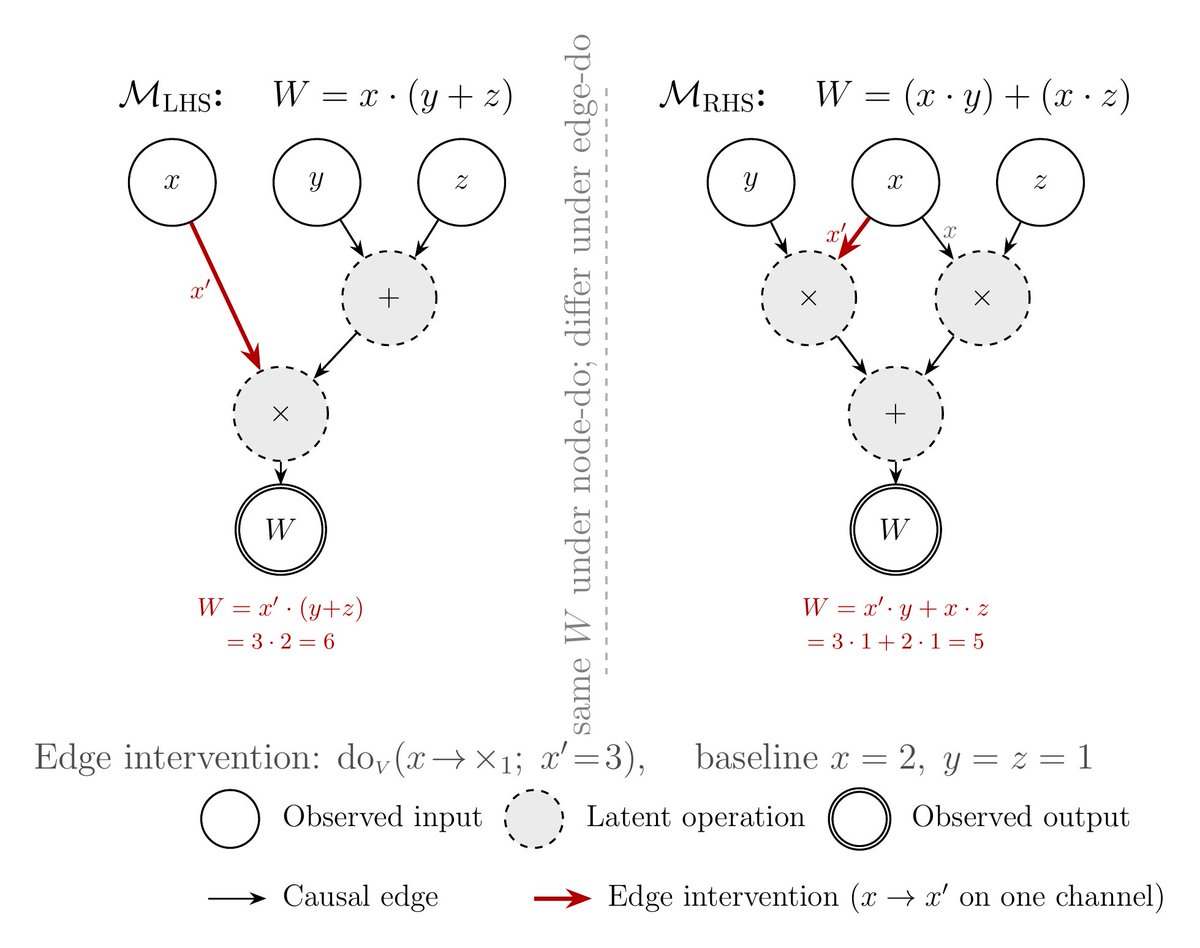
We show the power of edge interventions in POSCMs using the distributive law of multiplication.
x·(y+z) and x·y+x·z agree under every node intervention do(x,y,z) when the internal ops are latent.
Perturb one channel of x: LHS 3·(1+1)=6, RHS 3·1+2·1=5. Graphs are separated.
The connectome-shifting, economic-link-rewiring interventions can be modeled in POSCMs
as the Phase-I context interventions that alter the graph-generating measure: P(A_j | do(β_j = b)).
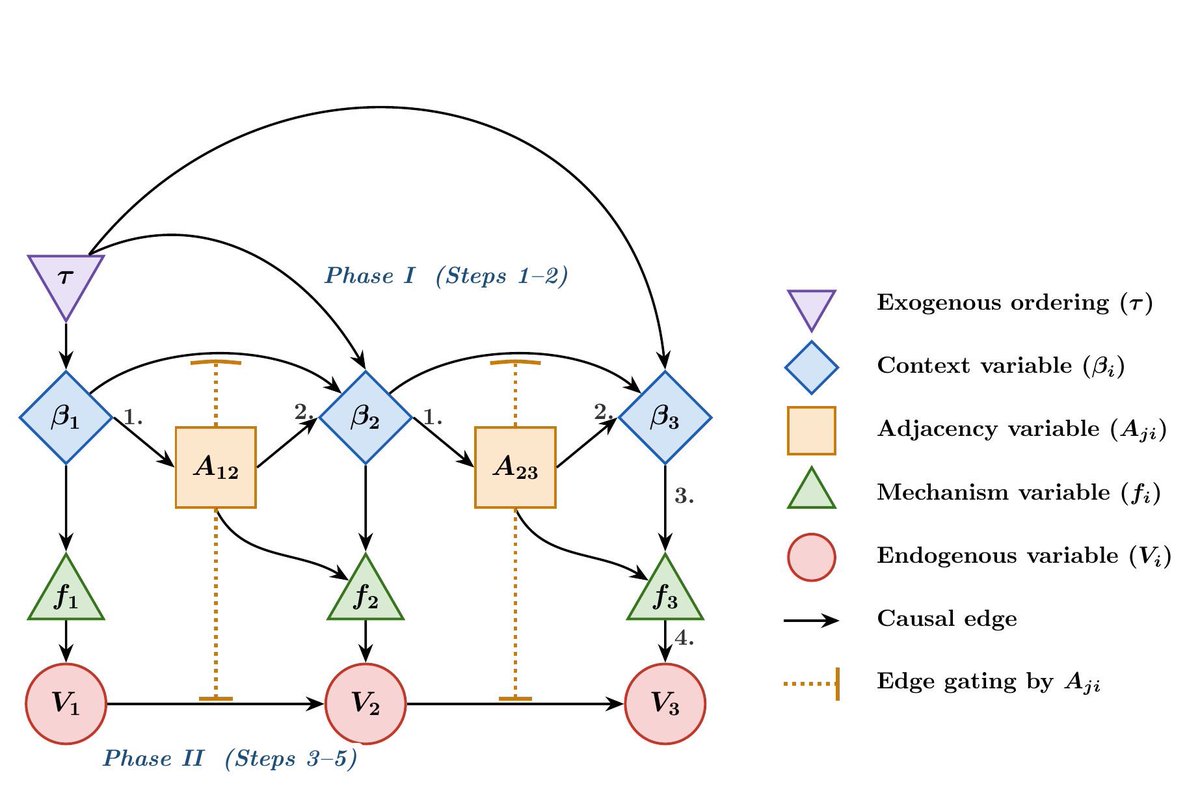
Generation happens in two phases:
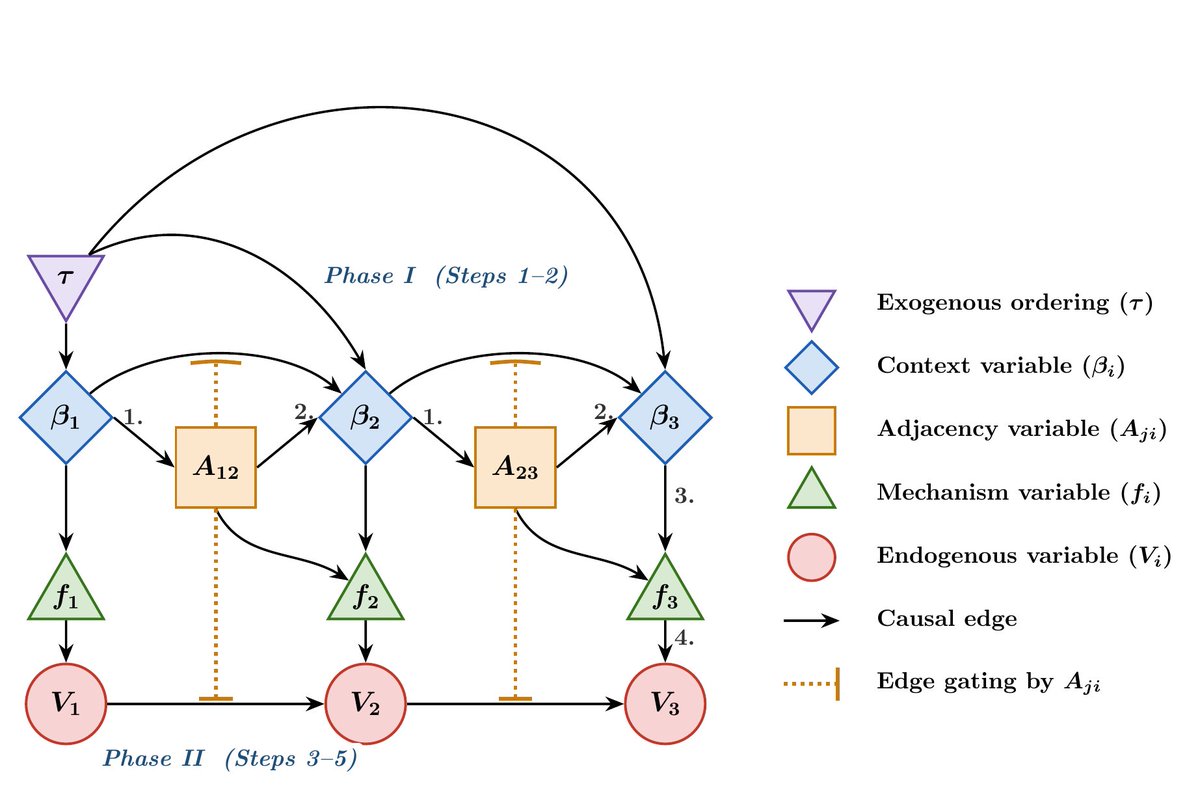
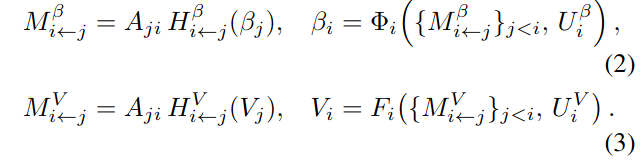
Phase I: A_ji ← α(β_j), then β_i ← φ_i(β_pa)
Phase II: f_i ← Γ(β_i, Pa(i)), then V_i ← f_i(V_pa)
The augmented graph β₁→A₁₂→β₂→… stays acyclic.
SCMs are the degenerate case A ~ δ_A*, f ~ δ_f*.
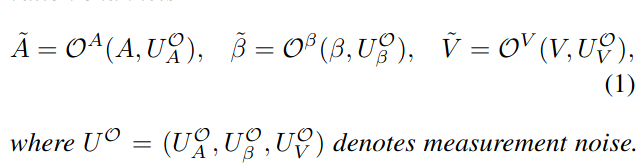
POSCM's constituent parts (context β, structure A, mechanisms f, values V) are jointly generated and can be partially observed via noisy channels. Furthermore, context shapes wiring (A), wiring shapes context. To avoid circularity, we impose generation over an exogenous order τ.
UAI 2026 paper: A genetic perturbation can change the connectome, a new policy can rewire economic links between firms. In each case, interventions change the graph itself which standard SCMs treat as fixed.
We tackle this in Partially Observed Structural Causal Models (POSCMs).
The above stated positive and negative identification results are mathematically formalized and proven in the full paper: https://t.co/6b12rirDiV
I thank my co-authors Jordan Matelsky, Martin Butz, Charley Wu, and Konrad Kording (@KordingLab).
UAI 2026 paper: A genetic perturbation can change the connectome, a new policy can rewire economic links between firms. In each case, interventions change the graph itself which standard SCMs treat as fixed.
We tackle this in Partially Observed Structural Causal Models (POSCMs).
We use eccentricity (distance from the center of the retina) as a stand-in for β, and recover the sigmoidal BC (bipolar cell) → RGC (retinal ganglion cell) transfer curve (stand-in for mechanism f) with the help of β and V interventions.