One last graph before the big event in five hours! Because both the Earth and the Voyagers are moving in very different directions, the speed that is observed (and the differences in distance that I post each day) are not intuitive. Kind of like watching a train move from inside another train, but in 3D. Here are the changes in speed over 2026 for Voyager 1 (blue) and Voyager 2 (green) both in km/s and in light-seconds/day. These speeds are very important because they cause Doppler effects in both the received and transmitted radio frequencies which DSN has to take into account (in the real version they also factor in the _rotational_ speed of the Earth at the antennas, which this graph does not). Some of you will recognize this as a dot product of the Earth's orbital velocity with the Voyager orbital velocities. The maximum for V1 is 41.04 km/s (11.83 l.s./day) on Nov 10th, and for V2 it is 38.33 km/s (11.05 l.s./day) on Dec 14th. The minima are -7.65 km/s (-2.21 l.s./d) for V1 on May 8th, and -8.17 km/s (-2.36 l.s./day) for V2 on Jun 11th.
The @EmpireStateBldg was illuminated in gold to celebrate @NASA's Voyager 1 spacecraft as it is about to pass one light-day away from Earth, a distance reached by no other human-made object, Tuesday, Nov. 17, 2026, in New York City. The color gold is emblematic of the gold-plated copper phonograph record that is flying on Voyager. The record contains sounds and images selected to portray the diversity of life and culture on Earth. More Photos: https://t.co/XoR48bV1g5
What about Voyager 2? V2 is traveling about 10% more slowly, and so is currently just over the 20 light-hour mark. This graph is more complicated than the last, but I thought this might interest those of you following our progress in detail. Here is a summary of all the One-Way Light Travel Times of the Voyager spacecraft over 2026. The first thing to note is that the plot lines have different vertical axes! While the times are _offset_ by 03H:50M, the intervals are the same. If you plot both these times on a _single_ vertical scale, you can barely see the sinusoidal shape. Remember: blue with blue (Voyager 1), and green with green (Voyager 2). OK, why is there this shape?
Because the distance measurements are being made from a moving platform: Earth. The sinusoidal variance is because of Earth's orbit around the Sun. At certain times of year, the Earth is moving towards the Voyagers faster than they are leaving, so the distance _decreases_. Why are they offset from each other? The Voyagers took very different paths out of the Solar System. V1 left after its Saturn encounter, while V2 chased down Uranus and Neptune, traveling farther around the ~plane of the planets' orbits, and that's why V2's interesting points are 'farther along in time.' We can also see that V1 is traveling faster than V2: it makes much more progress each year. Why? Because V2's last encounter (with Neptune), slowed it down significantly. The different angles involved between the spacecraft, the Earth, and the Sun are responsible for the precise shapes we see. Voyager 2 will reach the one light-day milestone just under nine years from now in 2035! #Voyager #OneLightYear
Shining bright across the solar system!
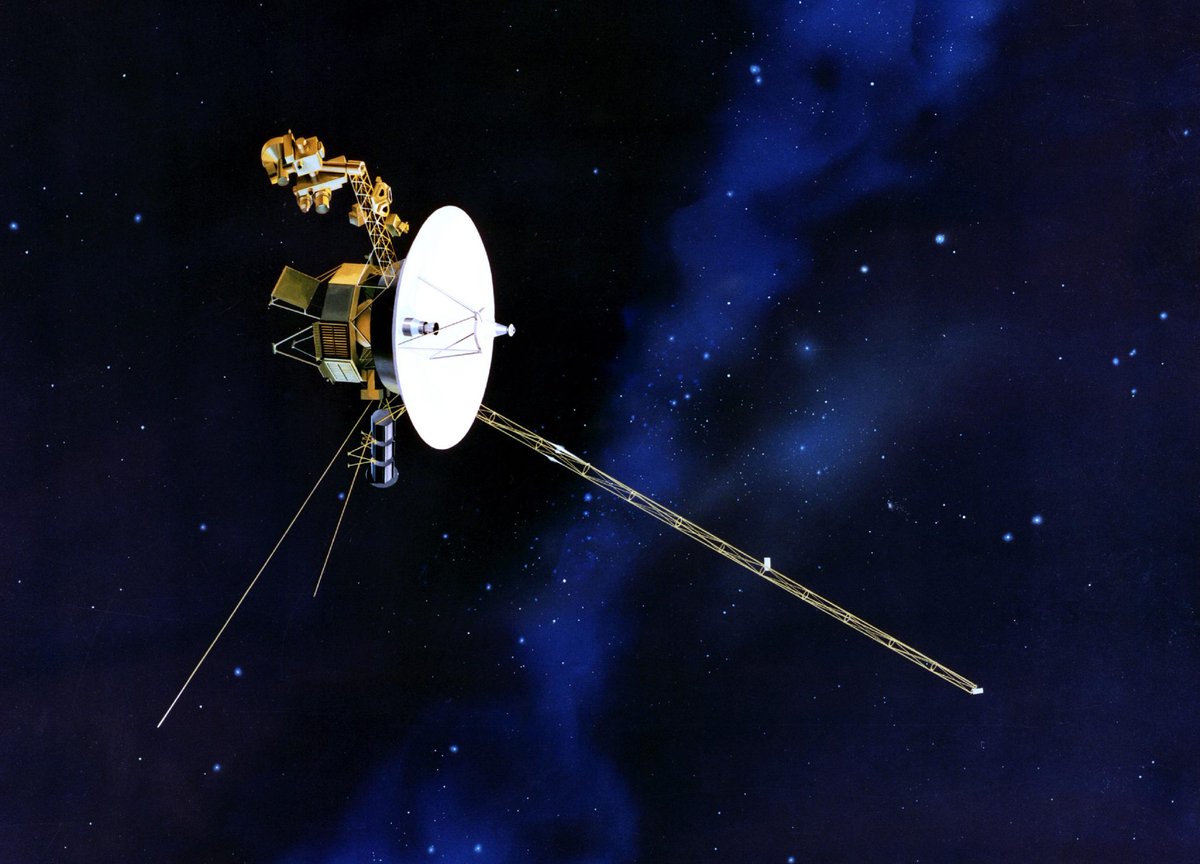
On Nov. 18, the Voyager 1 spacecraft will pass an extraordinary milestone, a distance reached by no other human-made object: one light-day away from Earth. And we're celebrating with a special message for the spacecraft!
I hear they've announced the new James Bond @007... Robert, welcome to the most exclusive club in the world. But remember to enjoy yourself. Let's see if you'll have "this never happened to the other fella" moment. All the best mate, George xx
In 1977 @NASA launched Voyager 1, currently traveling at 38,000 mph. Hailing from beyond all the Sun’s planets, on Nov. 18, 2026, Voyager reaches a distance of exactly 1 Light-Day from Earth.
Before you get too excited by this, the Sun's nearest stars are Light **Years** away.
2026 Rock & Roll Hall of Fame inductee Phil Collins talks about being inducted into the Hall of Fame for the second time. He was inducted as a member of the band Genesis in 2010.
38 years today since the maiden flight of Buran. The most expensive human spaceflight program to never fly crew - around 74 billion USD in 2026 terms spent between 1976 and 1993.
It was such a thrill and I am deeply honored by the Beverly Hills City Council for marking Nov 10th 2026 "Barbara Eden Day."
I've been a Beverly Hills resident for many years, proudly calling 90210 my home.
Here's to many more! My love, gratitude and best to Mayor Corman and the City Council for this honor.
It means so very much to me. -Barbara Eden