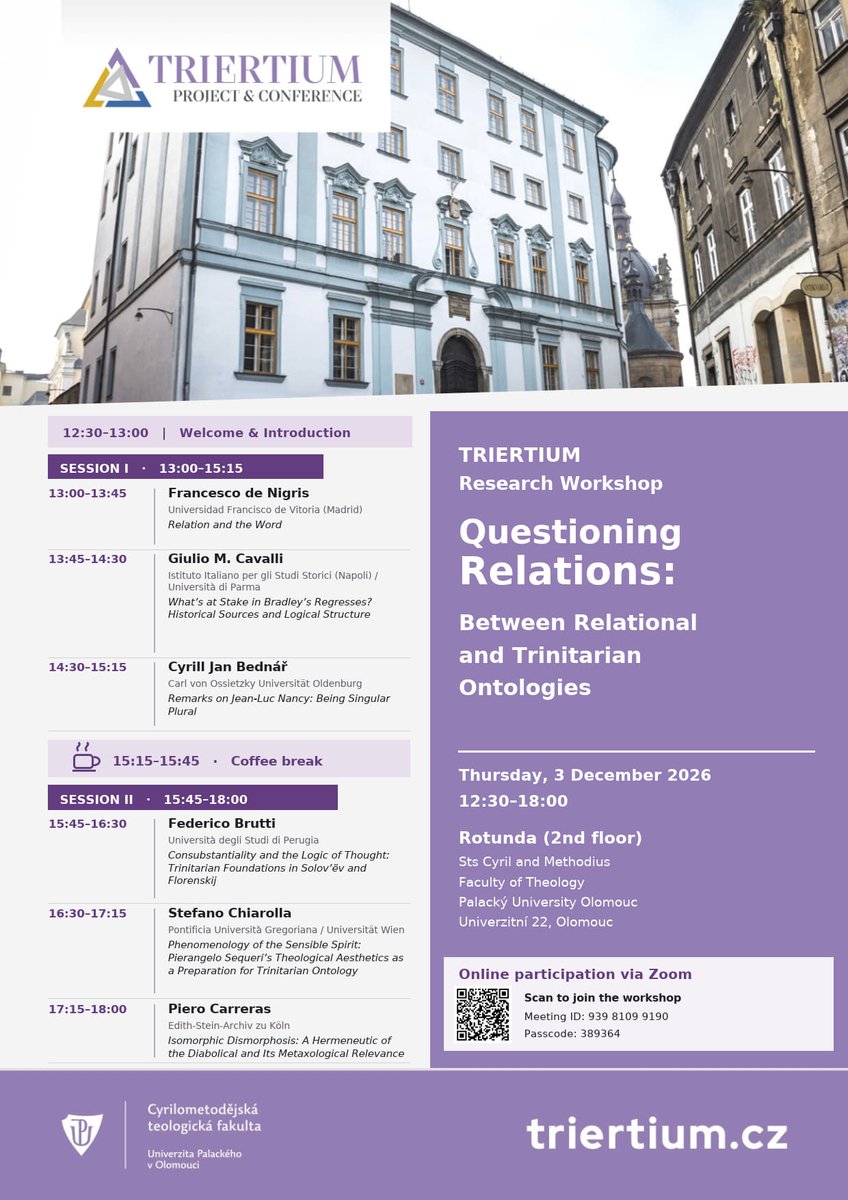
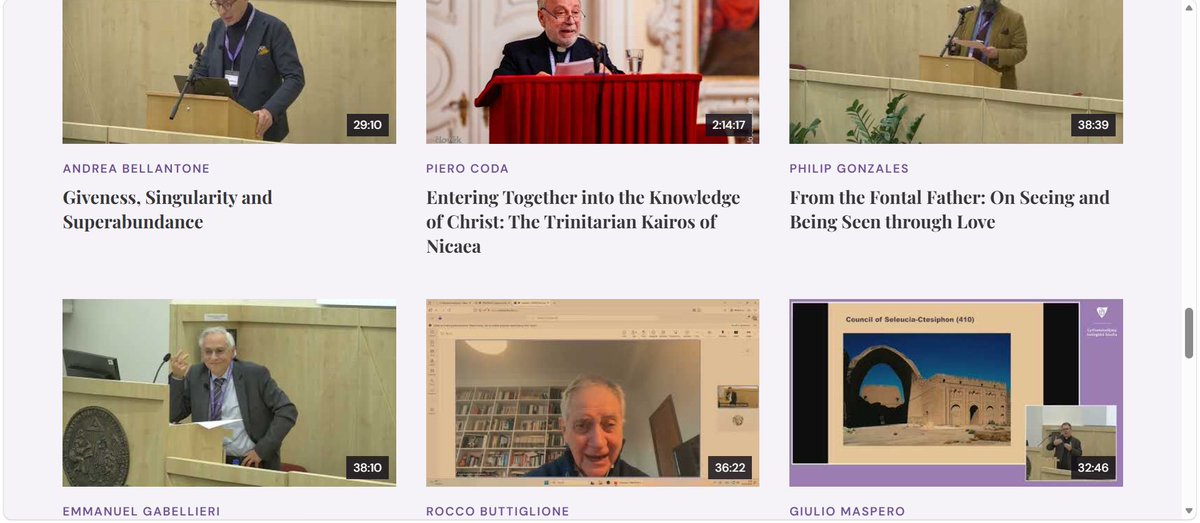
TRIERTIUM unites philosophy, theology, science & art to address today’s big questions through a new synthesis of wisdom in Trinitarian Ontology. @UPOlomouc
We are pleased to announce that the complete video recording of the TRIERTIUM 2025 Conference is now available online.
We invite you to explore the recordings and continue the conversation.
https://t.co/1kupQ9wpSb
Yes I think this is right. Laruelle specifically proposes this notion of “generic cosmos” in the context of outlining an account of what he calls the “MAP (system),” which stands for the “man-animal-plant (system).” The overall intention is to have an “ecological science” of the relationships “of MAP,” which he describes as “entangled without mixture.” Interestingly what feels most “modern” about this is the effective substitution of a distributed system for any “localization” of authority, in particular there is a very obvious tension with a lot of the formulations in Genesis (thinking especially about the idea of man’s “dominion over the earth,” but it does not come close to stopping there).
Maybe the Gnostic metalepsis of Genesis 1:26 consists in what Laruelle refers to as the “humanization” of MAP, which seems to be a kind of messianic passage of MAP over from the “World” to the “Universe” (perhaps the formulation could be ventured: the generic cosmos is an “unrealized Universe”). Either way, your reference to the Tripartite Tractate seems apt. @johnmilbank3 is also a big fan of it, and at the @TRIERTIUM conference in Czechia last year was trying to adapt a lot of its formulations for the possibility of something like a “Gnostic Orthodoxy.”
In terms of the reciprocal redemption of the Redeemer by the redeemed, that theme seems like it opens up the specific convergence of Valentinian gnosis with alchemical themes in the Hermetic corpus, and in terms of the “narrative grammar,” also seems crucial to why Cyril O’Regan situates the TT as the closest classical Gnostic anticipation of modern “Gnostic return” as it develops in the wake of alchemical Hermeticism in Böhme and Hegel.
Another way to approach this is with the apocalyptic thematic of Hans Urs von Balthasar in his theological history of metaphysics, inspired by Gustav Siewerth, to the effect of a kind of subliminal conflict in the constitution of human Being between grammars of “analogy” and “identity” (particularly in The Glory of the Lord V). It seems like, strangely, more “aggressively” heretical Gnostic grammars of absolute transcendence in classical antiquity resemble something like a psychotic derangement (within the “pneumatic asylum”) of the analogy of relative identity within a divided creation to an uncreated and absolute divine identity, as it was cashed out differently in classical paganism and in Christianity. But the Corpus Hermeticum and the Tripartite Tractate seem like exceptions to this analogical “paradigm,” and ones which lead into the identity-philosophy paradigm of the modern “metaphysics of spirit” which Balthasar sees as the condition of possibility for some kind of robust version of atheism to exist at all. He also singles out and critiques Iamblichus specifically in The Glory of the Lord IV for developing a kind of early theurgical “projection theory” of divinity that, blasphemously inverted, could yield something like Feuerbachian secular humanism; various Epicureans, Stoics, Academic skeptics, etc. were also taking the alternate (“proto-deist”) route of preserving the regulative function of absolute divine identity, while still cutting off human analogical participation in it.
As a proviso, a lot of Milbank’s project consists, instead, in developing the argument that analogy and identity reciprocally imply each other, and are not fundamentally opposed—weirdly it is a bit like Milbank’s critique of Balthasar mirrors @kkolozova’s critique of Judith Butler’s “post-structuralism,” because both are trying to redeem some notion of “identity” (hence the shared interest in Laruelle) against the “pathos of difference,” and in different ways Balthasar and Butler are I suppose are both differently afflicted with the Heideggerian legacy of “differential ontology” there. But at least Balthasar develops the classical notion of analogical metaphysics that preserves a robust sense of divine identity, in which there is still Eucharistic participation.
New Trinitarian Ontologies, Vol. 2, edited by John Milbank @johnmilbank3, Alexander L. Abecina, and Austin Stevenson, has now been published.
https://t.co/O1clQlHZyC
Here is the full interview with William Desmond on our Revelation & Finitude conference @StMarysSem_Balt .
It's time to sign up on Eventbrite!
https://t.co/FbbcAilsyV
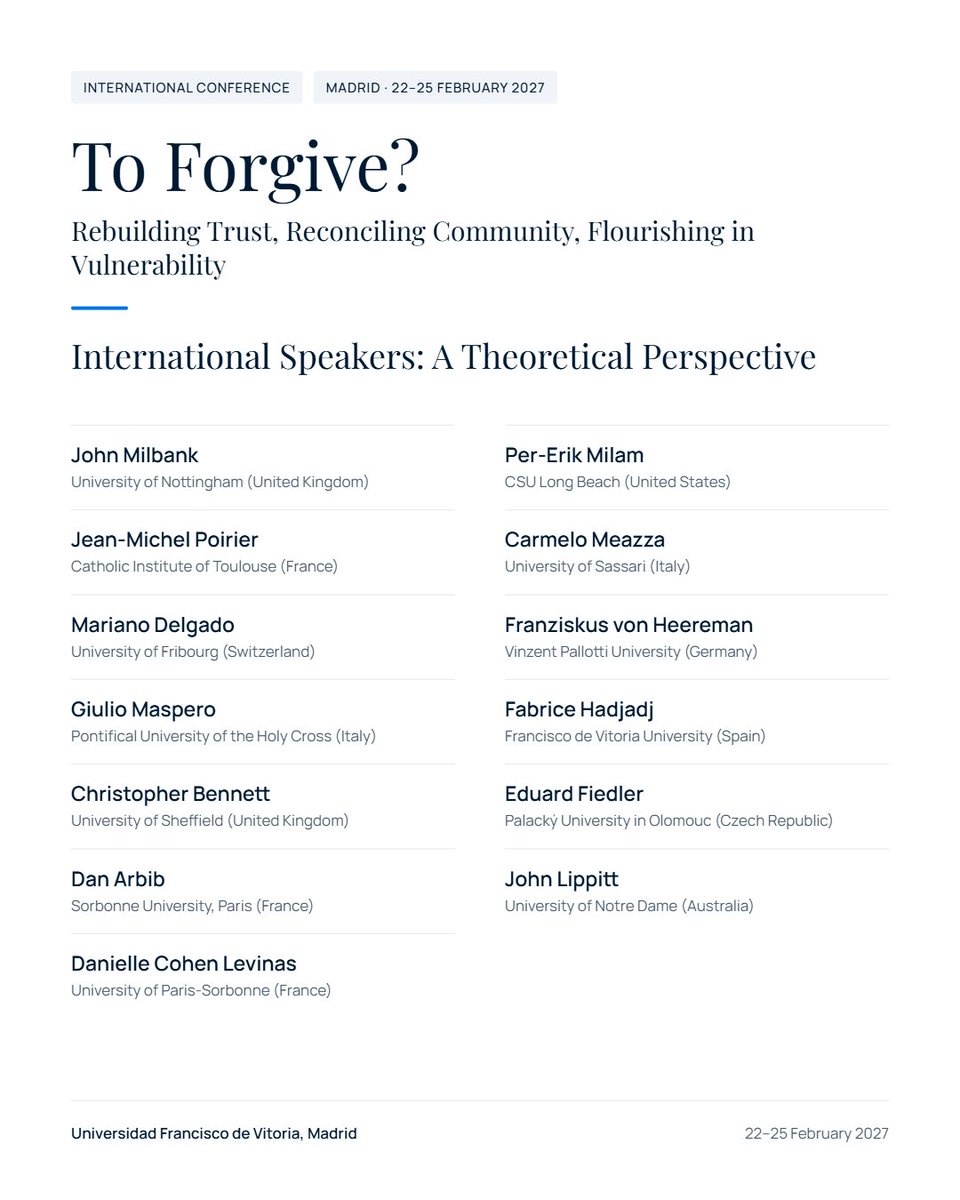
Grateful to be invited to the international conference “To Forgive?” at Universidad Francisco de Vitoria, Madrid (22–25 Feb 2027), where I will speak on “Causality and Forgiveness: On the Origin of Reconciliation and New Relations.”
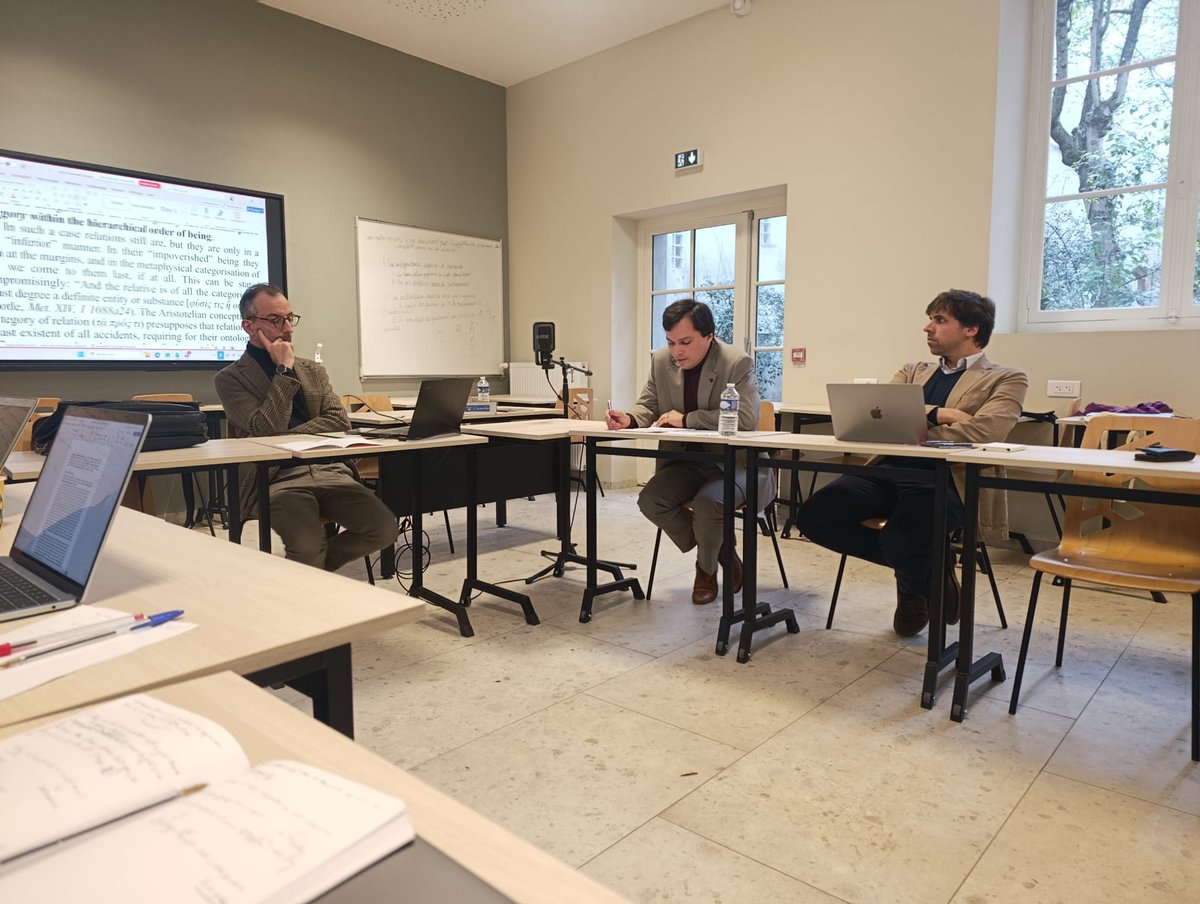
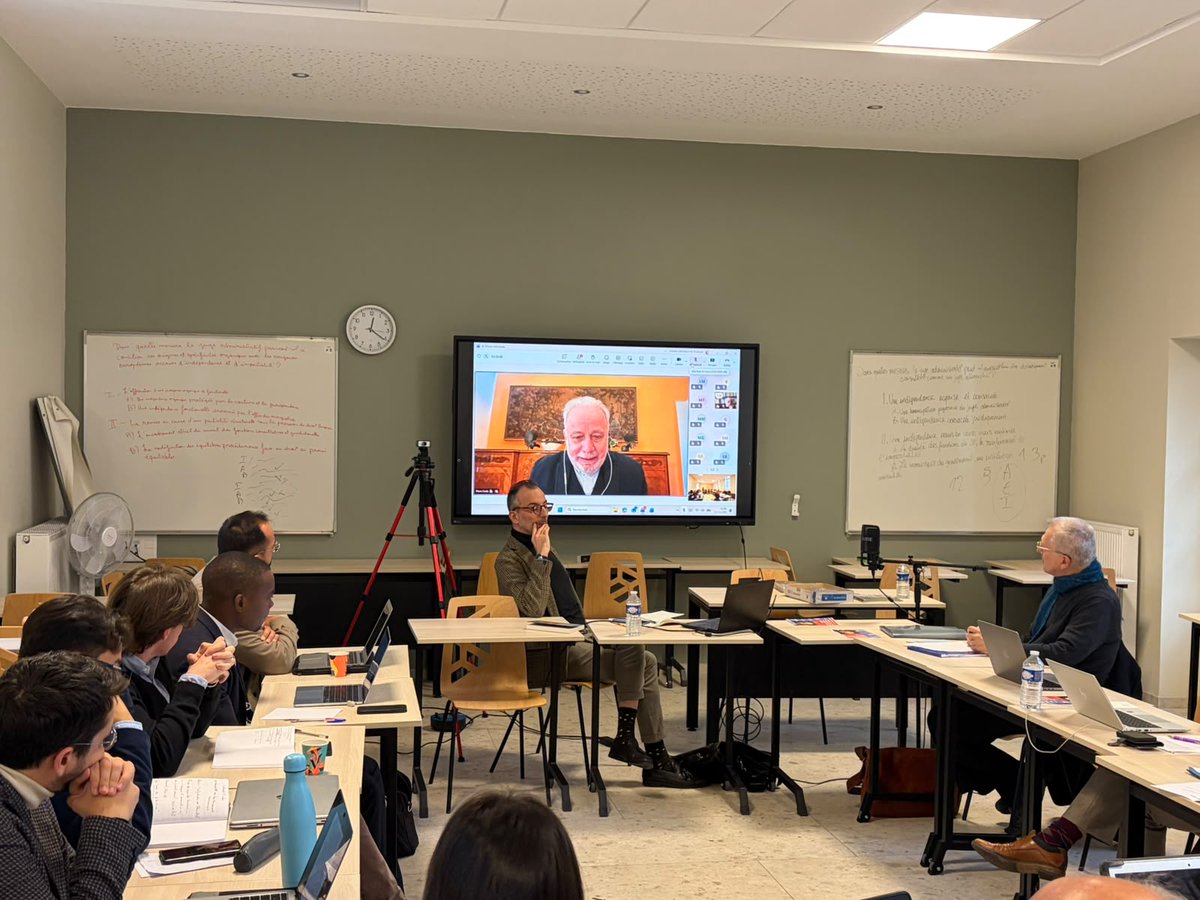
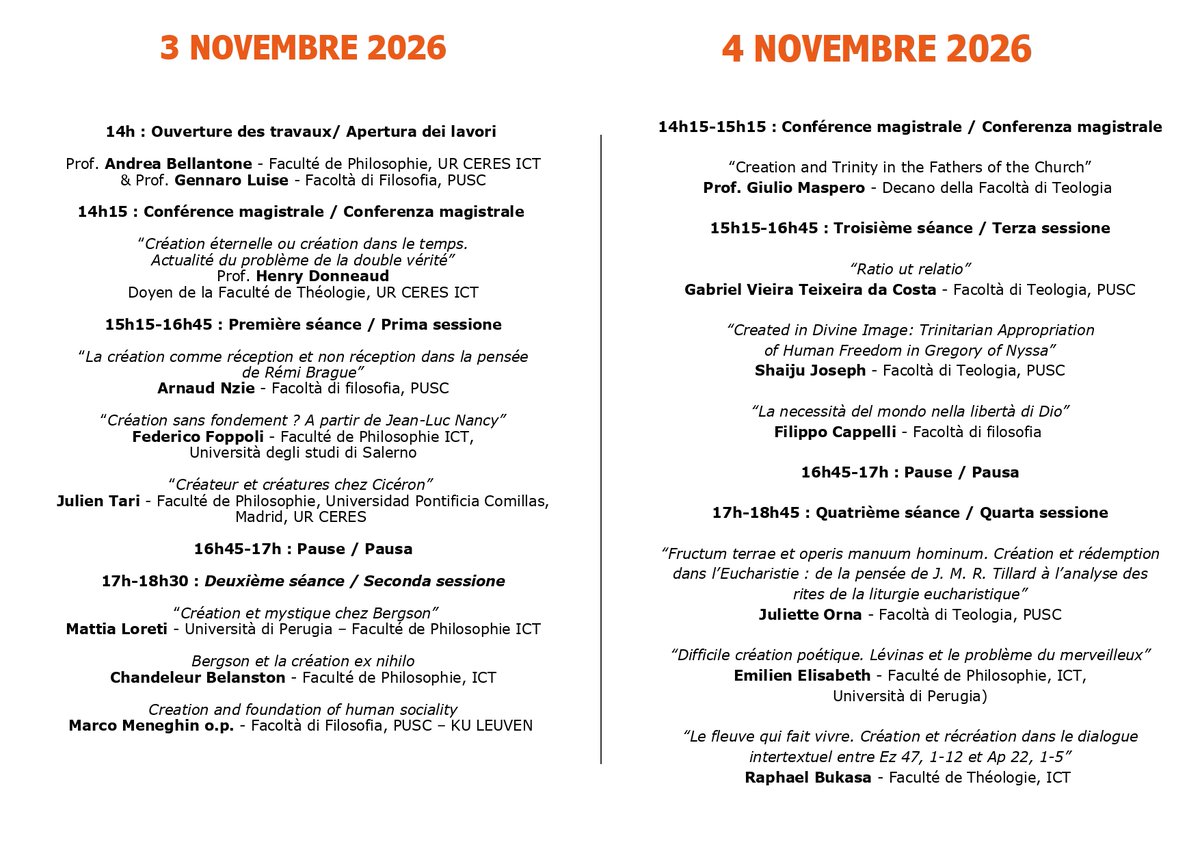
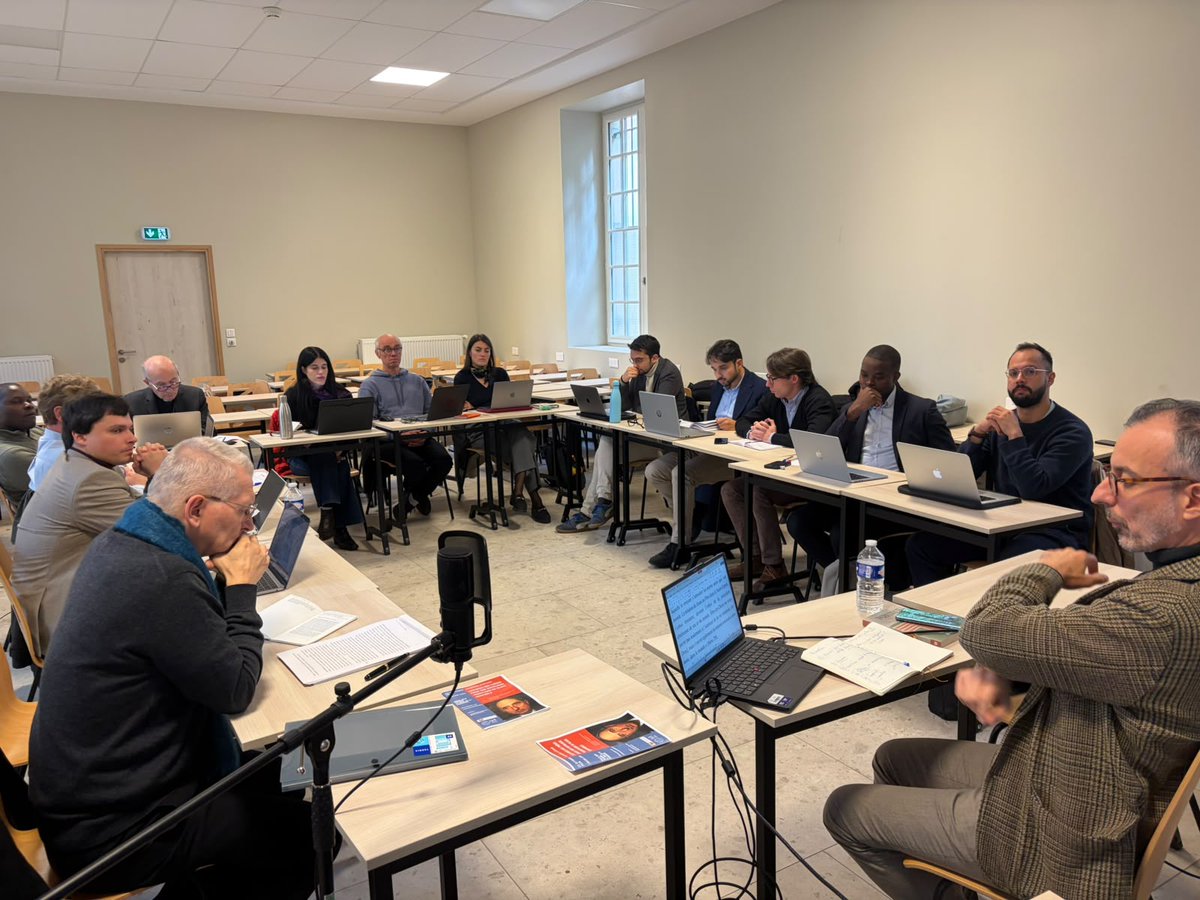
Magnifique journée d'étude (22 octobre) autour des Thèses pour une ontologie trinitaire de K. Hemmerle. Avec @EduardFiedler, Piero Coda, Eduard Prenga, Bruno Gautier et Raul Buffo !
Une magnifique occasion de travailler ensemble !
Many thanks to @a_bellantone for inviting me to take part in the Journée d’Étude on Hemmerle’s Theses Towards a Trinitarian Ontology at the ICT.
The community of philosophers and theologians here is fascinating, and they are deeply committed to their vocation.
It is a great honour for the Faculty of Theology in Olomouc that Pope Leo has appointed our colleague, Professor Ľubomír Žák, to the International Theological Commission.
Žák delivered a paper on Trinitarian ontology and complex thought at the @TRIERTIUM conference in 2025.
"Method here is not a path constructed towards the truth: it is a road that has been walked, and the reader recognizes it."
Samuele Migliore has written a thoughtful review of my book Kinder der Trinität:
https://t.co/mLi9N2F7Wx
A few version of this article are published or forthcoming to publication, but not yet available online.
For an accessible online summary of my Jesuit Cybernetics articles, see this article on https://t.co/QA9T8Moens, and my remarks to the @TRIERTIUM conference.
https://t.co/3w2RbNbxfU
Dear friends: it's time to send in your abstracts and register for this awesome event. Please also retweet and help spread the word. Deadline is Jan. 1st
https://t.co/01hX5Um326