And it's LIVE! Thanks to the participants and my supervisory team which is slowly making my dream of adult tic disorder recognition a reality! https://t.co/3pa0GhHrdb
In 2024, collaborators, including Herts Lecturers, came together to create "Everyday Tics", showing the complex expressions of tics as experienced in a day. 💚
Watch the trailer below created by Herts Lecturer Samantha Jury.
🔗Full film: https://t.co/1iIKWEZaJw
@tourettesaction
🎬 What does a typical day look + sound like for an adult living with Tourette’s?
The short film Everyday Tics brings lived experience to screen – complex, honest, real.
By @uniofherts lecturer Samantha Jury 🎞️
🔗 https://t.co/5cUk5dfYml
Last study of the PhD is now live! Please support. Unlike previous this has global reach, so please share as widely as possible! Thanks so much in advance to everyone who participates! https://t.co/SDJuTeD4fu - Now with Alt text
Last study of the PhD is now live! Please support. Unlike previous this has global reach, so please share as widely as possible! Thanks so much in advance to everyone who participates! https://t.co/SDJuTeDC52
I am so happy and thankful! With @DPhilipJones, our joint paper entitled Tourettic Research of Tourette Syndrome: Some Reflections is now published and live! Watch this space for more to come! https://t.co/gqoMTDpUJq
Can anyone help a #TICS question from one of our members?
‘My daughter has started to have tics where she jolts her neck. She’s had a lot of pain lately in her upper cervical spine and neck. I wondered if somehow the Hypermobility she has (hEDS) is making the tics cause too much movement and contributing to the pain’?
Really amazed and excited how my PhD journey is going. I never thought it would have impact both in the sciences and the arts. A pre-submission soon! Can't wait for the full event in March! https://t.co/RzsafNb8Zz
How is FND taught and represented in neurology across Europe?
Our new paper – led by the brilliant @TerezaSerranova in Prague
“FND in Europe: regional differences in education and health policy”. Open access: https://t.co/DonJBrAp0g
a brief thread.... 1/🧵
Happy to report I am doing a presentation on #TouretteSyndrome in Adulthood in person for
@TICYorkshire in August! Really looking forward to seeing familiar faces and connecting with new people. To those going, see you there! #tics#adulthood
Looking forwards to delivering a keynote lecture on current trends in #TouretteSyndrome research for @TICYorkshire this coming month! Why not tag along? There are some incredible speakers and I’m feeling very honoured to be included in the lineup!
#tics#TS#Neurodiversity
I'm looking to get in touch with as many people as possible who are Tourettic (/have #TouretteSyndrome) and also #research#Tourette Syndrome. Whether you're based in academia or not, early career or professor... I'd love to look into creating a network!
#AcademicTwitter
Really important perspectives.
From the paper, "We propose to apply the term "catatonia" as a descriptive element...rather than as a diagnostic [phenotype]."
Agreed, #catatonia lacks phenotypic specificity (https://t.co/yxtbfQEVBh)
It does, though, get us in the ball park! ⚾️
It is time to reappraise the primary diagnostic criteria for tic disorders? Yes. Times change and a nice construct is proposed by Marianna Sarchioto, Davide Martino and colleagues in a great viewpoint in @MDJ_Journal.
Key Points;
-The categorization of “primary persistent tic disorder” into different diagnoses or clinical entities is not supported by evidence and has been challenged by the recently increased experience of functional tic disorders.”
- Keeping the ‘separation among Tourette syndrome, persistent motor tic disorder, and persistent phonic/vocal tic disorder perpetuates and stigmatizing a divide between TS and non-TS tic disorders that is neither clinically nor neurobiologically justified.’
- The authors propose that the ‘community of clinicians, scientists, and persons with lived experience should join forces to ‘reappraise existing diagnostic criteria and establish a single diagnostic entity identified as primary persistent tic disorder. (or other conceptually similar terminology).’
- ‘The key proposed changes are summarized in tye below table.’
- ‘Whether a neutral term will one day be preferred to the use of the TS eponym will require discussion and buy in from multiple stakeholders.’
My view: Sometimes we must let go of the things we hold fast to; however if we go down this path, the dialogue should be approached slowly, so all stakeholders can ‘have the chance to get on the bus and suggest changes to the route.’
https://t.co/O8Jtjv3Jz3 #tourette @ESSTS_Tourette @TouretteAssn
@KJBinSTL That is the eventual plan. Going through the painful process of journal publication at the moment with three papers and have two others I am writing. If that fails I believe my thesis which I’m aiming for completion early 2025 should be online. Thanks so much for asking!
Please Share!
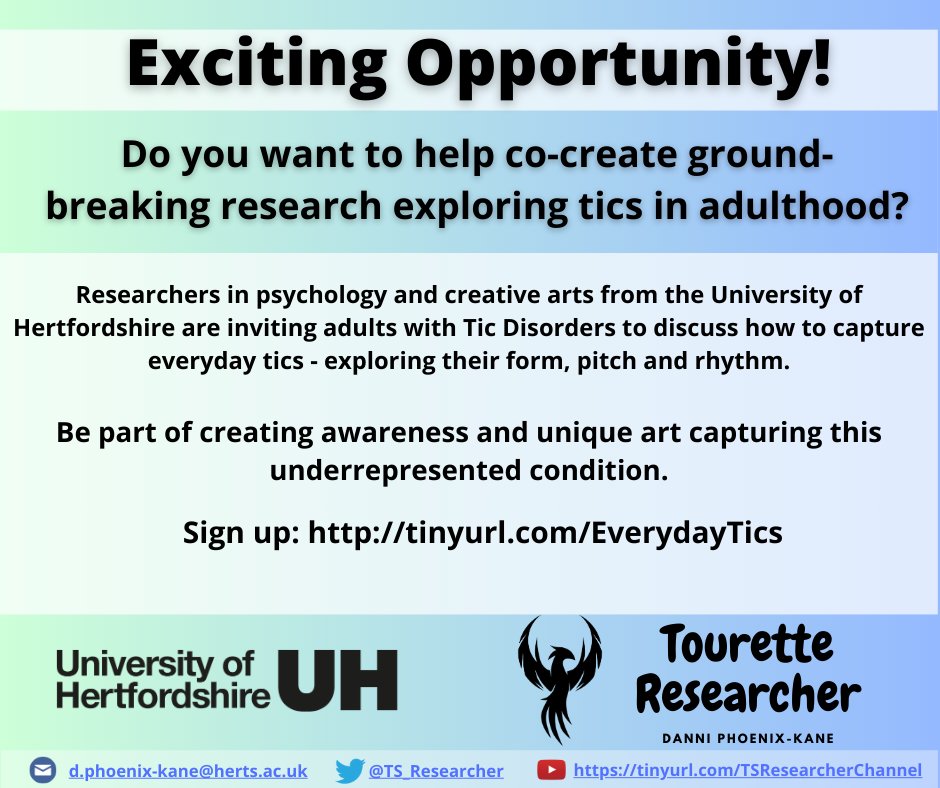
Having dedicated my PhD focus to explore the world of tics in adulthood, I am embarking on a new study! Seeking research co-creators to explore the nature of tics in adults. Join me! #Tourette#Adulthood#tics
Sign up to the workshop here: https://t.co/mA5D0ocIYy