To produce just 25% of aviation fuel from vegetable oil in 2050 at average oil seed yields globally would require at least 1/3 of global cropland and more likely all. Europe recognized problem, so crop-based biofuels do not count toward its sustainable targets. U.S. should too.
Biofuels require working land to produce. Powering planes with biofuels requires ALOT of land. There is a finite amount of land. If we expand demand on working land we risk food insecurity & conversion of remaining ecosystems w/loss of carbon & biodiversity. SAF isn't sustainable
@SizeMichael The superior use of land is to not use it for anything. There is a carbon opportunity cost to using it for farming.
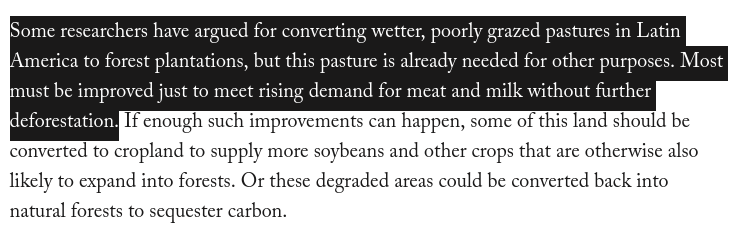
The expansion of soybean and palm oil especially has been a key driver of tropical deforestation. We shouldn't be putting those crops in cars.
WRI's latest report projects a “business as usual” 54% increase in overall wood demand between 2010 and 2050. Producing this wood would require harvesting an area of forest land the size of the continental U.S.
https://t.co/hVUs9AJlBD
To start, this study assumes ag land is available. Nothing to do with real world today with vast ag exp. If you assume VERY HIGH energy crop yields & VERY HIGH CCS capture rates, BECCS can be better than natural regen. for carbon. (Not for biodiersity). Irrelevant now.
@TSearchinger I am struggling to identify why your results differ from the ones of @ciais_philippe
Is it the carbon accounting issue or the assumptions regarding substitution and CCS ?
I admit to being staggered by this thinking. Forests overall are growing. In EU due to many forces inc. CO2 fertilization, shifting agri. to tropics, cars replacing horses. Without wood harvests, forests would grow MORE. Harvests mean they grow LESS. Less means more CO2 in air.
@deisgreat@RobertHoglund@TSearchinger That is the case if you look at that one tree only (or the area covered by that tree). If you consider the whole forest, there is no dept if the carbon stock does not decrease.
So less meat, particularly beef. Less burning wood. More efficient grazing, crops, wood processing & use. Denser housing. But bioenergy/BECCS calls huge; 50% construction with timber increases ind. wood demand 60% over present levels per year.
Bottom line report (40 years): Ag grows 600 Mha (2x size of India); wood harvest 800 Mha (Cont. U.S.); urban exp. 80 Mha; emissions 11 gigatons per year! Lessons: Consume less land-stuff; produce more same land. DON'T add more wood demand & bioenergy. https://t.co/2XYsuToq6E
Incorrect. We call strongly for reducing milk & meat by wealthy. But 60% of 2050 pop will be in countries that eat little milk & meat and it will grow there. We must deal with the real world in food as in energy and driving and everything else.
@TSearchinger You close with this: "The world has a fixed quantity of land; people should be working hard and creatively not to expand, but rather to reduce their footprint on it."
...yet you view increasing meat and milk production as a hard requirement. Seems contradictory!
Haven't see new Mathews stuff but prev. work showed that harv. wood for bioenergy was worse than not harvesting wood. But result obscured in way info presented. This eg below is not relevant. It involves planting new trees. Cost would be UK offshoring yet more food production.
@TSearchinger a couple of years ago, while doing a 🌐 #CircularEconomy report, I was assigned to model what if 🇨🇳 would use + #wood in the 🏗️🏢 sector. When I finished my boss made me redo it 3x My results were that #GHG would ↗️↗️ massively. We had to change the whole narrative
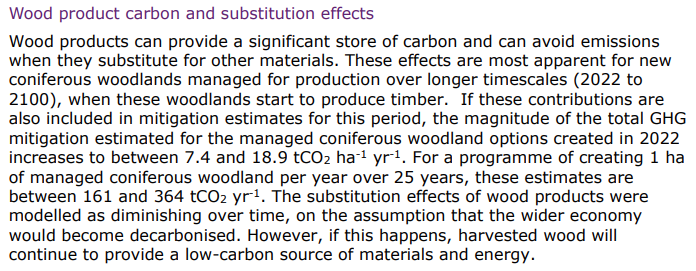
Our analysis finds using wood is likely worse than concrete or steel and much worse when burned to replace fossil fuels. At least for decades. Other analyses that differ treat wood as carbon neutral; they ignore the carbon actually emitted to the air from burned or decomp wood.
One error in C accounting for wood is just comparing wood with alternative. A small car emits less than a large car, but it still emits; it is not negative. Wood is the same. We can compare wood v. alternatives, but we also want to find ways to reduce all emissions.
It is extremely costly to increase C in air for many decades when claiming to reduce emissions. We show if society has even a small preference for early mitigation, our results are the same.
@TSearchinger Many dont realise that it is only a temporary effect, and in a few decades you have the same fossil use and no carbon sink in the forest. So you are in fact propagating a loose-loose scenario.
Recycled paper is significant and factored in explicitly. Recycled wood is small and built into estimates of how long a ton of wood remains before sent to landfill.
Implicitly countries do factor in wood harvests when they report net forest changes, but the effects are hidden because they only report net changes. So people don't often realize countries can emit less C overall if they harvest less wood.
No. Burning diesel is counted by countries. But if you want to reflect that in climate laws or LCAs, you have to count it again. No one disputes that. Wood the same. Each law, treaty or LCA has to account for all emissions they address.
Also, when countries actually use reference levels for wood harvests, they are grandfathering in previous levels of wood harvest - so not counting them.
New report today, using model from recent Nature explains why using more wood in construction likely to increase emissions and requires huge increase in harvesting wood. https://t.co/X84x0sb0jK - Hint, wood is not carbon neutral & only small amount gets into buildings.
New report today, using model from recent Nature explains why using more wood in construction likely to increase emissions and requires huge increase in harvesting wood. https://t.co/X84x0sb0jK - Hint, wood is not carbon neutral & only small amount gets into buildings.