If you all enjoy the concept of getting periodic updates on positive happenings in the world, I'll build on this.
Heroic news stories from the last week:
In China, a man named Tian Ruliang became known online as the “mud-covered hero” after reportedly helping evacuate around 60 villagers during catastrophic flash floods moments before part of a mountain collapsed. Witnesses said he repeatedly ran back into danger to warn more residents. - @timesofindia
In Queens, off-duty FDNY firefighter Travis Langan saw several cars submerged during sudden flash flooding on the Jackie Robinson Parkway. After learning a woman was trapped inside one vehicle and nearly drowning, he climbed onto the roof, punched through the sunroof with his fists and a metal cup, and pulled her to safety. The woman later said her face was already pressed against the glass when he reached her - @nypost
In Hanoi, 20-year-old student Nguyễn Lê Tú reportedly rushed into a burning multi-story building and rescued seven trapped people before firefighters fully arrived. Videos showed him repeatedly entering smoke-filled hallways while residents screamed from windows above.
In Colorado prairie-fire country earlier this year, farmers, ranchers, and oil-field workers used their own tractors, bulldozers, and heavy equipment to create firebreaks and stop fast-moving wildfire walls threatening homes and livestock. Many had zero firefighting training but drove directly toward flames in 70 mph winds to help neighbors. - @ColoradoSun
During recent flooding events across parts of the U.S., there have been repeated reports of civilians:
-forming human chains in floodwater
-rescuing elderly neighbors by kayak
-carrying stranded pets through waist-high water
-using pickup trucks and fishing boats to evacuate strangers
-Many of these incidents never become national stories because they happen one neighborhood at a time. - @MirageNewsCom
the world is still full of amazing humans
While everyone argues about data centers and water, California almonds quietly use up to 80x more, AND the whole industry only survives because of trucked-in "livestock"...
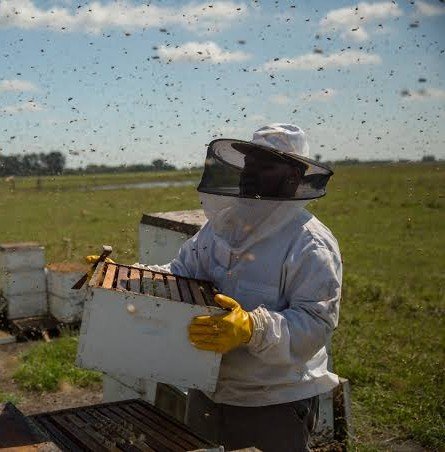
Every February, beekeepers transport nearly every commercial honeybee colony in the United States (around 2.8 million hives) to California to pollinate almonds.
It's the largest "managed-pollination" event on the planet. Almonds cover 1.4 million acres and need bees to pollinate so they set nuts.
So why do we need to truck them in? Well, almonds are grown in huge monoculture orchards, meaning the native bee species are all but eradicated...there's nothing for them to eat most of the year.
To fix the problem WE created, we ship in bees from across the country. I interviewed the creator of the 2019 documentary The Pollinators, which followed this migration and brought a lot of this story into public view.
First off, honeybees aren't native to North America. They were brought from Europe in the 1600s. The "bee crisis" you read about, with national colony losses around 55% last year and some commercial keepers losing 60 to 70% in a single season, is happening to a managed, introduced species.
It's a livestock collapse driven by long-haul transport, pesticide exposure at bloom, hives packed together spreading mites and viruses, and a monoculture diet.
Meanwhile, North America has roughly 4,000 native bee species. Most are solitary, don't make honey, don't sting, and quietly pollinate everything from squash to blueberries.
Research out of UC Davis and UC Berkeley has been direct about this: when blue orchard bees, bumble bees, and other natives forage alongside honeybees in almond orchards, fruit set goes UP, not down.
The presence of wild bees changes how honeybees move through the trees and makes the honeybees themselves more effective pollinators.
So the fix isn't more honeybee hives. It's hedgerows, wildflower strips, bare ground for ground-nesting bees, and uncut field edges, aka habitat for the natives who were doing this work long before we started trucking in livestock.
Honeybees are livestock. Native bees are the wildlife, and we should be planting to include them in our agriculture.
Just LAST WEEK, when Kyle Busch won his 69th NASCAR Truck Series race, he was asked why these wins “never get old”
Kyle’s response?
“Because you never know when the last one is.”
And today, Kyle passed away at 41 🙏🏻