Of course that’s what you’re wearing. You’re in your first year of post-golf bro style discovery. You used to call Lululemon “gay” with the old heads in the clubhouse, until your girl bought you ABC pants for your birthday and you haven’t shut up about how “comfy they are” since. You say “technical” even though you mean tapered joggers from Vuori. Those came from mom at Christmas.
You think you’ve evolved, but give it another month — you’ll be denouncing logos and going full Reigning Champ minimalist after they hit you with targeted ads for their “off the course” collection, before moving on to Aime Leon Dore, where you’ll use words like “palette” and profess “skinny polyester pants are for nerds”
By this time next year, you’ll be dressing like a SoHo ceramics teacher and swearing you’ve “always secretly had a passion for artisanal menswear modeled after time-tested silhouettes born from the days when men used to do real work.”
I could make a cheap joke about how he probably wrote this with AI, but there’s a bigger point to be made.
There’s a point in the book version of Jurassic Park where the company counsel, Gennaro (who is not dead and has not been eaten off of a restroom toilet seat by a T-Rex as in the film), essentially tells the group to pack it in and get ready to evacuate, because the Costa Rican military (which exists in the book but not so much in real life) is going to firebomb the island and solve the problem.
Grant corners him and physically grabs him, pointing out that there will be no way to know for sure if they’ve gotten everything if they don’t do a complete survey of the island’s dinosaur breeding sites, and demanding that he face up to the situation he and his megalomaniacal bosses helped create and do his part.
That’s what this looks like, only no one is playing Grant and there isn’t even a fig leaf of a promise that the danger will be contained and the situation rationalized.
If you think you’ve created a monster, that may unleash a bio weapon or similar (as alluded to in the letter and has actually been discussed by various AI safety luminaries), and there is no way to fix it within your company, you do -not- get to go and pursue a poetry degree. (So that what, anyway? You can write something your program can’t think of?)
You should be testifying before every government body that will hear your information, giving interviews, writing like mad, shouting from the rooftops if you have to - and when somebody listens you should at least have something prepared that can tell them about what’s going on and what is and isn’t possible to deal with it.
And you should be prepared to face legal consequences yourself, or else offer -extra- help in exchange for immunity. If need be, and if it is that bad, you should be prepared to spend the rest of your life, or however long it takes, fixing your and your colleagues’ mistake.
And if it isn’t that bad, don’t fire off a parting shot like this - it’s pulling the fire alarm on the way out the door.
One or the other - but not this.
-Hired Klint Kubiak & Offensive staff
-Kept Chenna
-Traded problem kids Geno Smith and DK Metcalf
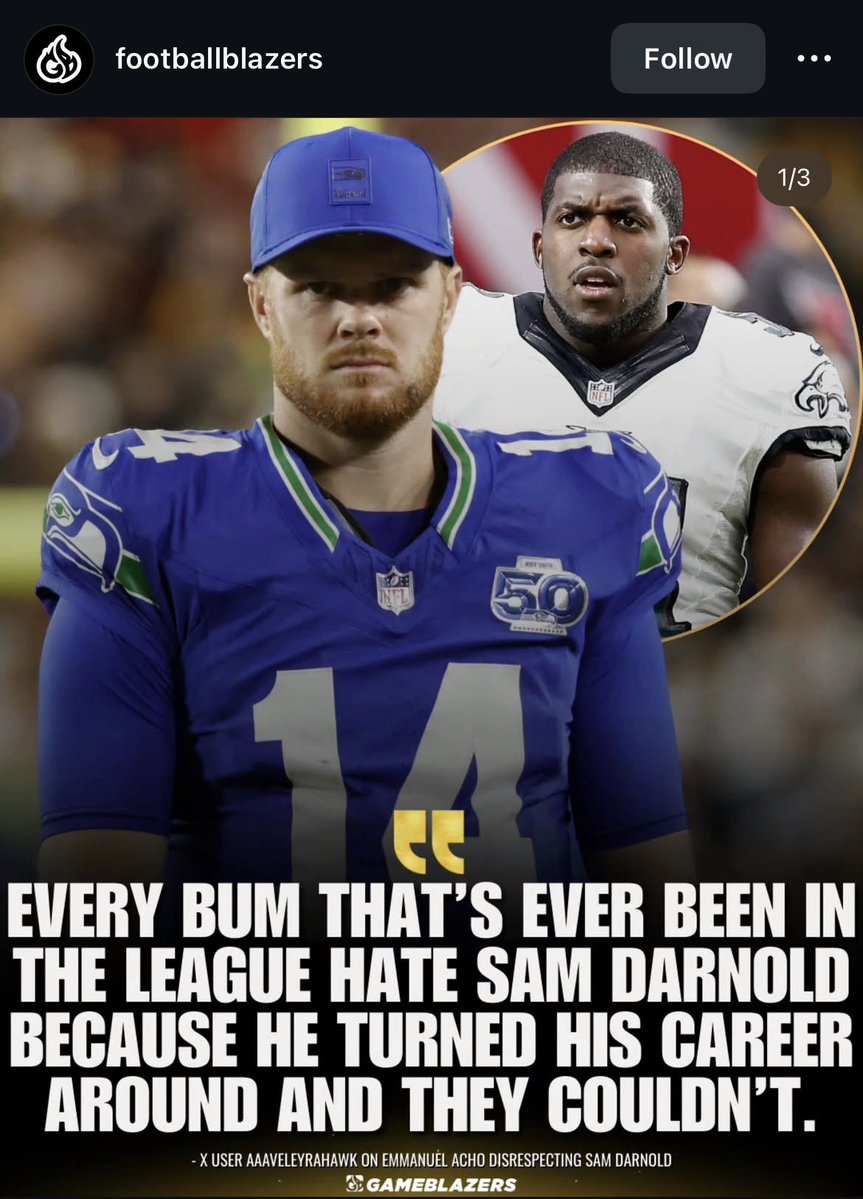
-Signed Sam Darnold to a bargain contract
-Avoided overspending on OL in FA
-Signed DLaw and Kupp as culture-setters
-Extended Cross, Lucas, EJ
-HR draft
-$71m 2026 cap
Everyone wants to get rich quickly. Here’s my guide to getting rich slowly.
Boring, I know. But hopefully helpful to some people. Nobody taught me this, I had to learn it myself. Which is dumb. We should teach this stuff
The idea here is that you:
1. Build a safety net
2. Take advantage of all free money and tax-advantaged vehicles
3. Make sure your future is secure
4. Then, and only then, would I invest in individual stocks
Step 0: You need to be trying to maximize your income. This is WAY higher ROI on your time than investing in individual stocks. That comes later (step 11 in this plan. The last step). If you want money left over for individual equities, you’ve got a lot of steps to get through
Step 1. No fucking margin. No options:
If you are using them, stop it.
Step 2. Spend less than you make:
Just like you will always be fat if you eat more calories than you burn, you will ALWAYS BE POOR if you spend more than you make. Do you know where your money goes? I doubt it. Build a damn budget.
Step 3. Create an emergency fund. Depending on the security of your job, 3 months to 1 year is appropriate. Put it in a high yield savings account or money market account. This is how you don’t blow up
Step 4a: Save 20% of your paycheck for retirement:
This is a gift to future you. It’s non-negotiable. Just fucking do it. Plus, your 401k probably has an employer match. That’s free money. Double check your fees don’t suck, the 401k might not be the right vehicle, but you still need to save 20%.
Step 4B. Pay your high interest debt
If you have double digit debt, literally everything you do should be laser-focused on wiping this out. In this scenario, you get the employee retirement match and switch to paying this down. Vaporize high interest debt is your life goal until it’s gone
Step 5. If you have access to an HSA, max it out:
The HSA is a triple tax advantaged vehicle. Tax-deductible contributions, tax-deferred growth, tax free withdrawals
Step 6: Max out a Roth IRA. If you make too much, do a backdoor Roth:
This is another excellent tax-advantaged vehicle. Don’t be stupid. Use it
Step 7: if your company offers and ESPP use it.
This is also free money. Check the details but it should be an automatic 15% at least every 6 months.
Step 8: Big purchases in the next 3 years?
This should not be in the market. Houses, cars, etc. Use a HYSA/money market.
Step 9: Have kids? 529 time
While personal preference, I want to help my kids with school. That also comes before buying individual stocks. Sorry
Step 10: Max 401k.
I wouldn’t buy individual stocks before I had maxed this. Sorry again
Step 11: Congrats, you made it. Buy some stocks.
Kyle Hamilton has Cook in man and subtly pushes him out of bounds so he can't legally come back and be the first to touch the ball
Then he zones off knowing he doesn't have to worry about Cook and pick off the 2-point pass
“For every buyer there’s a seller, and one must ask: why would the other fellow be willing to part with a position that you think is attractive? If you can’t answer that question, you probably shouldn’t be buying.”
— Howard Marks, Oaktree Capital
64 vs. 33. A lifetime of hard work vs. a silver spoon. The results speak for themselves.
The weight of the job is too heavy for “Mamscrawny.” The only thing he can lift is your taxes.
Yes my two sons are hopelessly addicted IPad kids, but we only allow all-22 and NFL plus.
You’re kid is disassociating to cocomelon and mine is diagnosing a hidden quarters coverage, they’re not the same.
Don’t ever let me catch you investing in a 3rd-layer SPV.
I don’t care how hot the startup is, or how great the returns in the underlying company might be. It’s a con, you’re the mark, and you’re going to bleed out on fees.
If you’re not familiar with a 3rd-layer SPV, it’s an SPV (special purpose vehicle) that invests in another SPV, which invests in yet another SPV, which finally—at the tail end of the train here—invests in an actual company.
Picture multiple extension cords daisy-chained together to reach an electrical outlet. Only, in this case, each cord charges fees. And the fees really start to add up.
Each SPV charges annual asset-management fees (1-2%), which are usually applied in full up front. When you apply five years of these fees to all three layers of SPVs, it means that every $100k you invest only ends up providing $70-85k to the company itself. The rest is given to the three layers of SPV sponsors to cover their expenses (you can imagine what their number-one expense is, I’m sure).
On top of that, upon exit of the investment, each SPV also gets to levy their own carry (if you’re not familiar with carry, think of it as a performance bonus). Carry for these SPVs is usually 10-25%, depending on how “close” the SPV is to the actual investment.
In total, what this means is, even if the underlying company itself is a home run deal, the combination of AUM fees “leaking” out capital that never ends up in the company, combined with carry extracting three layers of profit on the exit, means a huge amount of the potential gain from the original company never ends up in your hands.
I built a quick model to show you how this works. Let’s assume a $100k investment in the third-layer SPV, with an assumed 5x MOIC (return multiple) on the underlying company.
If you had invested $100k into the company itself, your $100k would turn into $500k. But, remember, $100k didn’t actually end up with the company—only $81k here did. Which means, right off the bat, your potential $500k exit is already down 18%, to $406k.
Before that $406k makes its way back to you, though, there is not one, not two, but three(!) layers of carry. This carry ends up extracting another 24% of the return, leaving you with $285k—just 57% of what you otherwise would have received from the company itself. Three levels of fees on the way in, plus three levels of fees on the way out, have cannibalized more than two fifths of what you could have made.
I get that allocation in hot startups is hard to come by, even if you have the checkbook to play in this league (which, chances are these days, you don’t, unless you’re able to quickly write a nine-figure check). SPVs can, under the right circumstances, be a great way to get access to deals people like us wouldn’t otherwise have access to, whether it’s due to being “outside the circle” or not having the capital to do this on our own.
But don’t let FOMO turn you into the mark on these deals. Three layers of SPVs is two too many, no matter how great the company is or how exciting the investment would otherwise be.
Would love Kalshi for my workplace:
- NO on Kevin VP promo before 2026
- NO on headcount request from Marketing org (will get told to use AI)
- 2+ mentions of “disagree and commit” from Laurie this week
- NO to Erin responding to my slack message before Wednesday EOD