If you are lucky enough to be at #Cosyne24#Cosyne2024, we'll have a poster on the science of these results tonight.
Plus, we'll have a bunch of bands, so you can demo the tech yourself! 🤘🤓🤘
Poster info:
1-039 Scaling neural network training enables neuromotor interface decoders to generalize to new users
1/7
For the past decade, our team at Meta Reality Labs (previously CTRL-labs) has been dedicated to developing a neuromotor interface.
Our goal is to address the Human Computer Interaction challenge of providing effortless, intuitive, and efficient input to computers.
Very excited to present Multiple Physics Pretraining!
MPP is a group of techniques for pretraining on a diverse set of time-dependent physics to learn models that can be fine-tuned for multiple problems.
Blog: https://t.co/fJw9xyCOhM
Paper: https://t.co/LF68K5D8rO
Announcing:
*The Polymathic AI Initiative*
We are researching a new class of foundation models for scientific *data*, developing models that share scientific concepts across disciplines.
Site: https://t.co/C2Qsi59HzI
News: https://t.co/JomPjdIJAG
Thread: 👇
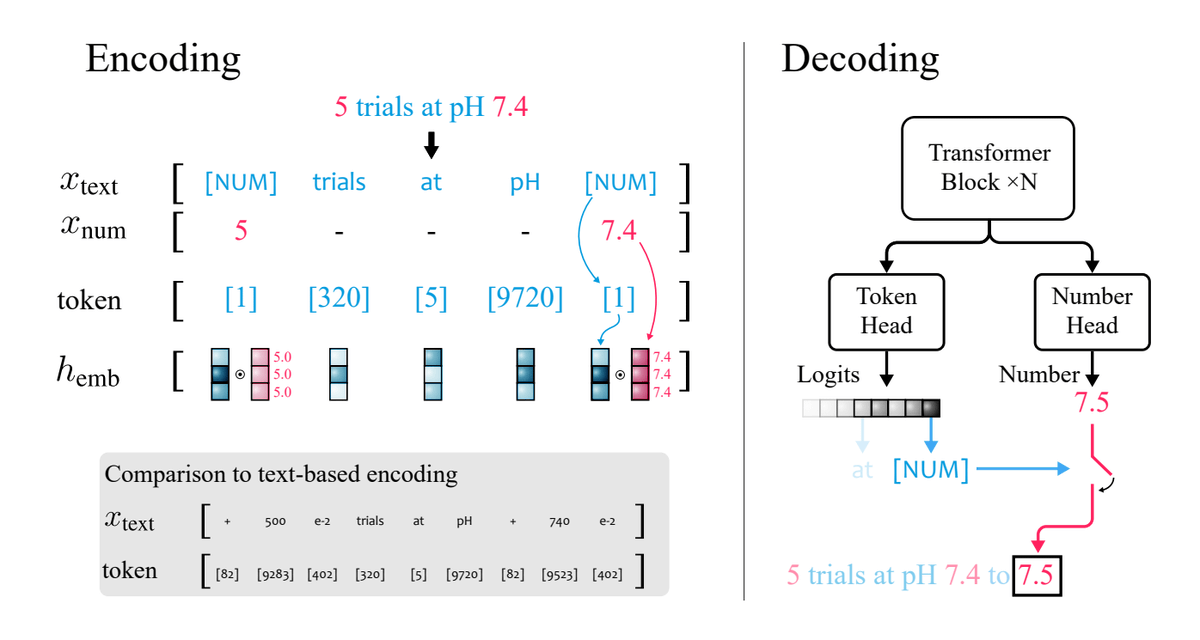
1/ Did you know LLMs like ChatGPT struggle with number manipulation and data analysis? They make up answers and fail to generalize.
Today I am excited to share xVal, a continuous and efficient number encoding scheme with better generalization performance.
https://t.co/rhrxmrxnG6
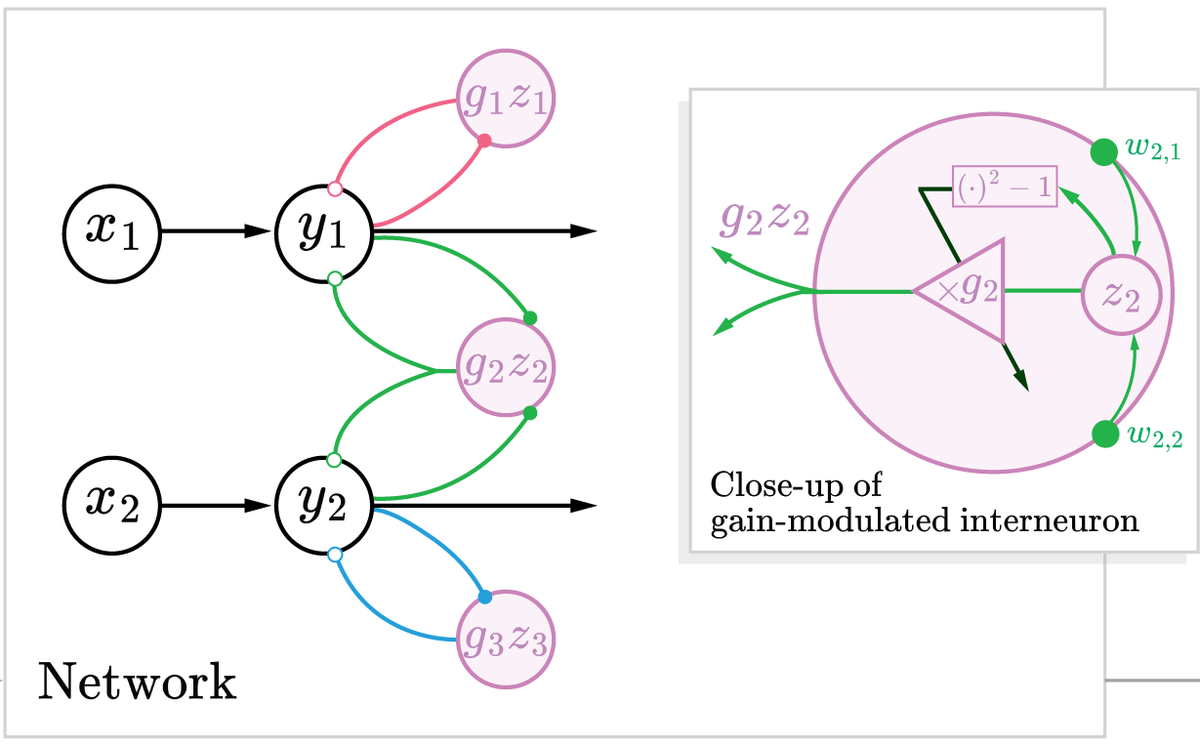
Neural whitening via gain control in an overcomplete frame with a possible application to the olfactory bulb. A normative bioplausible network derived in a fantastic collaboration between the Simoncelli and Chklovskii labs led by @lyndoryndo and @dlipshutz https://t.co/JrZucQeqIN
@GaryMarcus So here's an AI that accurately describes mammals and the sailfish (Wiki: "considered by many scientists the fastest fish in the ocean"), but confuses the animal with a mammal. It's about as coherent as my 3-year-old, yes. Are you implying that that makes it a failure?!
@neurograce To me a figure like that is similar to having a sentence with 17 subclauses without any clear hierarchy -- I doubt any human could parse that without breaking it up into more manageable pieces. Ideally the authors would have broken things down for the readers.
Physics of Neural Systems focus session at the APS March Meeting! Please submit your contribution now https://t.co/e7MQFYT62b [https://t.co/5qHOb5wvn3], sorting categories 04.01.31, 02.01.53, 03.01.39 (image credit: DALL-E 2) (1/4)
First day as an assistant professor at NYU🔥Our lab is now up and running fully & jointly at NYU and Flatiron! Our lab's primary research interests lie at the intersection between theoretical neuroscience and machine learning. (1/)
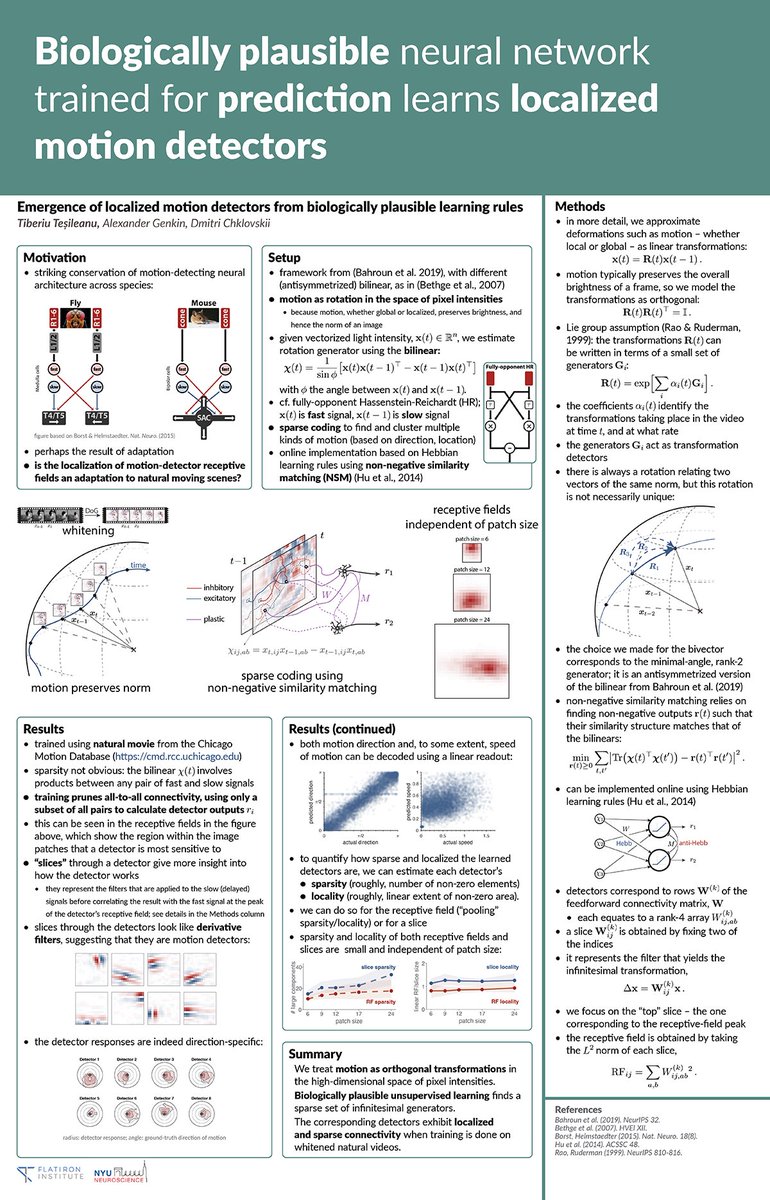
Come see our Cosyne poster (1-041) on learning localized motion detectors using biologically plausible neural circuits! With Alexander Genkin and @chklovskii. @CosyneMeeting
A postdoc position is available in my group. Background in dynamical systems and data-driven control a plus. If interested, please send me your CV or see me at #cosyne2022 Please retweet
@KennethHayworth It can be a problem of access, not understanding. Take a microchip with a copy of the human genome but slow access 1bit/second. It has a lifetime of 10 years, and the memory is volatile so you can't just crack the case open and read it. How would you copy what's on that chip?