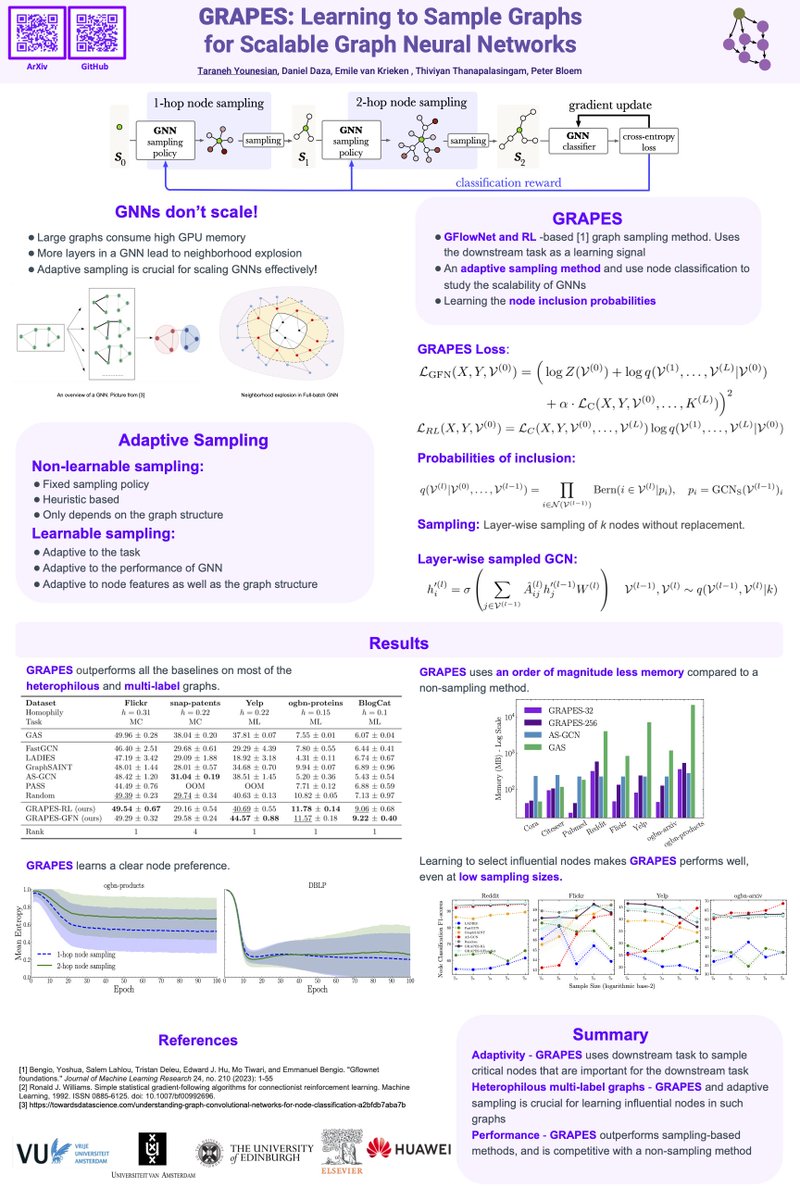
If you want to reduce the size of your graph while still maintaining an accurate GNN, which nodes should you select? Which nodes are influential in a graph?
Check out our TMLR paper, GRAPES, to get your answer:
If you want to reduce the size of your graph while still maintaining an accurate GNN, which nodes should you select? Which nodes are influential in a graph?
Check out our TMLR paper, GRAPES, to get your answer:
If you want to reduce the size of your graph while still maintaining an accurate GNN, which nodes should you select? Which nodes are influential in a graph?
Check out our TMLR paper, GRAPES, to get your answer:
🍇GRAPES is a learnable and adaptive graph sampling method. It utilizes GFlowNets and reinforcement learning to learn which nodes to sample adaptively based on the task.
We show that adaptive sampling is crucial in heterophilous and multi-label graphs.
Struggling with scaling RGCNs on large knowledge graphs? Check out "ReWise: A Relation-Wise Sampling Framework" by @TYounesian, @pbloemesquire, and Stefan Schlobach from @VUamsterdam now live at #SemanticsConf! Discover this game-changing approach for efficient RGCN training!
This week, I'm presenting my work "ReWise" at @SemanticsConf.
We introduce a graph sampling framework to scale Relational Graph Convolutional Networks to large multimodal knowledge graphs.
Check out our paper at: https://t.co/ZkfNXTf3Ng
This year, the fabulous @jmtomczak gave the closing remarks for our second #GenAI summer school (https://t.co/YPpyaiQrpT) and revealed that we are brining GeMSS to home of the fantastic @pamattei in Nice in 2025!
#GeMSS
Attending #NeurIPS2023 this week?
Interested in neurosymbolic reasoning or scaling GNNs to large graphs?
Then, you might want to drop by our posters to learn about ⚡️ A-NESI and 🍇 GRAPES (@glfrontiers workshop)
1/4
If you’re going to #NeurIPS2023, check out our poster GRAPES in GLFrontiers workshop (December 15th)!
🍇 GRAPES is a GFlowNet-based adaptive graph sampling method to scale GNNs to large graphs.
Paper: https://t.co/S7vQOXT5eJ
I'm at #NeurIPS2023 for the first time! With my collaborators, we'll be presenting
🕵️CQD-A: A data efficient method for answering knowledge graph queries https://t.co/FudDaZ2hAP
🍇 GRAPES: Scaling GNN training with GFlowNets
https://t.co/qnwHTqxKfv
Feel free to reach out!
SHAP, LIME, PFI, ... you can interpret ML models with many different methods.
It's all fun and games until two methods disagree.
What if LIME says X1 has a positive contribution, SHAP says negative?
A thread about the disagreement problem, and how to approach it:
Wanna work at the most exciting boundary in modern AI (combine machine learning and symbolic reasoning), and use it to improve drug safety for kidney patients, in a leading AI team, jointly with medical researchers? Apply for our PhD vacancy before 1 Sep! https://t.co/xTT5GTmOja
*Present Failures*
❌ "It doesn't work."
✅ "Here is HOW it fails. I feed X but somehow did not get Y. I believe the core issues lie in steps Z and W. I have ruled out W as the cause. Next, I will design experiments to isolate the step Z."
I want to talk about burnout. A brief 🧵...
I was well aware I was burnt out in the fall, but it's hard to fully appreciate the impact of burnout in the moment.
After 2 weeks of vacation and a month of aggressively blocking daily focus time, the impact has become more clear: