It's been great to be part of this collaboration!
In my opinion a neat result: graph embeddings trained for 1-hop link prediction generalize well to complex queries, with a tiny increase in parameters and the power of t-norms and t-conorms.
Excited to announce that we will be presenting our paper "Adapting Neural Link Predictors for Data-Efficient Complex Query Answering" at @NeurIPSConf
Done with the most amazing researchers - @PMinervini@danieldazac@michaelcochez@IAugenstein
paper: https://t.co/iWkruqiLEU
Congrats to all the UnRavL team for a Best Paper Honorable Mention at the 2024 Learning on Graphs Conference!
UnRavL expands the types of queries that we can answer over incomplete knowledge graphs🧙
Read the paper here: https://t.co/GZmLXj8JFZ
🏆 Best Paper Award & Honorable Mention 🏆
Congratulations to our outstanding authors for their exceptional contributions to LoG 2024! 🎉
📜 Your work inspires the entire graph and geometric ML community!
🚀 Don't miss Tamara Cucumides’ talk at LOG 2024 at 19h10 CET about "UnRavL: A Neuro-Symbolic Framework for Answering Graph Pattern Queries in Knowledge Graphs". https://t.co/Ts8H3XXx5K @LogConference
This week, I'm presenting my work "ReWise" at @SemanticsConf.
We introduce a graph sampling framework to scale Relational Graph Convolutional Networks to large multimodal knowledge graphs.
Check out our paper at: https://t.co/ZkfNXTf3Ng
Machine learning and database theory combine well: A Neuro-Symbolic Framework for Answering Graph Pattern Queries in Knowledge Graphs
Read more: https://t.co/b7KmSqsjnq #nesy#graphlearning#knowledgegraph
What excites me about Sora: imagining what we could achieve if, instead of a bunch of layers that compute attention over everything, trained with astronomical amounts of data and compute; these models had stronger biases for representing objects and relations compositionally.
With Sora, the evidence is piling up quickly. Now we're operating at scale. And the evidence will keep piling up with new models going forward -- even faster.
And the evidence so far is resounding -- you really are looking at latent-space collages and interpolations. The inner physics model doesn't generalize to novel situations at all. It's not just that you can't use it as a reliable replacement for a fluid dynamics simulator to design a new aircraft or as a gravity simulator to design a new marble run course...
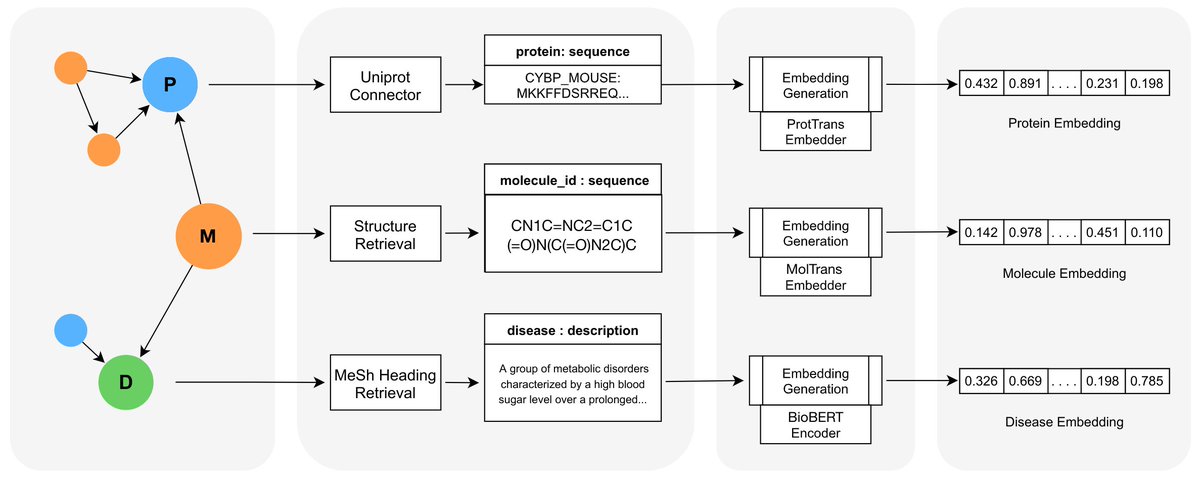
Our work on embedding multimodal biomedical knowledge graphs is now published at the Journal of Biomedical Semantics @BioMedCentral!
Read the paper here: https://t.co/IifHKrgFno
New preprint! We introduce BioBLP, a method for learning embeddings on multimodal knowledge graphs.
Paper: https://t.co/92TAkpOTRP
Code: https://t.co/deK9SlcO2L
w/ @DimitrisAlivas@pmitra01@thompijn@michaelcochez@pgroth
1/4
If you’re going to #NeurIPS2023, check out our poster GRAPES in GLFrontiers workshop (December 15th)!
🍇 GRAPES is a GFlowNet-based adaptive graph sampling method to scale GNNs to large graphs.
Paper: https://t.co/S7vQOXT5eJ
I'm at #NeurIPS2023 for the first time! With my collaborators, we'll be presenting
🕵️CQD-A: A data efficient method for answering knowledge graph queries https://t.co/FudDaZ2hAP
🍇 GRAPES: Scaling GNN training with GFlowNets
https://t.co/qnwHTqxKfv
Feel free to reach out!
📢 Exciting news! We're presenting our paper "On the Trade-off between Over-smoothing and Over-squashing in Deep Graph Neural Networks" at @cikm2023 as a long paper (oral). Check out the preprint: https://t.co/XCLrN4Neos. The code is here: https://t.co/RqJVvxgUgc. 📚 #GNN
In knowledge graphs, the triple representation
(subject, predicate, object)
tells only a part of the story. Join us at #CIKM2023 to learn about more expressive paradigms and the interesting prediction problems that we can solve with them!
Thrilled to announce that we will be giving a tutorial with @danieldazac@michaelcochez and Mojtaba on "Reasoning beyond Triples: Recent Advances in Knowledge Graph Embeddings", at #cikm2023.
Slides will be available on the tutorial website https://t.co/hIrG0dwFpD. Stay tuned!