Hi everyone! We have some exciting news to share!
Today, we released a brand new trailer and confirmed that Minds Beneath Us will be launching on Steam on July 31st🎉! Add the game to your wishlist now!
👉 Add to your Steam Now
https://t.co/cHM7hLsCgv
『gen ATLAS』発表に合わせてキーアートを公式サイトに掲載しています
https://t.co/XWSq5JaudO
また、ウィッシュリスト登録もはじまりました
・Epic Games Store
https://t.co/OxmZTUoL1k
・PlayStation Store
https://t.co/wDvgsR2tYY
・Microsoft Store
https://t.co/HLt80gkSQe
#genATLAS
#genDESIGN
#SummerGameFest
#SGF2026
We are pleased to announce that 'PROJECT: ROBOT' is officially titled 'gen ATLAS', the latest project from genDESIGN.
A new trailer is also now out - we hope you enjoy watching it.
https://t.co/0S6EQRFDji
#genATLAS#genDESIGN#SummerGameFest#SGF2026
#PitchYaGame Marblearium is a calm marble experience focused on flow rather than challenge. Accompanied by laid-back LoFi beats you roll through a looping world of interconnected tracks, collecting unique marbles and discovering new paths, while the world slowly grows stranger.
2XKO release started off slow, but they really are cooking now. The character designs and release pace is so good.
Really impressed with everything the team is putting out.
New episode of Wading Through AI is up! This time, Demetri and I discuss the concerns people have about relying on AI for their work:
https://t.co/DKVexIIdMd
The first way people usually learn code compression is by pulling common things out into helper functions, but in my view the complexity of adding a new entry point is often overlooked, and things quickly turn into a mess.
It’s a useful exercise to try compressing code without helper functions, and instead merging similar work by using loops, tables, and reordering. In my experience this leads to dramatically simpler architecture, and it’s a lot easier to keep the whole picture in your head.
"Immediate mode" does not necessarily imply that you rebuild everything every frame, no. It's a description of the API shape.
First of all, it is worth suggesting that organizing UI code around "only update what changed" is often suboptimal in cases where many things change, because the entire architecture is built *specifically not* to batch work. Thus, when you have a situation where many things (perhaps the entire frame) did need to update, the full update path will be massively worse than if you had just written the "update everything" path. It will simply do hundreds or thousands of incremental updates, rather than a single batch update.
Second of all, immediate mode APIs do not prohibit caching at any layer. You can cache parts of the rendered frame, or UI trees, or any artifact required to produce a frame. The only adjustment is that you need to mask off the codepaths which would've re-done that work, and then just instead use the cached artifacts. Then, when you notice those artifacts are dirty (e.g. a hash of the parameters, etc.), only then do you run the "update this" immediate mode path.
Today I looked at what cpp2better does to the il2cpp code of a Unity game I'm currently looking at: It makes roughly 4 million small changes to the generated C++, for a net effect of multiple milliseconds saved. Never ceases to amaze me what it can do for the right game.
I am leaning more and more in this direction - using c++ local functions to ensure code reading locality. Never fully satisfied with the result, but always thinking about this topic when writing code!
[1/2] If you enjoyed the entity component system (ECS) history I laid out in The Big OOPs, I have some good news! Marc "Mahk" LeBlanc and I have redone the original (unrecorded) interview we did as part of the research for the talk.
Character Controller update. It's probably more complicated than it needs to be I wanted a bunch of options to show the differences in physics updates. Anyways it is up on git hub.
https://t.co/oVNJ4dLQ4D
#GameDev#IndieDev#Unity3D
been trying something new
I have all my layouts as unit tests, but I also have them as real displays using raylib and writing out. I take all those images and save them to disk as "goldens" when I believe they are correct. Now i can
1. watch them all for visual sanity
2. save new ones for new goldens / additional goldens
3. use CI to test that i haven't ruined the real display
in 2000 a programmer discovered you can implement coroutines in C using the same switch trick as Duff's Device
it's called Tatham's Coroutine. it still compiles and is technically valid C
he used it in production inside PuTTY (the SSH client used by millions)
Simon Tatham's own words: "As far as I know, this is the worst piece of C hackery ever seen in serious production code."
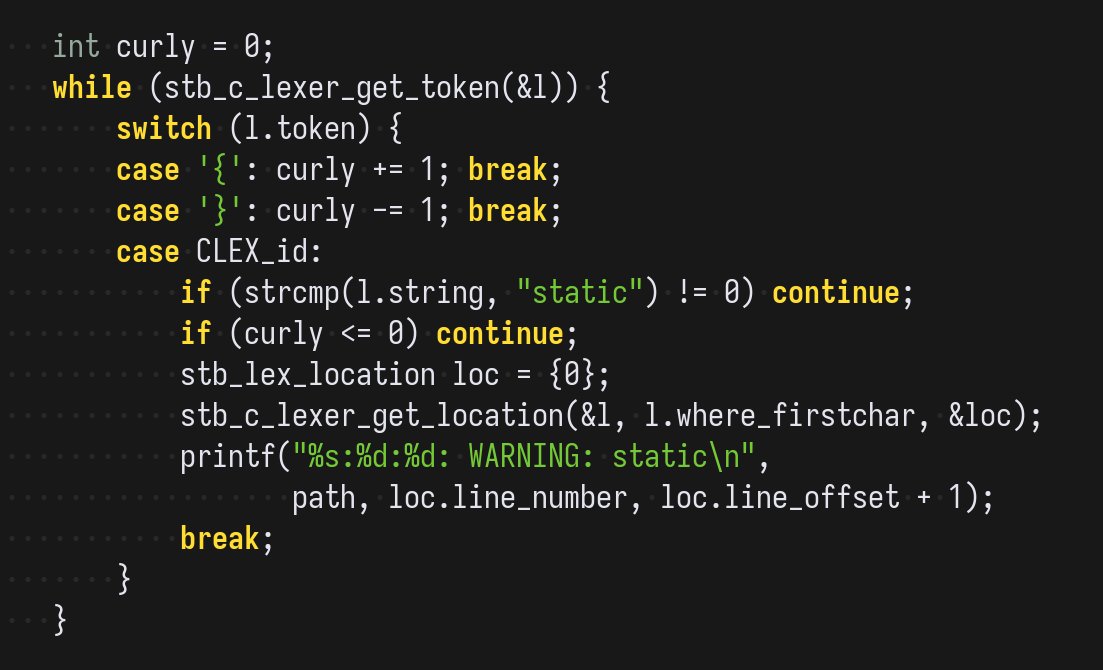
Sloppy way to find all the static local variables in C code:
1. Iterate all the C tokens,
2. Maintain the counter of the nested curly braces,
3. If you see the `static` keyword within at least one layer of curlies, you found it!