LLM Knowledge Bases
Something I'm finding very useful recently: using LLMs to build personal knowledge bases for various topics of research interest. In this way, a large fraction of my recent token throughput is going less into manipulating code, and more into manipulating knowledge (stored as markdown and images). The latest LLMs are quite good at it. So:
Data ingest:
I index source documents (articles, papers, repos, datasets, images, etc.) into a raw/ directory, then I use an LLM to incrementally "compile" a wiki, which is just a collection of .md files in a directory structure. The wiki includes summaries of all the data in raw/, backlinks, and then it categorizes data into concepts, writes articles for them, and links them all. To convert web articles into .md files I like to use the Obsidian Web Clipper extension, and then I also use a hotkey to download all the related images to local so that my LLM can easily reference them.
IDE:
I use Obsidian as the IDE "frontend" where I can view the raw data, the the compiled wiki, and the derived visualizations. Important to note that the LLM writes and maintains all of the data of the wiki, I rarely touch it directly. I've played with a few Obsidian plugins to render and view data in other ways (e.g. Marp for slides).
Q&A:
Where things get interesting is that once your wiki is big enough (e.g. mine on some recent research is ~100 articles and ~400K words), you can ask your LLM agent all kinds of complex questions against the wiki, and it will go off, research the answers, etc. I thought I had to reach for fancy RAG, but the LLM has been pretty good about auto-maintaining index files and brief summaries of all the documents and it reads all the important related data fairly easily at this ~small scale.
Output:
Instead of getting answers in text/terminal, I like to have it render markdown files for me, or slide shows (Marp format), or matplotlib images, all of which I then view again in Obsidian. You can imagine many other visual output formats depending on the query. Often, I end up "filing" the outputs back into the wiki to enhance it for further queries. So my own explorations and queries always "add up" in the knowledge base.
Linting:
I've run some LLM "health checks" over the wiki to e.g. find inconsistent data, impute missing data (with web searchers), find interesting connections for new article candidates, etc., to incrementally clean up the wiki and enhance its overall data integrity. The LLMs are quite good at suggesting further questions to ask and look into.
Extra tools:
I find myself developing additional tools to process the data, e.g. I vibe coded a small and naive search engine over the wiki, which I both use directly (in a web ui), but more often I want to hand it off to an LLM via CLI as a tool for larger queries.
Further explorations:
As the repo grows, the natural desire is to also think about synthetic data generation + finetuning to have your LLM "know" the data in its weights instead of just context windows.
TLDR: raw data from a given number of sources is collected, then compiled by an LLM into a .md wiki, then operated on by various CLIs by the LLM to do Q&A and to incrementally enhance the wiki, and all of it viewable in Obsidian. You rarely ever write or edit the wiki manually, it's the domain of the LLM. I think there is room here for an incredible new product instead of a hacky collection of scripts.
- Drafted a blog post
- Used an LLM to meticulously improve the argument over 4 hours.
- Wow, feeling great, it’s so convincing!
- Fun idea let’s ask it to argue the opposite.
- LLM demolishes the entire argument and convinces me that the opposite is in fact true.
- lol
The LLMs may elicit an opinion when asked but are extremely competent in arguing almost any direction. This is actually super useful as a tool for forming your own opinions, just make sure to ask different directions and be careful with the sycophancy.
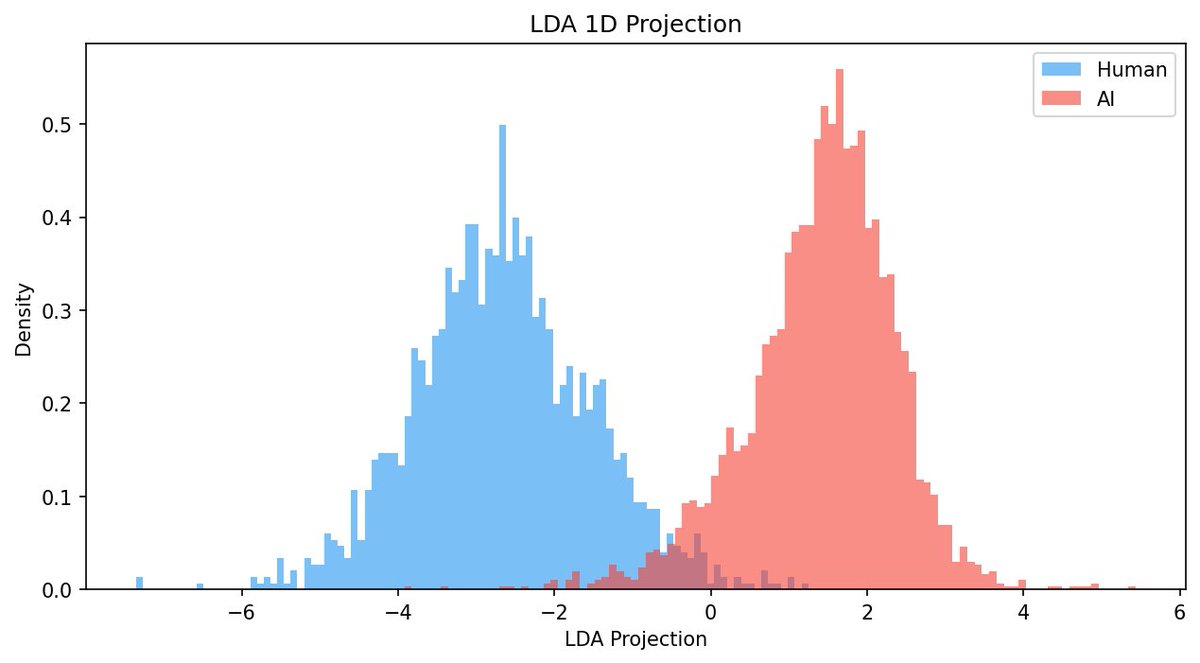
In an effort to try stop seeing so much slop I've been trying to train my own AI detection model.
Found something incredibly interesting.
for the most part LLM generated text and human written text are linearly separable.
AutoResearch might be the most important open-source release of 2026
Because it doesn't just complete tasks, it evaluates its own results and iterates until they're better
But 99% of people think it's only used for machine learning. They're wrong.
Full breakdown here:
The impact @karpathy has on the AI community is fascinating. He’s almost like an operating system: he surfaces important problems, directs collective attention, and makes the excitement contagious enough that people shift what they work on. All through sheer curiosity and range.
Andrej Karpathy says when AI agents fail, it's usually a skill issue, not a capability issue
You didn't write good enough instructions, didn't set up the right memory tool, or didn't parallelize correctly
"the real shift is working in macro actions"
One does research, one writes code, one plans, all running 20-minute tasks simultaneously
I only started doing AI research 9 months ago, despite 6 years as data scientist/ML engineer.
It's scary to start.
Seeing @karpathy’s autoresearch made it accessible.
I built autoresearch-gen that lets you run autoresearch with one command + generate dashboard, it works locally on a MacBook too!
It scaffolds the autoresearch setup, runs experiments, and gives you a dashboard to track results.
If choosing the right statsistical test gives you anxiety..
Save & Share this quick reference guide of common statistical tests ⤵
[descriptive stats set the stage but aren't a test]
✅ Z-Test: Large samples with known population variance
✅ T-Test: Comparing means, typically for smaller samples
✅ ANOVA: Juggling 3+ groups? This is your go-to
✅ Pearson's Correlation: Linear relationships between continuous variables
✅ Mann-Whitney U: Non-parametric alternative when normality is violated
To pick a test, understand WHY it fits your data and research question!
💬 𝐖𝐡𝐢𝐜𝐡 𝐬𝐭𝐚𝐭𝐢𝐬𝐭𝐢𝐜𝐚𝐥 𝐭𝐞𝐬𝐭 𝐰𝐨𝐮𝐥𝐝 𝐲𝐨𝐮 𝐚𝐝𝐝?
𝐏𝐒. 𝘓𝘦𝘮𝘮𝘦 𝘬𝘯𝘰𝘸 𝘪𝘧 𝘺𝘰𝘶'𝘥 𝘭𝘪𝘬𝘦 𝘢 𝘗𝘋𝘍 𝘰𝘧 𝘵𝘩𝘪𝘴 𝘨𝘶𝘪𝘥𝘦!
------------------------------------------------------
Useful find? Pass it on!
🔄 𝐑𝐞𝐩𝐨𝐬𝐭
Receive exclusive FREE tips on using AI in research ⤵️
🔗 in bio
& Click @RaziaAliani + follow + 🔔
I test AI tools to simplify your research & analysis
(& 𝘤𝘰𝘯𝘥𝘶𝘤𝘵 𝘵𝘳𝘢𝘪𝘯𝘪𝘯𝘨𝘴 𝘰𝘯 𝘵𝘩𝘦𝘮)
A veces solo tenemos que confiar en que todo va a salir bien; abrazarnos a lo nuevo, a la magia de lo desconocido, a la fuerza de creer en lo perfecto del tiempo y a las sorpresas que el universo tiene preparadas para nosotros.









![RaziaAliani's tweet photo. If choosing the right statsistical test gives you anxiety..
Save & Share this quick reference guide of common statistical tests ⤵
[descriptive stats set the stage but aren't a test]
✅ Z-Test: Large samples with known population variance
✅ T-Test: Comparing means, typically for smaller samples
✅ ANOVA: Juggling 3+ groups? This is your go-to
✅ Pearson's Correlation: Linear relationships between continuous variables
✅ Mann-Whitney U: Non-parametric alternative when normality is violated
To pick a test, understand WHY it fits your data and research question!
💬 𝐖𝐡𝐢𝐜𝐡 𝐬𝐭𝐚𝐭𝐢𝐬𝐭𝐢𝐜𝐚𝐥 𝐭𝐞𝐬𝐭 𝐰𝐨𝐮𝐥𝐝 𝐲𝐨𝐮 𝐚𝐝𝐝?
𝐏𝐒. 𝘓𝘦𝘮𝘮𝘦 𝘬𝘯𝘰𝘸 𝘪𝘧 𝘺𝘰𝘶'𝘥 𝘭𝘪𝘬𝘦 𝘢 𝘗𝘋𝘍 𝘰𝘧 𝘵𝘩𝘪𝘴 𝘨𝘶𝘪𝘥𝘦!
------------------------------------------------------
Useful find? Pass it on!
🔄 𝐑𝐞𝐩𝐨𝐬𝐭
Receive exclusive FREE tips on using AI in research ⤵️
🔗 in bio
& Click @RaziaAliani + follow + 🔔
I test AI tools to simplify your research & analysis
(& 𝘤𝘰𝘯𝘥𝘶𝘤𝘵 𝘵𝘳𝘢𝘪𝘯𝘪𝘯𝘨𝘴 𝘰𝘯 𝘵𝘩𝘦𝘮)](https://pbs.twimg.com/media/HDWRnBLaAAAAKxv.jpg)