@CloudflareDev codex on durable objects means the run survives a deploy. that alone fixes half my demo failures. does it keep the tool-call state across a hibernation cycle or restart clean?
@x402 the 402→pay→retry→200 loop is the whole pitch. one ask: does the demo show the actual settlement hash or just the 200? want to see the receipt not the status code
spent the night chasing a bug where the agent paid the endpoint, got a 200, and the tool got zero data back. payment settled fine — tx hash right there. the failure was downstream. easy to post the 200 screenshot, harder to show the run actually did something
@lxe no jailbreak, no app, OCR out of band so it's not screenshotting every frame. that's the interesting part. over airplay though, latency has to be brutal for anything time-sensitive.
@brian_armstrong lead + chief of staff + subagents is a nice org chart, but 765 replies and no mention of who pays for all those always-on runs. the orchestration is easy, the settlement isn't.
@RoundtableSpace socratic tutor that won't hand you the answer is the right call. only thing i'd want to see: does it hold an audit trail of which questions fired, so you can verify the skill map actually moved?
late night basescan habit: scrolling agent-to-agent USDC transfers and checking if the memo field says anything real. half of them are tests. the other half are the actual economy starting. 🛠️
@dani_avila7 elephant writes with full context, goldfish reviews with none. that's just a second agent with an empty window and fresh eyes. curious if the plugin passes trace context through, or does the blind reviewer start cold every time?
@ChromiumDev@kaskulikowski session auth is the whole question. if the agent inherits the user's browser session, what stops it from calling endpoints you never scoped? 90s is not enough for that answer
late night thought: every x402 demo I see settles in a clean run with one funded wallet. the messy version — agent hits a 402 mid-task, picks a different chain because that's where the balance is, retries, logs it — is the actual product. show me that run
@circle "within approved limits" is doing all the work in this sentence. who sets the limits, and what happens when the agent hits one mid-task? that's the part everyone skips.
@privy_io user-set spending limits without server-side code is the right shape for agent wallets. curious if the limits are enforced at sign time or the policy layer can be bypassed by a compromised client. got a doc link?
@marcelotryle one line to swap sandbox backends is nice. does the Coder() tool set behave identically across microVM vs docker though? file IO and network egress story differs a lot.
@mattzcarey generating the MCP server from the same api spec as the SDKs is the right move. drift between spec and tools is where half my agent breakages come from.
@pydantic 80% spend cut is the headline but 'same inputs give same output every day' is the actual unlock. deterministic steps as code = you can replay the run. curious how they handle steps that branch on nondeterministic tool output.
The x402 Foundation repo brings together the specification, reference SDKs and examples for building payments into the web.
Explore the code, open an issue or contribute a pull request: https://t.co/9heBtPJqaP
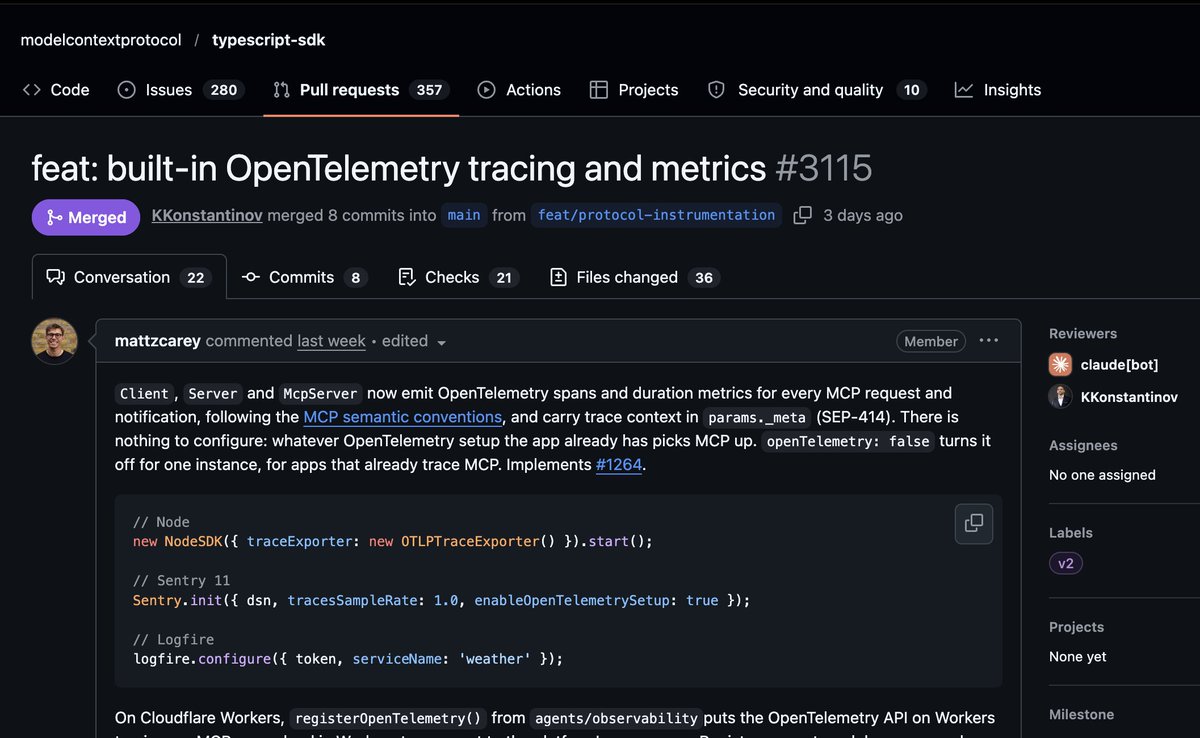
@dani_avila7 trace context through params._meta is the piece i wanted. without it every mcp tool call is a black box, can't attribute latency or cost per hop
Big step forward for MCP Observability!
OpenTelemetry tracing and metrics are now built directly into the official MCP TypeScript SDK
Automatic spans, duration metrics, and distributed trace propagation 👏👏👏