Supply chain + AI, explained with numbers. Fast takes on tariffs, freight, factories, chips and the AI changing how companies plan. By Taksh Solutions.
Most supply chain news never reaches the plan.
Every day here: one fast take on tariffs, freight, factories, chips, or the AI changing how companies plan. The number that matters and what it means for your plan, in a minute or less.
For planners, buyers and operations leaders.
Which one hits your plan hardest right now: tariffs, freight, or chips?
Sources: Manufacturing Today (Fed G.17 data via Reuters), Nov 20, 2026: https://t.co/qCHW7krjo1
CBI Industrial Trends Survey via Specification Online, Nov 20, 2026: https://t.co/8iFgUovh3x
𝗨𝗦 𝗳𝗮𝗰𝘁𝗼𝗿𝗶𝗲𝘀 𝗺𝗮𝗱𝗲 𝟬.𝟯% 𝗺𝗼𝗿𝗲 𝗶𝗻 𝗢𝗰𝘁𝗼𝗯𝗲𝗿. 𝗧𝗮𝗸𝗲 𝗼𝘂𝘁 𝗰𝗮𝗿𝘀 𝗮𝗻𝗱 𝗼𝘂𝘁𝗽𝘂𝘁 𝗳𝗲𝗹𝗹 𝟬.𝟭%.
This week's factory data looked better than it is:
- US (Fed, Oct): autos jumped 4.4% after a 2.7% drop, and chip output rose 2.2%. Factory capacity use is 76.0%, about 2 points below its long-run average.
- UK (CBI, Nov): output turned positive for the first time since May 2024. But makers expect almost flat output for the next three months.
One strong sector is a rebound, not a trend. Before you add a shift or pull raw material buys forward, check your own orders, not the headline.
What moved first in your plant this fall: orders, output, or nothing?
@FirstSquawk When tariff fear fades, the US premium on copper tends to shrink and metal moves back to where demand is. If you buy copper-heavy parts, it's a good moment to recheck how your contracts pass through price swings.
𝗖𝗶𝗿𝗰𝘂𝗶𝘁 𝗯𝗼𝗮𝗿𝗱 𝗼𝗿𝗱𝗲𝗿𝘀 𝗮𝗿𝗲 𝘂𝗽 𝟱𝟲% 𝗶𝗻 𝗮 𝘆𝗲𝗮𝗿. 𝗦𝗵𝗶𝗽𝗺𝗲𝗻𝘁𝘀 𝗮𝗿𝗲𝗻'𝘁 𝗸𝗲𝗲𝗽𝗶𝗻𝗴 𝘂𝗽.
On Nov 19, the Global Electronics Association warned of shortages of glass fabric, resin, copper foil and laminate. Bookings rose 56.1% in the year to September; shipments rose 13.3%.
The driver: AI servers. A typical PC board has about 12 layers. AI-server boards are moving to 40-60+, and every layer uses more material.
If you buy anything with a board in it:
- High-layer board lead times now run 16–20 weeks or more
- Hyperscalers are locking up supply; auto, industrial, medical and defense buyers can end up waiting
- The group sees no meaningful relief before mid-2028
The risk is getting boards at all, not what they cost.
Is the board lead time in your system above or below 16 weeks?
@financialjuice For shippers, the threat matters almost as much as a strike. Carriers and insurers price risk before anything happens, so Red Sea routings and war-risk premiums can move on headlines alone.
@statementdog If yields push Google back to CoWoS, the real constraint is packaging capacity, not wafers. Anyone planning AI hardware for 2027 should track advanced packaging slots as closely as GPU allocations.
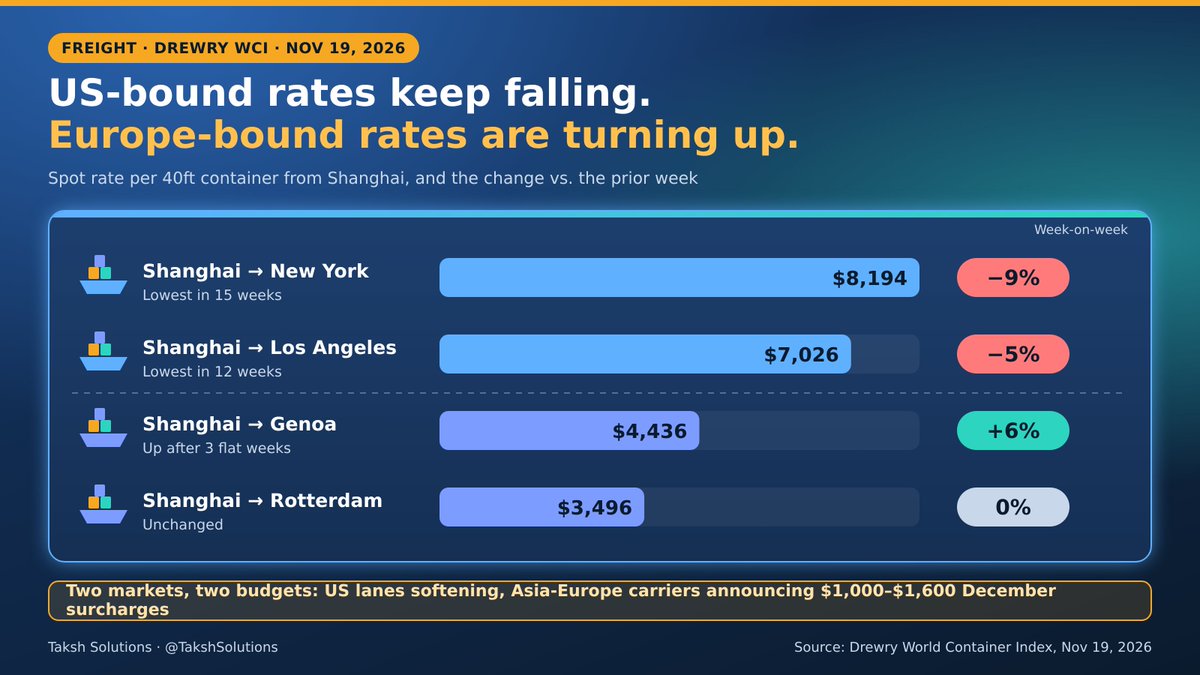
𝗨𝗦-𝗯𝗼𝘂𝗻𝗱 𝗰𝗼𝗻𝘁𝗮𝗶𝗻𝗲𝗿 𝗿𝗮𝘁𝗲𝘀 𝗷𝘂𝘀𝘁 𝗳𝗲𝗹𝗹 𝗳𝗼𝗿 𝗮 𝟳𝘁𝗵 𝘀𝘁𝗿𝗮𝗶𝗴𝗵𝘁 𝘄𝗲𝗲𝗸. 𝗘𝘂𝗿𝗼𝗽𝗲-𝗯𝗼𝘂𝗻𝗱 𝗿𝗮𝘁𝗲𝘀 𝗮𝗿𝗲 𝗵𝗲𝗮𝗱𝗶𝗻𝗴 𝘁𝗵𝗲 𝗼𝘁𝗵𝗲𝗿 𝘄𝗮𝘆.
Drewry's index on Nov 19, per 40ft box from Shanghai:
- New York: $8,194, down 9% (lowest in 15 weeks)
- Los Angeles: $7,026, down 5%
- Genoa: $4,436, up 6%
- Rotterdam: $3,496, flat
Even with 10 Transpacific sailings blanked for next week, Drewry expects US rates to keep sliding. On Asia-Europe, carriers have announced $1,000 to $1,600 peak surcharges per 40ft for December.
The takeaway: one freight number no longer fits your landed cost. The US and Europe are now two different markets.
Which lane worries you more for Q1: Transpacific or Asia-Europe?
@jimcramer Copper is the quiet input cost in every data center build: busbars, cabling, cooling. When it swings this hard, the teams that locked supply early look smart and everyone else re-prices mid-project.
@JewelsJonesLive Cargo theft is also a dwell-time problem. Every hour a container sits on a parked train is exposure. For high-value freight out of LA and Long Beach, transit visibility is loss prevention, not just tracking.
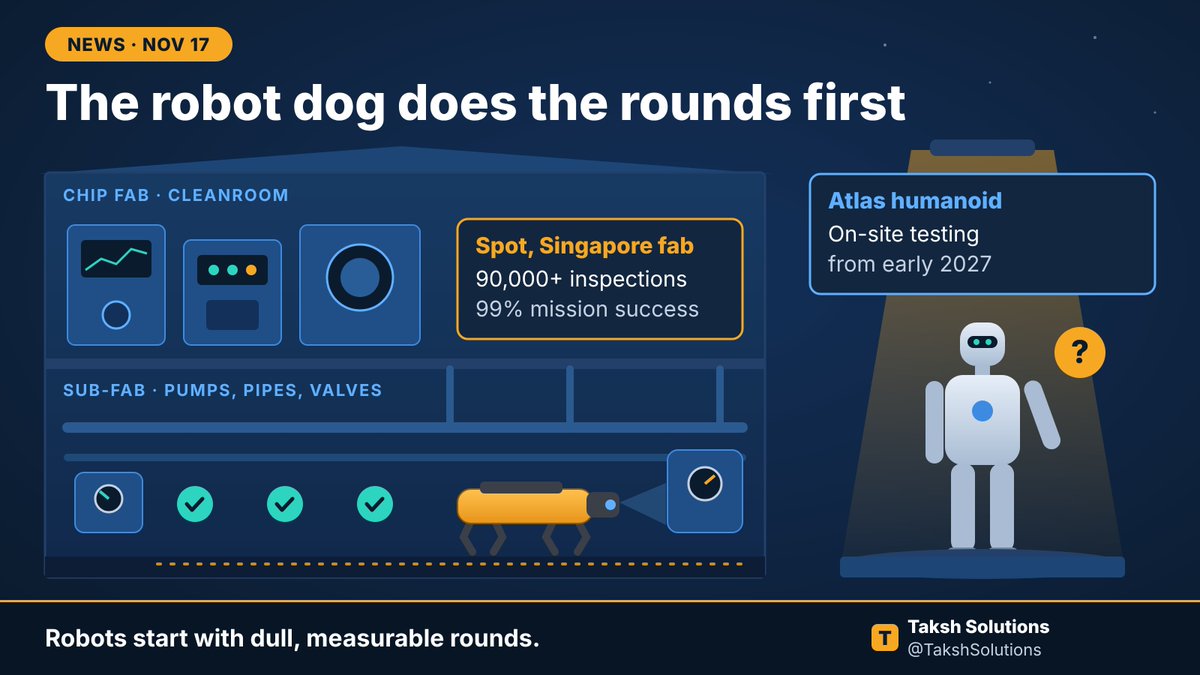
The humanoid gets the headline. Two robot dogs did 90,000+ inspections.
On Nov 17, Boston Dynamics and GlobalFoundries said Spot will expand across GF chip fabs in New York, Vermont, Dresden and Singapore. Atlas, the humanoid, starts testing on site in early 2027.
What the four-legged robot already did in Singapore:
- 2 Spot robots, nearly 900 km walked since April
- 90,000+ inspections in sub-fab areas
- 99% mission success
- 875 routine inspections redeployed in two weeks, with plans to more than double
What Atlas gets first: a test program, not a job. Use cases, integration needs, early task training.
The takeaway for any plant or warehouse: robots win first on rounds that are repetitive, measurable and dull. The humanoid comes after the routines and the data exist.
Which job in your operation should a robot take first: inspection rounds, inventory counts, or moving material?
Renting an AI chip now gets checked like shipping one.
On Nov 16, the US Commerce Department's BIS issued a rule on remote access to advanced AI chips: data centers abroad must vet who uses their compute, and serving companies based in China and other restricted countries needs a license.
What changed:
- Licenses now cover advanced chip exports to companies based in Indonesia, Malaysia, Singapore, Thailand and Brazil
- Overseas data centers renting large amounts of compute must do customer due diligence
- Providers already serving restricted-country firms get 90 days to get licensed
Why it matters even if none of that is you: compute is turning into a supply chain like any other. Where it sits, who owns it and who rents it now decide whether capacity is there when you need it.
Treat GPU capacity like a critical part: know the location, the provider and the backup.
Where does your team's AI actually run: your own cloud region, a vendor's, or no idea?
@kimmonismus Agents can replace status meetings, and that's a real win. The meetings worth keeping are the ones where someone has to own a trade-off. An agent can lay out the options; a person still signs off on one.
Sources:
Supply Chain Dive, November 11, 2026: https://t.co/VVh9E4o6UF
NRF Global Port Tracker, November 9, 2026: https://t.co/3WPg0QRNhQ
Kesco Logistics freight report (diesel), November 13, 2026: https://t.co/MNgSQtSmQO
Peak season is over. Peak pricing isn't.
US imports are heading down: 2.37M TEU in September, a forecast 2.05M in November (NRF). But shipping a 40-ft box from Asia to the US West Coast cost $8,245 on Nov 10, about 2.8x the $2,958 of a year ago (Freightos).
What that means if you plan, buy or ship:
- Fewer boxes doesn't mean cheaper boxes. Budget Q1 lanes at today's rate, not last year's.
- Cargo is sitting at the West Coast. September rail dwell at LA/Long Beach hit 7.19 days, up from 6.75 in August (PMSA).
- Mark Nov 20: the extended deadline in the ILWU Local 26 watchmen talks at San Pedro Bay terminals.
- Trucking costs more too: truck stop diesel was $6.23/gal on Nov 9, up 65% in a year (SONAR).
Takeaway: plan Q1 on fewer boxes at a higher cost per box, and stop waiting for the post-peak discount.
Your freight cost per container vs. last year: lower, about the same, or way up?