We track the companies and technologies behind the AI buildout. We explain what is changing, why it matters, and what to watch next.
StatementDog operates Taiwan’s largest fundamental stock analysis platform and one of its leading investment media brands, with a widely followed podcast and newsletter.
Our group also invests across public and private markets. Several startups in our venture portfolio are partners or suppliers to NVIDIA $NVDA and TSMC $TSM.
These roles allow us to engage with companies through media interviews, investor meetings, and site visits, while also drawing on a network of equity researchers and industry experts.
We combine these perspectives with public filings, earnings calls, and industry data to analyze semiconductors, AI hardware, capacity, pricing, and supply chains.
Follow @statementdog for ongoing analysis.
Daiwa expects prices for copper-clad laminate (CCL), the base material for AI server boards, to rise again in Q4 2026, with increases of about 10% for high-end grades and 20% for low-end grades.
Those hikes would follow increases of roughly 100% for low-end CCL and 40% to 50% for high-end grades in 2026, the broker estimates.
September revenue at Elite Material (2383 TT), Taiwan Union Technology (6274 TT) and ITEQ (6213 TT) came in 5% to 15% above expectations. Elite Material’s revenue rose 169% year over year to NT$21.5 billion. Management attributed about half of the month-on-month increase to higher prices and the rest to product mix. It did not rule out another price increase in Q4.
Daiwa also says concerns that PTFE and co-packaged optics (CPO) could hurt high-end CCL demand are overdone. PTFE is still undergoing qualification and is used in only a few layers of some high-end boards.
Elite Material expects CPO adoption around 2030 and says CPO switch boards would still use at least M6-grade CCL, even in a worst-case scenario.
$TER $LITE $COHR $KEYS $AMKR
WOW! TAIWAN'S NEW STATE CPO GRANTS GO TO ALIGNMENT AND TEST. THE CALL ITSELF SAYS TESTING CAN EAT 20–30% OF A MODULE'S COST
TAIPEI, Oct. 6 — Taiwan's National Science and Technology Council has opened calls for two three-year university research programs, one on silicon photonics and co-packaged optics (CPO), the other on power conversion for next-generation AI data centers. The council's engineering department sent the calls out in a letter dated Oct. 2, universities began forwarding them on Oct. 6, and campus deadlines fall on Dec. 31. Funded projects would run from Aug. 1, 2027 to July 31, 2030.
The photonics call is aimed at the packaging and assembly level, and its documents state plainly that chip design and wafer manufacturing are out of scope. The suggested target specs:
- Fiber-to-chip alignment accuracy of ±0.5 µm, coupling loss under 1 dB
- A 16-channel fiber array aligned in under 90 seconds on a demo line, under 60 seconds as a stretch goal
- CPO packaging cycle under 120 seconds per module, yield above 85%
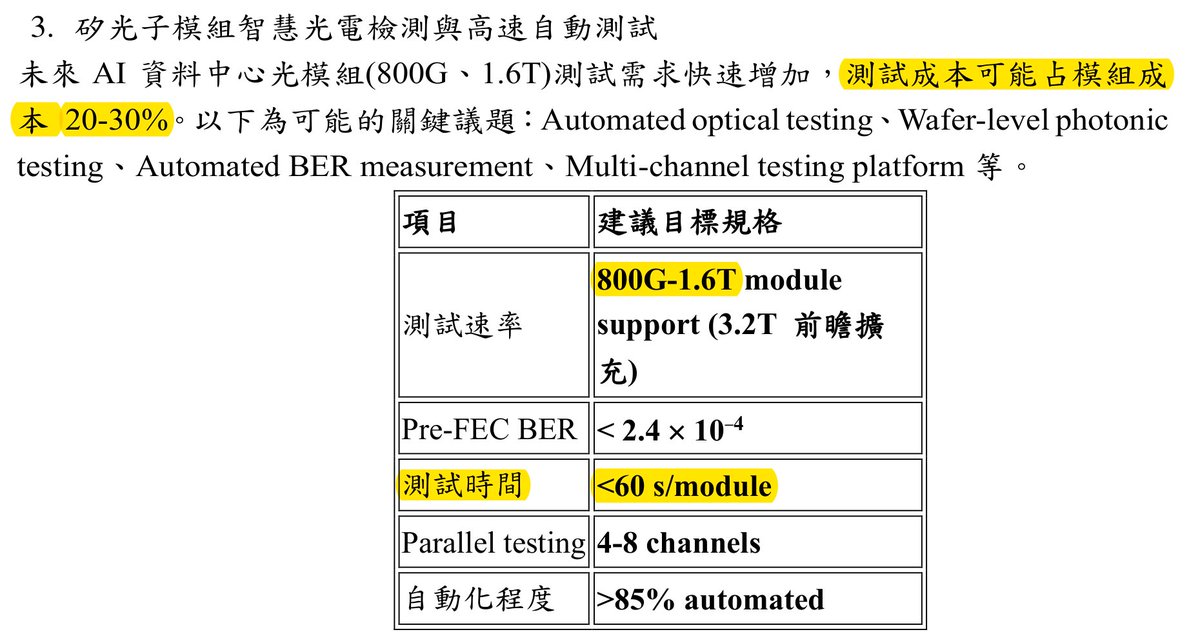
- 800G to 1.6T module testing in under 60 seconds per module, 4 to 8 channels in parallel, more than 85% automated
- CPO first-pass yield above 80%
The documents say testing may account for 20% to 30% of module cost as demand for 800G and 1.6T data center modules rises, and that fiber-array coupling with external lasers, thermally stable packaging and testability are among the biggest obstacles to industrialization. They put CPO's power saving at roughly 60% versus pluggable optics in rack-to-rack (scale-out) links, and roughly 80% if it moves inside the rack (scale-up). They also describe 2026 as the year silicon photonics and CPO move from qualification into volume ramp, citing $NVDA's newsroom.
Each team must sign a domestic company before applying and show its milestones at that partner's site or at the partner's customer. Funding is capped at NT$8 million a year per project, about US$252,000, and the program generally won't pay for large equipment.
The power call is capped at NT$7 million a year and is designed for a DC bus above NVIDIA's 800 V. It assumes buses will rise to 1,200 V or 1,500 V and sets these targets:
- A solid-state transformer taking 34 kV or 13.2 kV medium-voltage AC down to 1,200 V or 1,500 V DC, demonstrated above 12 kW, at 97% peak efficiency
- A 1,200 V or 1,500 V to 54 V converter at 12 kW and 98% peak efficiency
- A 54 V to 1.8 V stage delivering 100 A with a power-density goal of 1,000 W per cubic inch
- A DC solid-state circuit breaker that opens in under 25 microseconds
DIGITIMES reported the two programs on Oct. 6.
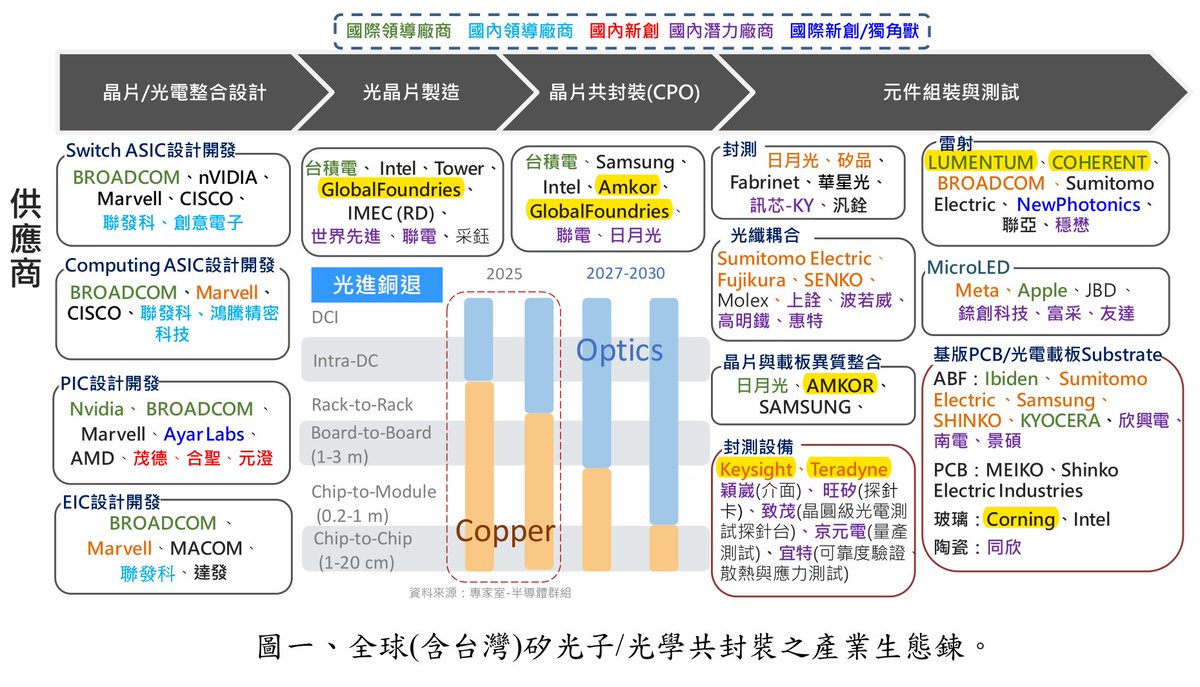
I put the photonics call's supply-chain chart next to the U.S. optical and test names we follow. The chart, compiled by the council's semiconductor expert group, places $LITE and $COHR in the laser slot, $TER and $KEYS under test equipment, $AMKR and $GFS in CPO packaging, and $GLW under glass substrates. $AAOI and $FORM are not on it, and the probe-card slot goes to Taiwan's MPI (6223 TT). The chart says its list is not exhaustive. The grant won't pay for testers, so that equipment has to come from partners and existing labs, and on the chart's test-equipment row the only U.S. names are Teradyne and Keysight.
Transcend (2451 TT) says customer demand is unchanged, but the timing of project shipments can cause short-term revenue swings, DIGITIMES reports.
Shipments to industrial PC and networking customers helped September revenue rebound 24.8% from August to NT$6.04 billion. Revenue was up 290% year over year.
Q3 revenue totaled NT$16.07 billion, the company’s second-highest quarterly figure. That was down 14.6% from Q2 but up 291% from a year earlier.
https://t.co/PKuQsRPegY
Sigurd Microelectronics (6257 TT) says it has raised chip-testing prices, and most of its customers have signed capacity agreements that run for more than a year.
At its Oct. 6 investor briefing, the Taiwanese company said the agreements help customers secure capacity while giving Sigurd better visibility into demand to support investment in facilities and equipment.
Management expects optical communications revenue to grow sharply in 2027 and says optical testing is more profitable than traditional testing. Sigurd aims to increase the combined share of revenue from AI, silicon photonics and high-performance computing to more than 30%, up from about 24%.
https://t.co/X988df7ycn
AMD $AMD is now planning three to five years ahead with its suppliers in Taiwan, up from one to two years previously, CEO Lisa Su said in Taipei on Oct. 6.
She said AMD’s $10 billion investment in its Taiwan supply chain, announced in May, is on track. The company is increasing that investment as demand grows, and securing more capacity was one reason for her visit.
Su expects capacity to keep growing in 2026 and 2027 but still fall short of demand. AMD plans to remain fabless.
https://t.co/0VgsBf5RYv
https://t.co/tLTGUYyZDN
I’d watch for any long-term capacity deals that follow. How much AMD books—and how far ahead—would give us a better read on future orders for Taiwan’s packaging, testing and substrate suppliers.
Only three PCB makers currently meet the requirements for 3.2T optical module boards, according to an industry source cited by DIGITIMES: Zhen Ding Tech (4958 TT), Unimicron (3037 TT) and Shennan Circuits (002916 CH).
The modules are expected to begin shipping in 2028. Their boards require line widths and spacing of 10 to 15 microns, which could push production from mSAP to the more complex SAP process. Suppliers also need FC-BGA substrate capacity.
More suppliers, including Compeq (2313 TT), can handle mSAP, which supports line widths and spacing of 12 to 25 microns. Boards for 1.6T modules already require mSAP and M8 laminates, while M9 is planned for 3.2T boards.
The ramp-up is expected to overlap with the IC substrate shortage. Module makers that don’t reserve capacity early could end up competing with AI and HPC chipmakers for production slots.
https://t.co/opJgIIDkqM
TSMC supplier Da Yi Cheng Technology says its order backlog stood at NT$10.1 billion at the end of September, giving it visibility through year-end 2028.
The Taiwanese contractor installs power distribution systems and handles equipment hookups at semiconductor fabs. At its Oct. 5 investor briefing, it attributed the orders to customers expanding advanced-node and advanced-packaging capacity, as well as overseas fab projects.
TSMC accounts for more than 60% of its revenue. The backlog is roughly 3.8 times the company’s 2025 revenue of NT$2.66 billion.
https://t.co/Sp59yJjfiL
Nanya’s Q3 revenue jumps 62% from Q2
Nanya Technology’s monthly revenue figures put its Q3 total at NT$133.65 billion, up 61.9% from Q2.
September revenue rose 0.9% from August to NT$45.09 billion. In July, revenue jumped 49.3% from June, a gain the company attributed mainly to new contracts taking effect.
The figures are unaudited and do not show how much of the Q3 increase came from pricing versus shipment volumes.
https://t.co/iUNXKAKSvQ
Vehicles with Level 4 or higher autonomy typically need more than 200GB of memory and several terabytes of storage, Micron said on its Sept. 30 earnings call. The company expects humanoid robots to have similar requirements.
Micron sees physical AI as a potential growth driver for memory and storage beyond data centers. Several physical AI customers are testing Micron’s next-generation products.
The company says these applications could generate significant demand by the end of the decade. It did not disclose order volumes or a shipment timeline for the products being sampled.
https://t.co/8EuWbzzpBJ
I’d watch for any long-term capacity deals that follow. How much AMD books—and how far ahead—would give us a better read on future orders for Taiwan’s packaging, testing and substrate suppliers.
Taiwanese media report that AMD CEO Lisa Su personally visited Taiwan today to secure the company’s packaging, testing, and substrate supply chain.
https://t.co/RNGjhyKW4L
@AIQuanting The report says production resumed after HP executives negotiated a price adjustment in Thailand. It doesn’t give the final terms or the size of any increase.
Quanta reportedly halted production of HP notebooks for about a week in September after pricing talks stalled amid rising component costs.
Production resumed after HP executives traveled to Thailand to negotiate, DIGITIMES reports, citing supply-chain sources.
Server sales accounted for more than 80% of Quanta’s Q2 2026 revenue, according to the report. Its sources say the growing AI server business gave Quanta more leverage in notebook pricing negotiations.
https://t.co/DKJxhgD64p
ASPEED’s monthly revenue figures put its Q3 total at NT$4.79 billion, above its earlier guidance of NT$4.1–4.3 billion.
The Taiwanese server-management chipmaker posted record revenue of NT$1.64 billion in September, up 100.9% year over year and 0.6% from August.
On Sept. 4, ASPEED forecast Q4 revenue of NT$6.6–6.8 billion and said it planned double-digit price hikes to pass on higher supplier costs. That range implies a 38%–42% increase in revenue from Q3.
https://t.co/hY0XkskDpE
Barclays sees upside to its $370 billion forecast for Nvidia’s 2027 revenue from hyperscalers. Analyst Tom O’Malley’s calculations imply $401 billion, with $417 billion in a more optimistic scenario, Stocktwits reported on Oct. 1.
The estimates depend on cloud providers’ projected IT spending and Nvidia��s share of those budgets. O’Malley also notes that the comparison isn’t like-for-like: Nvidia’s hyperscaler revenue includes SpaceX, while the spending chart covers only the five largest cloud providers. These are analyst scenarios, not Nvidia guidance.
https://t.co/JBYVwa91WX
Micron’s data center SSD revenue reached nearly $10 billion in fiscal Q4 2026, the company said on its Sept. 30 earnings call. That was more than 10 times the year-earlier level and accounted for over two-thirds of its total NAND revenue.
The company sees growing opportunities for SSDs in AI context storage, including KV cache offloading during inference, and as replacements for hard drives.
Total NAND revenue rose 42% quarter over quarter, with prices up about 30% and bit shipments up about 10%.
https://t.co/8EuWbzzpBJ
Wiwynn expects to recoup its investment in collaborative robots at its US plant within a year, DIGITIMES reports.
The AI server maker is deploying robots from Teradyne-owned Universal Robots at its plants in El Paso, Texas, and Mexico. Tasks include tightening screws and positioning cooling modules and circuit boards.
Wiwynn says the biggest benefit is more consistent assembly quality with fewer errors. That is also the main reason its customers support the investment.
https://t.co/du2S0mj9tz
Aletheia Capital estimates that PCB content per Google $GOOGL TPU v8 rack could reach $30,000 to $40,000, up from about $20,000 for TPU v7. Its estimate assumes eight compute trays per v8 rack, each with four TPUs.
The firm expects CCL content per rack to rise to between $12,000 and $18,000, from about $7,000. It sees a further 40% to 50% increase in content per rack with TPU v9 as boards move to HDI.
Aletheia’s supply-chain checks also point to more discussions between cloud providers and PCB and CCL suppliers about long-term agreements and prepayments to secure high-end capacity. Most of those talks are still ongoing.
In networking, the firm expects PCB prices to rise from between $350 and $400 for 400G switches to about $1,500 for 800G models. For 1.6T, it sees prices reaching $3,000 to $4,000 as boards move to 44 to 50 layers and M9 laminates.
Nvidia $NVDA says robots can now install busbars in GB300 tester trays with a success rate above 95%, compared with a 99.5% target for factory use.
The task involves positioning a long, heavy metal bar and securing it with 16 screws. It currently takes about 160 seconds, versus a target of 124 seconds, or no more than twice the time a skilled worker needs.
A separate task, inserting four cable connectors (two large and two small), has a success rate of 90% to 95%. The target is to complete all four insertions within 72 seconds.
Nvidia published the results in a technical blog post, cnyes reports. Its Seattle Robotics Lab and Isaac engineering team are developing the system, with Foxconn (2317 TT) and Nvidia’s operations team helping select the tasks and define the manufacturing requirements.
https://t.co/PGWteGvkeY
This week's supply-chain recap, Sept. 28 to Oct. 4.
1. JPMorgan expects TSMC $TSM to raise wafer prices again in 2027.
The bank forecasts an 8% to 10% increase in N2 and N3 wafer prices, which it says would exceed market expectations.
It also expects TSMC's blended wafer average selling price to rise 23% year over year in 2027, compared with an estimated 17% increase in 2026.
https://t.co/LR1oMr3qKH
2. Machvision is ordering components earlier as lead times stretch.
The inspection equipment maker (3563 TT) says component lead times are now six months, up from two to three months, with CNC machining the main bottleneck.
The company is placing orders further in advance while expanding its Hsinchu and Kunshan facilities.
https://t.co/5JxCQKTddn
3. Shinko Electric and Unimicron are buying existing plants to expand their substrate operations.
Shinko Electric has agreed to buy Japan Display's former LCD plant in Mobara and convert it into a production hub for advanced chip substrates. The company says its factories face greater demands as AI chip substrates get larger and require more layers.
https://t.co/gRpQsBNxox
Unimicron (3037 TT) is buying land and buildings in Hukou, Hsinchu County, from Bridgestone Taiwan for NT$10.09 billion to make room for future expansion in high-end substrates.
The company says space at its existing sites is limited, while customers are already reserving capacity for the next five years.
https://t.co/BVrOtWDokU
4. Some Biostar customers are taking longer to commit as CPU and memory prices rise.
At its Oct. 2 investor briefing, the motherboard and industrial PC maker (2399 TT) said higher component prices were delaying some customers' decisions on system purchases. Intel raised processor prices in late August, and memory quotes rose again in October, according to the company.
Biostar also warned that processors for industrial and consumer PCs could be harder to source in Q1 2027, as it expects chipmakers to prioritize data-center CPUs.
https://t.co/YCEevVnGju
5. Micron says more than 75% of its 2027 output is already spoken for.
Most customer discussions now center on 2028, according to CEO Sanjay Mehrotra.
Micron $MU has also signed 26 multiyear take-or-pay agreements, up from 16 in June. Customer commitments under those agreements have grown from $22 billion to $32 billion, mostly in the form of cash deposits.
https://t.co/9Fak3WBmTp
Micron $MU says more than 75% of its 2027 output is already committed to customers.
CEO Sanjay Mehrotra said on the earnings call that this includes customers with and without long-term supply agreements. Most discussions with customers now focus on 2028, he added.
Micron has signed 26 multiyear take-or-pay agreements, up from 16 in June. Customer commitments under those agreements have risen to $32 billion from $22 billion, mostly in the form of cash deposits.
The company has also signed agreements covering the vast majority of its 2027 HBM bit supply at prices significantly above 2026 levels.
Fiscal Q4 revenue jumped 379% year over year to a record $54.2 billion, while gross margin reached 87%.
For fiscal Q1, Micron expects revenue of $61.5 billion, plus or minus $1.5 billion. That is above the $57 billion analysts had expected, according to LSEG.
https://t.co/g6JtHvHNc9
https://t.co/vjnX8YJska