Happy publication day! You can now order (or download free, open access) @AndyDelton@dr_reubotnik and I's book Climate Games here: https://t.co/K1dPDZZ2q3 @UofMPress
🚨The Toronto Political Behaviour Workshop is back for its 12th edition! Join us on Nov. 13–14, 2026, at @UofT! We welcome paper/poster proposals on any topic in political behaviour, broadly defined!
📅 Submission Deadline: July 11.
Apply here: https://t.co/LK1CEFrxoG
NEW: Peter K. Enns, "How a Seemingly Innocuous and Intuitive Methodological Choice Confused a Generation of Research on Policy Responsiveness." https://t.co/PDKboYKdKR
Don’t miss your chance to read the new Cambridge element, Emotions on Our Screens, by @TalbotMAndrews, @lrpalladino and Yanna Krupnikov! Free access available until 14 April at
https://t.co/PfHjSnKSZ1
#cambridgeelements#politics
Now more than ever we encounter each other's emotions about politics. When do we take strangers' emotional expression seriously, and when do we dismiss it as inappropriate or even insincere? You can find out now in our Cambridge Element! https://t.co/OOeJs7LHQL
Across six experiments, we find people are skeptical of emotional expression about this critical issue (even when observers themselves are worried about climate change). And, evaluations depend at least in part on the platform through which they encounter those emotions.
🚨New publication in @poqjournal 📈
Americans see the Democrats as increasingly "liberal" and Republicans as "conservative."
Why? Turns out, it's not so much a response to actual policymaking as it is to how regular voters use these labels.
https://t.co/rFs2PZCDP1
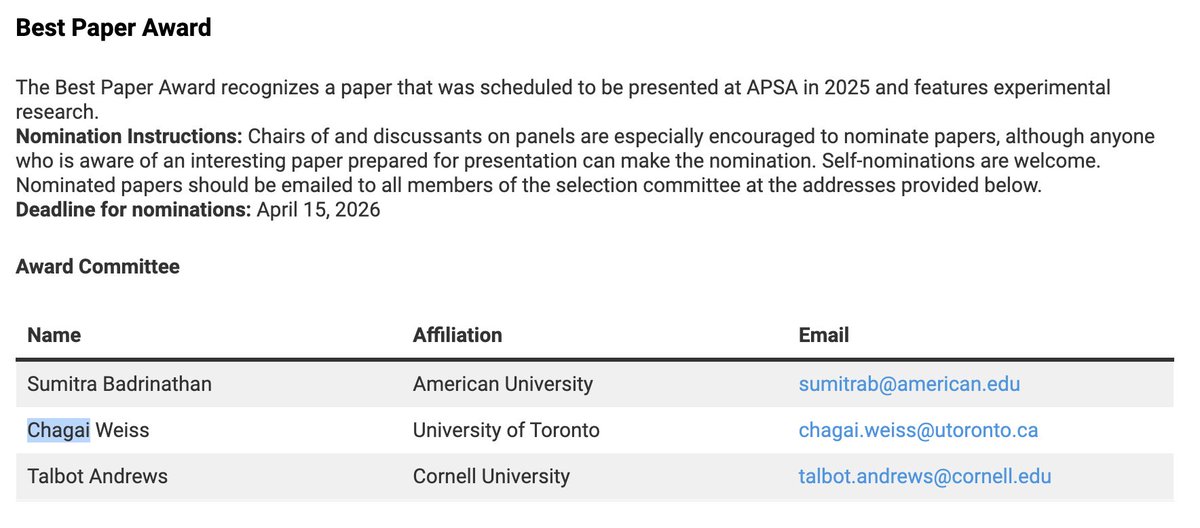
🏆APSA's Experimental Research Best Paper Award🏆Did you present an experiment at APSA2025? Submit your conference paper for the Experimental Research Section's best paper award by April 15, 2026.
@kharibiskut@TalbotMAndrews and I are excited to read your work!
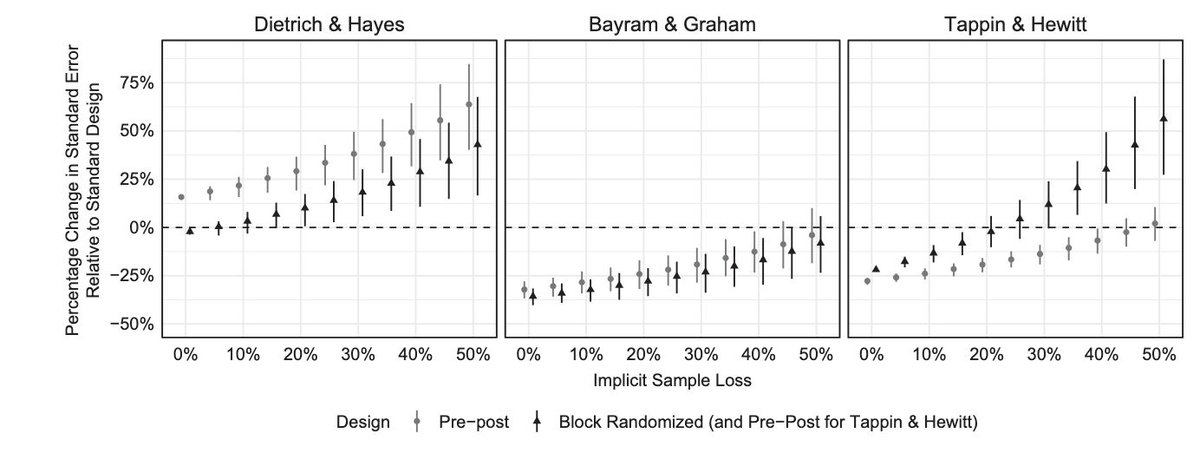
Currently in FirstView: In “Balancing Precision and Retention in Experimental Design,” Gustavo Diaz and @erinrossiter study how experimental design choices can increase precision when estimating treatment effects. Specifically, they examine block-randomized and pre-post designs.
🚨 The Cornell Population Center (@PopulationCU) is recruiting our next CPC Rhodes Postdoctoral Fellow (start: Aug 2026).
We welcome outstanding early-career scholars in all disciplines engaging population research.
Apply + share widely: https://t.co/PGh2eiL2tr
More climate disaster won't necessarily lead to more climate change mitigation support. In our newest paper, we find people closest to the fires in the 2021-2022 fire season prioritized local adaptive action, rather than mitigation. https://t.co/hFeMR1ACyi
The story is very different using self-reported measures of fire exposure! It is so important to use multiple methods to understand the effects of disaster on opinions, behavior, and policy support. @smconstantino@GardMurray
Winds of change? @cornellgov-led research finds that Texans on average hold positive views about wind energy developments, welcoming turbines’ local benefits despite state and national leaders’ resistance. @sciencedirect@TalbotMAndrews https://t.co/GL6irQcQbI