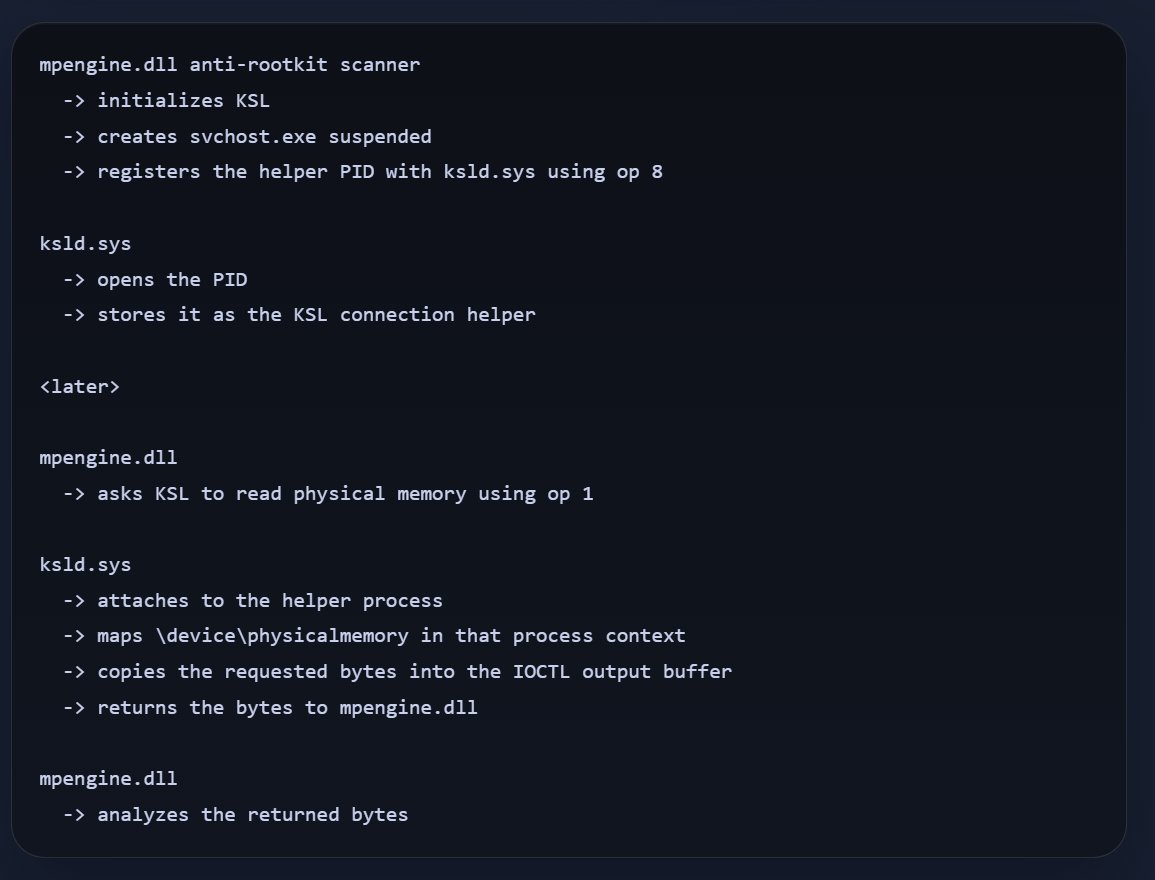
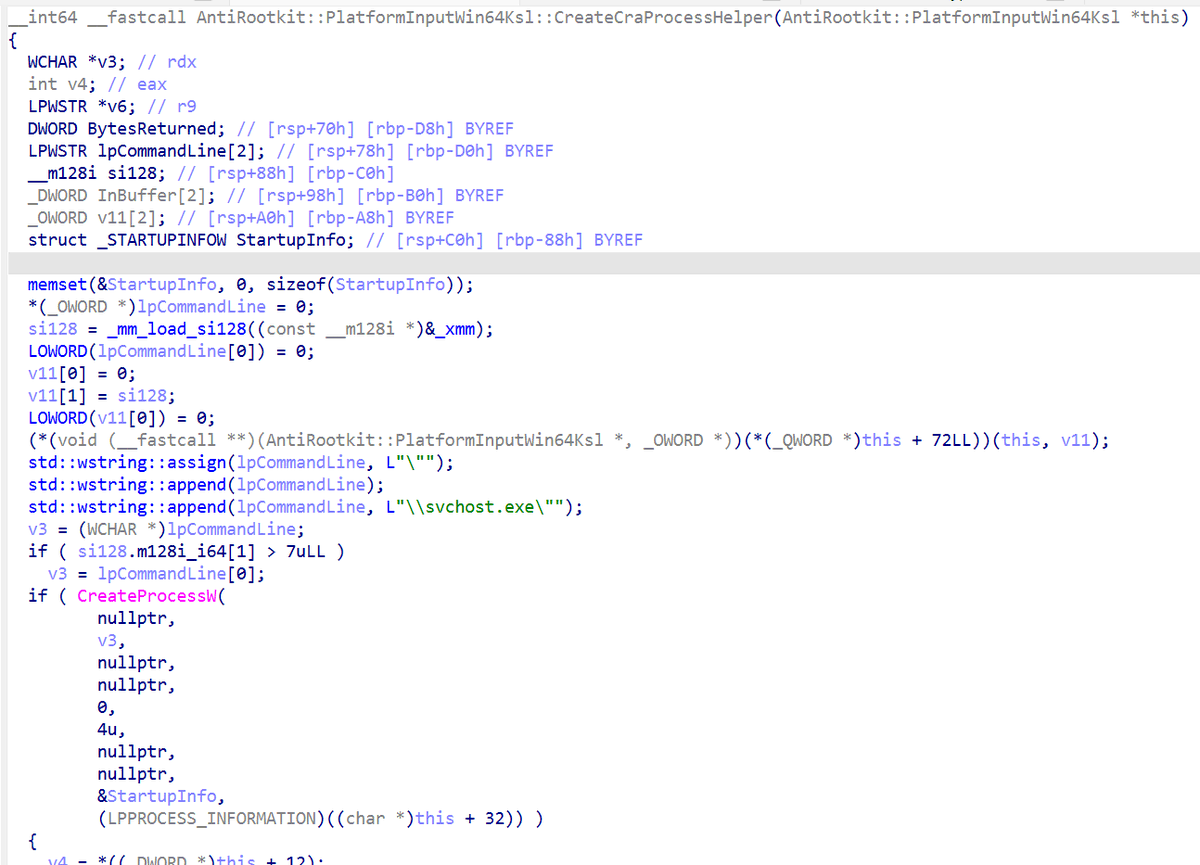
Have you ever wondered why svchost can spawn from Windows Defender MsMpEng.exe withouth any flags, even though a legit svchost should always have flags?
Welp that's because its not a real svchost :D
Read - Why Does MsMpEng Spawn svchost.exe Without Flags? - https://t.co/JQxnSF6Buk
TL;DR - MpEngine.dll (AKA Windows Defender Engine) has a function called CreateCraProcessHelper that is used as part of the AntiRootkit scanner. In it, it spawns a suspended process with just the CLI "svchost".
This is used by the engine and KSL driver to pass specific bytes from the \Device\PhysicalMemory between "Kernel" and "User mode" :D
The new BoxPwnr webpage to explore traces and stats is live!
https://t.co/nLp5a1a3mF
- 14 Platforms
- 3,407 Challenges
- 1,598 Unique challenges Solved
- 7,031 Traces
And a new trace viewer with a nice graph you can use to navigate the traces.
I also Added cheating/memorization analysis
Want a cloud lab environment thats misconfigured on purpose? BadZure deploys #EntraID and #Azure tenants populated with exploitable attack paths. Explore cloud tradecraft, run purple team exercises, or test your detections! Check out the latest release
https://t.co/xzzVVuLgUZ
[1/4] Stop prompting from scratch every time and pray for consistent expertise and results.
Anthropic just dropped a guide on "Skills", if you use Claude seriously, this changes everything.
It's called "The Complete Guide to Building Skills for Claude."
#AI#Claude#Anthropic
Kimi k2.5 is quite good at hacking (and it's cheap).
It solved 24 out of the 25 HackTheBox machines in Starting Labs (Easy).
9 months ago Sonnet 4.0 solved only 15 of them. Capabilities are increasing fast and costs are going down.
Explore traces, replay them (play button) or read the reports with an attack path diagram to see how Kimi did it
https://t.co/xNmpenbBoC
Just built a demo “monitoring matrix” for a slide in my blind spots talk.
Many orgs I’ve worked with have the same idea: “we monitor our systems, visibility is pretty good, only a few systems are not integrated yet.”
Then you put it into a simple table and the pattern is always the same: the top-left looks great. Servers and workstations send OS logs, basic auditing is enabled, some alerting exists. It feels like control.
But when you go deeper, it gets thin fast. Application logs are missing, not collected centrally, not normalized - and often there isn’t even alerting defined for them. People also rarely agree on what a “critical” application-level alert should be. That needs application owners and security to sit down and define signals. OS-level monitoring is already hard; application-level monitoring is where many programs stop.
And when you expand the coverage, it gets harder too. The further you move away from the “standard” systems, the more limits you hit: legacy systems, appliances, OT/embedded, unusual platforms, proprietary log formats, limited access, sometimes legal or organizational limits. Even if you get logs, they are often not easy to ingest and use.
Main point: “we have monitoring” is not a checkbox. It’s a spectrum - and many environments are fairly wide, but shallow.
‼️🚨 An ex-Anthropic engineer just published a 1-click remote code execution exploit for OpenClaw (formerly Moltbot and ClawdBot).
The attack occurs in milliseconds after the victim visits a webpage, giving the attacker access to Moltbot and the system it's running on. The victim does not need to type anything or approve any prompts.
New work from my team 👇
Threat reports are everywhere. Actionable detections are not.
Here’s how we’re applying AI to bridge that gap - extracting TTPs, mapping coverage, and accelerating detection engineering at scale.
Worth a read for all Defenders: https://t.co/STsOacxTZl
We at @safebreach Labs just dropped an exploit for CVE-2026-24061 (CVSS 9.8!)- A fresh RCE auth bypass in telnetd 👨💻
Working PoC: https://t.co/pGxNk4ODuW
Full root cause analysis: https://t.co/TEXnHMpKYP
[New Blog📚] A Shared Arsenal: Identifying Common TTPs Across RATs
Check out this latest Splunk blog by @tccontre18 and I, where we've looked at multiple RAT families based on open intel and our past research, to identify common TTPs.
https://t.co/64OQXBq8YZ
#reversing#repost
Windows Inter Process Communication:
A Deep Dive Beyond the Surface
Part 1 - IPC Roadmap - https://t.co/xXndRaEU7C
Part 2 - RPC Architecture Overview - https://t.co/976LmFavNf
Part 3 - Handles and binding - https://t.co/F3x5Kt5c8q
Part 4 - RPC Security - https://t.co/AEcP1Gdi2t
Part 5 - Securing the interface and endpoint - https://t.co/scfQ1a0OLy
Part 6 - Endpoint Multiplexing - https://t.co/vX1PeXGPnc
Part 7 - RPC Research Tools - https://t.co/oyqpIo2QYS
Part 8 - Reverse engineering an RPC server - https://t.co/ogBqjoo8mz
Part 9 - High-level reverse engineering - https://t.co/tJoe1GuKNz
Check Point Research (CPR) identified three security vulnerabilities in the Graphics Device Interface (GDI) in Windows. @_CPResearch_
https://t.co/dBIuPUKAbZ
While playing @defcon CTF Finals with @shellphish I managed to solve the ICO challenge using LLMs (GPT5 + Cursor) and almost no human intervention. You can read how I did it here! https://t.co/EcqYZdyIfV
Here are the resources for my talk "Racing Against the Lock: Exploiting Spinlock UAF in the Android Kernel" at @offensive_con today.
Write-up: https://t.co/PlA8ailV90
Slides: https://t.co/kZSHsixM4X
PoC for CVE-2022-20421: https://t.co/Pi8qQhJQIZ
#OffensiveCon2023
Client Said No Exploits, Light Pentest. We Delivered Chaos — and Got Paid.
https://t.co/uFW4kGxD2e
Disclaimer: This is a joke.
#Cybersecurity#RedTeam#BlueTeam#Meme




![nas_bench's tweet photo. [New Blog📚] A Shared Arsenal: Identifying Common TTPs Across RATs
Check out this latest Splunk blog by @tccontre18 and I, where we've looked at multiple RAT families based on open intel and our past research, to identify common TTPs.
https://t.co/64OQXBq8YZ https://t.co/c4VQRha4F6](https://pbs.twimg.com/media/G_bvPQIXQAAJxrY.jpg)
![nas_bench's tweet photo. [New Blog📚] A Shared Arsenal: Identifying Common TTPs Across RATs
Check out this latest Splunk blog by @tccontre18 and I, where we've looked at multiple RAT families based on open intel and our past research, to identify common TTPs.
https://t.co/64OQXBq8YZ https://t.co/c4VQRha4F6](https://pbs.twimg.com/media/G_bvPQDWUAAi0Vw.png)
![nas_bench's tweet photo. [New Blog📚] A Shared Arsenal: Identifying Common TTPs Across RATs
Check out this latest Splunk blog by @tccontre18 and I, where we've looked at multiple RAT families based on open intel and our past research, to identify common TTPs.
https://t.co/64OQXBq8YZ https://t.co/c4VQRha4F6](https://pbs.twimg.com/media/G_bvPPRWkAEsXJa.jpg)



![TristanInSec's tweet photo. [1/4] Stop prompting from scratch every time and pray for consistent expertise and results.
Anthropic just dropped a guide on "Skills", if you use Claude seriously, this changes everything.
It's called "The Complete Guide to Building Skills for Claude."
#AI #Claude #Anthropic https://t.co/VBtSpBW9jV](https://pbs.twimg.com/media/HBIb0AiXcAAR4Rf.jpg)




![nas_bench's tweet photo. [New Blog📚] A Shared Arsenal: Identifying Common TTPs Across RATs
Check out this latest Splunk blog by @tccontre18 and I, where we've looked at multiple RAT families based on open intel and our past research, to identify common TTPs.
https://t.co/64OQXBq8YZ https://t.co/c4VQRha4F6](https://pbs.twimg.com/media/G_bvPQlWAAAdyXe.jpg)


