Now out in @digital_rsc, our chemical language model for molecular property prediction:
1) Outperforms prior art
2) Validated on a large, proprietary tox. dataset
3) Reveals cytotoxic motifs via attention
4) Uses uncertainty to improve reliability
🧐https://t.co/YPXe22H1yi
🧵⬇️
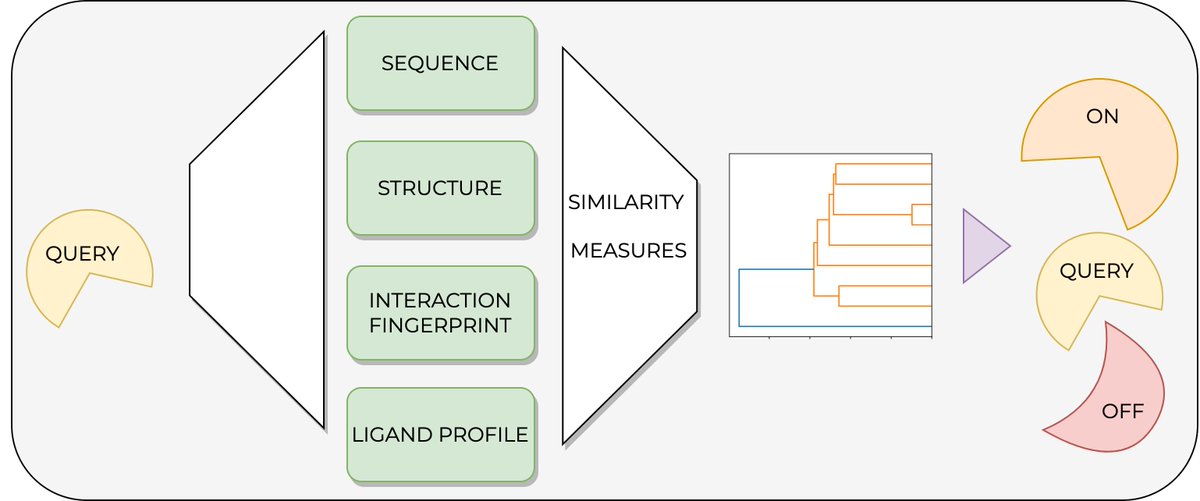
We’ve got a new article out, from Andrea Volkamer’s group, on a pipeline for kinase similarity assessment in order to help predict off-target effects. Check it out! The pipeline is part of TeachOpenCADD, and the code is all available. #CompChem
https://t.co/XeIFcxZ2C4
This is the perfect starting point for many applications: lectures/courses, bio/chem-informatics pipelines, research, software development, and more! Very proud to be part of such a great project! #teachopencadd
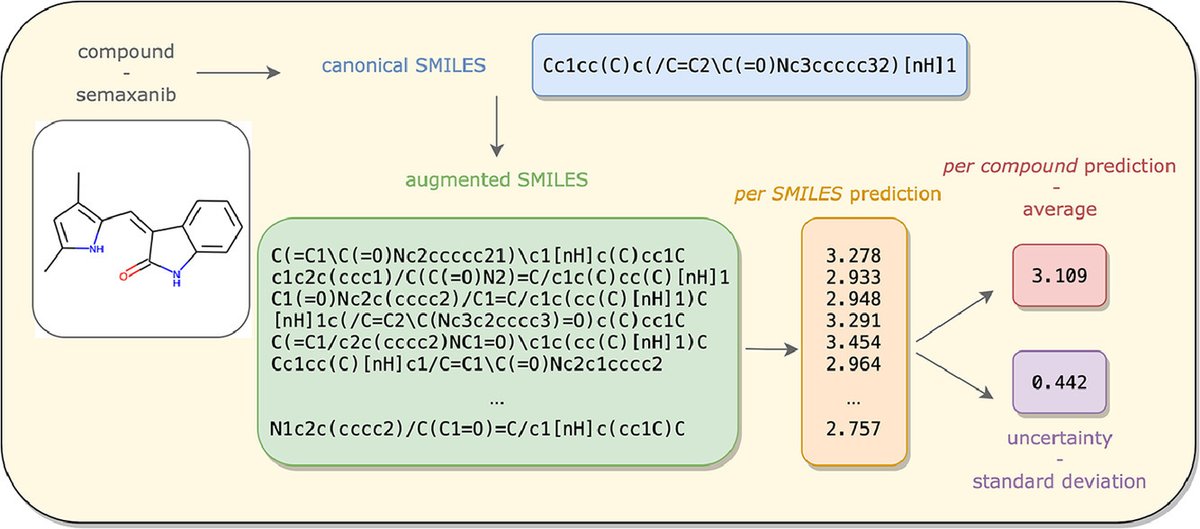
@rguha Even though the molecule is indeed the same, the SMILES notations will be dissimilar (various views of the same molecule). Therefore the input to the model will be different and the model will produce distinct outputs.
Are you tired of hearing that deep learning needs more data and that physico-chemical data sets are still scarce? Check out our latest publication https://t.co/eGdCFcDQeB for some augmentation strategies to improve your predictions!
"Maxsmi: Maximizing molecular property prediction performance with confidence estimation using SMILES augmentation and deep learning" Available on @AILSCI!
🔗Find out more at: https://t.co/HKvow0uPT4
#Maxsmi#SMILES#opensource#AI#DeepLearning#openaccess
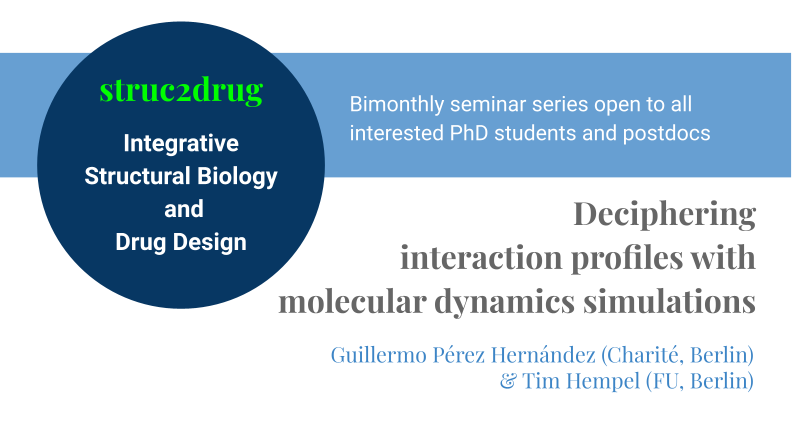
Join our next @struc2drug seminar on Thursday at 15:00 (CET)!
@Guille_PH and @tmhmpl will discuss with us how to guide GPCR and SARS-CoV-2 research by deciphering interaction profiles with MD simulations.
Find more details on https://t.co/E5YCTDQNVh
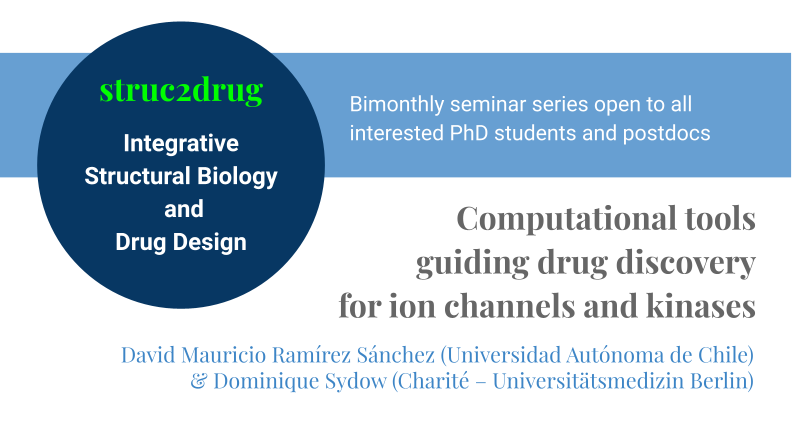
Join our next @struc2drug seminar this Thursday at 17:00 (CEST) on "Computational tools guiding drug discovery for ion channels and kinases" with @davimau and @dominiquesydow.
Contact us for an invite to the call!
More details: https://t.co/E5YCTDzd3J
TorchMD paper is out, a bio-molecular code entireley written in #PyTorch to build machine learning potentials and end-to-end molecular simulations. A collaboration with T. Giorgino, @FrankNoeBerlin@CecClementi and @acellera. https://t.co/J5PpDej4J4
https://t.co/UBwwSjqUyY
#Lisk Research Scientist, Alessandro Ricottone, is now on stage in the #LiskCenterBerlin.
He’s showcasing the four milestones for Lisk’s Interoperability and announcing the Interoperability direction for Lisk.
To learn more, join the #LCBevent online:
https://t.co/fcFPpX28kw.
For the last months, we have been working on putting our new website up. It's been online for a couple of weeks now so I think it's time to make it public:
AG Volkamer is now reachable via https://t.co/2OhriOQAmW!
Let us know what you think :)
Honestly, the question is not, and has never been, "can machine learning replace radiologists/etc" (which won't happen in the foreseeable future). The question is, how can radiology/etc utilize ML to improve outcomes, decrease the cost of care, and broaden accessibility.