Demo: NTP time sync on the real world web is now much better than UTC time sync. Necessary for time sensitive collaborative perception and advanced orchestration.
This is running on some of our robots already too.
⚠️ Scam alert: a phishing email is circulating that appears to come from an <@ outlierventures. io> address, pitching a "partnership."
It is not from us. Don't click any links or reply.
We're aware that some people are impersonating Outlier Ventures employees and we're taking immediate action. If you already engaged, please don't share any information with the sender.
If you're ever unsure whether outreach from OV is legit, email or DM us to confirm. Thank you and stay safe 🙏
Plus, especially in Fast mode, it is FAST!
I have invested heavily in my @cursor_ai setup, optimizing for long running, parallel multi-agent workflows that can go for 30-60 minutes. Most work items now tend to get done in 10-20 minutes or much faster. Time to raise the bar!
New CursorBench results just dropped.
Two big takeaways.
Composer 2.5 is way better than most people think.
63.2% score at $0.55 per task.
Nearly matching Opus 4.7 Max and GPT 5.5 Extra High at 20x less cost.
This is insane value.
Gemini 3.5 Flash is #10 at 49.8%.
Below GPT 5.5 Low.
Below Opus 4.7 Low.
Google's newest model can't even beat budget tier competition.
Composer 2.5 is the sleeper.
Gemini 3.5 Flash is the disappointment.
I rarely find myself reaching back to Opus for non-trivial and longer running tasks, which I had to do all the time before.
Subjectively, with most problems I throw at it, Composer 2.5 just "gets it", and gets the job done.
@yugalchittara@oviohq The more you can provide in-repo the better! Give us a ping and we'll re-process, or share a second repo with the additional materials and it'll be auto-processed.
Today, you can build a product in a weekend. You still can't fund it without a lawyer, a cap table, and a decade-long commitment.
🧩We've identified 10 open problems builders of the agentic internet need to solve.
We've set aside capital against this thesis and we're opening a Request for Builders today.
We've been sitting on this for months. Today we're going public with it.
10 open problems no one's solved yet for the agentic internet. Funding, ownership, coordination, moats. All broken when teams are hybrid human+AI.
If you're building anything adjacent, share your repo!
This is true for any agentic tool or workflow. Coding and anything else.
Always give the agent a way to verify its work, and it's much more likely to deliver good results on its own.
6/ Give Claude a way to verify its work
Finally, make sure Claude has a way to verify its work. This has always been a way to 2-3x what you get out of Claude, and with 4.7 it's more important than ever.
Verification looks different depending on the task. For backend work, make sure Claude knows how to start up your server/service to test it end to end; for frontend work, use the Claude Chromium extension to give Claude a way to control your browser; for desktop apps, use computer use.
Personally, many of my prompts these days look like "Claude do blah blah /go". /go is a skill that has Claude
1. Test itself end to end using bash, browser, or computer use
2. Run the /simplify skill
3. Put up a PR
For long running work, verification is important because that way when you come back to a task, you know the code works.
Living outside the SV eco-chamber is a super power 🦸♂️
Big tech is now finally hiring philosophers. Not as advisors. As staff. And they are all British! 🇬🇧
Anthropic did it first. Now Google DeepMind (Demis, also British) has followed.
Q. How do you build an artificial mind without a working theory of mind?
Q. How do you engineer consciousness without an ontology of what consciousness even is?
Q. How do you align intelligence you can't even define?
These aren't engineering problems.
They're age old questions of the humanities.
I've been publicly arguing with SV and folk like Elon Musk (since May 2023) that the humanities would be critical for AI.
https://t.co/OCrj5tyqnw
URGENT PSA - New supply chain attack vector that I found WILD > AI LLMs hallucinate package names roughly 18-21% of the time.
Hackers have started pre-registering those hallucinated names on PyPI and npm with malicious payloads; they call it "slopsquatting"
You can only imagine what's next
This is great. Some very recognizable points (nov/dec 25 🤖🚀, AI exhaustion 😩, red/green TDD 👌).
Others that make a lot of sense and I'll implement (start from a thin template and the agents will build the "right" way without lots of prompting).
Thanks @lennysan@simonw!
My biggest takeaways from @simonw:
1. November 2025 was an inflection point for AI coding. GPT 5.1 and Claude Opus 4.5 crossed a threshold where coding agents went from “mostly works” to “almost always does what you want it to do.” Software engineers who tinkered over the holidays realized the technology had become genuinely reliable.
2. Mid-career engineers are the most vulnerable—not juniors, not seniors. AI amplifies experienced engineers by letting them leverage decades of pattern recognition. It also dramatically helps new engineers onboard. Cloudflare and Shopify each hired a thousand interns because AI cut ramp-up time from a month to a week. But mid-career engineers who haven’t accumulated deep expertise and have already captured the beginner boost are in the most precarious position.
3. AI exhaustion is real and underestimated. Simon runs four coding agents in parallel and is mentally wiped out by 11 a.m. He’s getting more time back, but his brain is exhausted from the intensity of directing multiple autonomous workers. Some engineers are losing sleep to keep agents running. This may just be a novelty issue, but the underlying dynamic—that managing AI amplifies cognitive load even as it reduces labor—is a real tension. Good companies will manage expectations rather than expecting 5x output indefinitely.
4. Code is cheap now. This simple idea has profound implications. The thing that used to take most of the time—writing code—now takes the least. The bottleneck has shifted to everything else: deciding what to build, proving ideas work, getting user feedback. Since prototyping is nearly free, Simon often builds three versions of every feature when he’s getting started.
5. The “dark factory” is the most radical experiment in AI-assisted development happening right now. A company called StrongDM established a policy: nobody writes code, nobody reads code. Instead, they run a swarm of AI-simulated end users 24/7—thousands of fake employees making requests like “give me access to Jira”—at $10,000 a day in token costs. They even had coding agents build simulated versions of Slack, Jira, and Okta from API documentation so they could test without rate limits.
6. "Red/green TDD" is the single highest-leverage agentic engineering pattern. Having coding agents write tests first, watch them fail, then write the implementation, then watch them pass produces materially better results. The five-word prompt “use red/green TDD” encodes this entire workflow because the agents recognize the jargon.
7. “Hoarding things you know how to do” is one of Simon's other favorite agentic engineering patterns. Simon maintains a GitHub repo of 193 small HTML/JavaScript tools and a separate research repo of coding-agent experiments. Each one captures a technique, a proof of concept, or a library he’s tested. When a new problem arrives, he can point Claude Code at past projects and say “combine these two approaches.”
8. The "lethal trifecta" makes AI agent security fundamentally unsolved. Whenever an AI agent has access to private data, exposure to untrusted content (like incoming emails), and the ability to send data externally (like replying to email), you have a lethal trifecta. Prompt injection—where malicious instructions in untrusted text override the agent’s intended behavior—cannot be reliably prevented. Simon has predicted a “Challenger disaster” for AI security every six months for three years. It hasn’t happened yet, but he’s pretty sure it will.
9. Start every project from a thin template, not a long instructions file. Coding agents are phenomenally good at matching existing patterns. A single test file with your preferred indentation and style is more effective than paragraphs of written instructions. Simon starts every project with a template containing one test (literally testing that 1 + 1 = 2) laid out in his preferred style. The agent picks it up and follows the convention across the entire codebase. This is cheaper and more reliable than maintaining elaborate prompt files.
10. The pelican-on-a-bicycle benchmark accidentally became a real AI benchmark. Simon created it as a joke to mock numeric benchmarks—get each LLM to generate an SVG of a pelican riding a bicycle, and compare the drawings. Unexpectedly, there’s a strong correlation between how good the drawing is and how good the model is at everything else. Nobody can explain why. It’s become a meme: Gemini 3.1’s launch video featured a pelican riding a bicycle. The AI labs are aware of it and quietly competing on it.
Don't miss our full conversation: https://t.co/ghZZeyvWBZ
This photo of Earth is EXTRA spectacular for a good reason... let me explain. Most images you see of Earth from space are the daylight side of the Earth, and it's obviously very bright (see my last image), this means stars are too dim to be seen with that bright exposure setting (low ISO, high shutter and / or stopped down aperture).
BUT this image taken by the Orion crew looks so incredible because you can see the sun is BEHIND the earth, meaning it's night time on the side of the earth facing the crew in this image.
So how do you expose a night time earth from space? Same way you do on Earth! A mixture of opening up the aperture (F4 in this case), cranking the ISO (51,200 here), and using a relatively long exposure (1/4 of a second). We can see the settings used by looking at the exif data from the camera. What this means is our camera is also sensitive enough to see stars in the background of Earth, leading to an extraordinary image!!! GREAT WORK!!! These are the kind of images I've been so excited to see!
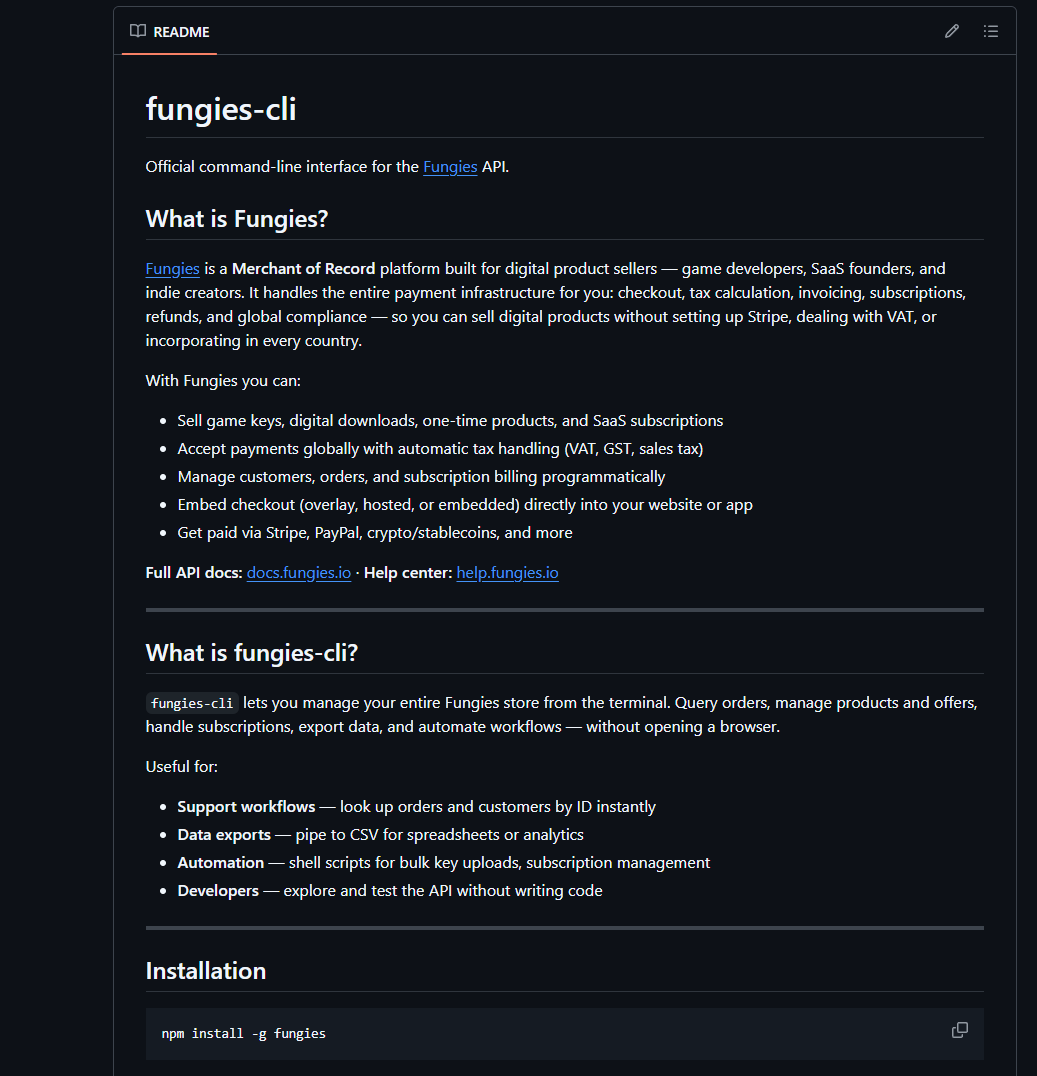
We just released the official Fungies CLI on GitHub.
You can now manage your entire Fungies store from the terminal. Query orders, update products, and handle subscriptions without opening a browser.
Check out the code here: https://t.co/W9xETtOg9k
#SaaS#Devs#MoR#Payment
We just released the official Fungies CLI on GitHub.
You can now manage your entire Fungies store from the terminal. Query orders, update products, and handle subscriptions without opening a browser.
Check out the code here: https://t.co/W9xETtOg9k
#SaaS#Devs#MoR#Payment
@ChristopherA Do you have some more concrete examples you can share where this happened? Is the multi-agent setup such that agent A coordinates other coding agents B and C, and the failure occurs because B and C deliver well-wrapped "nothingness" and A accepts it where it shouldn't?
Some people have been contemplating an idea for years, maybe decades. Obsessing, attempting, discarding, agonizing, retrying.
Some of these ideas are unpopular, niche, impractical. Not obviously capitalizable. They live on in the inventor's mind.
In 2026, millions of these ideas will come to life thanks to superintelligent coding agents.
AI doesn't get tired. It amplifies the individual, and for better and sometimes for worse, it always takes you seriously. "Great idea. Splendid. Wow. You're absolutely right."
A world of digital wonders awaits us. This world will disproportionally favor the boldest ideas. Software that once seemed impossible will be one hyperlink away. I can't wait to see it.