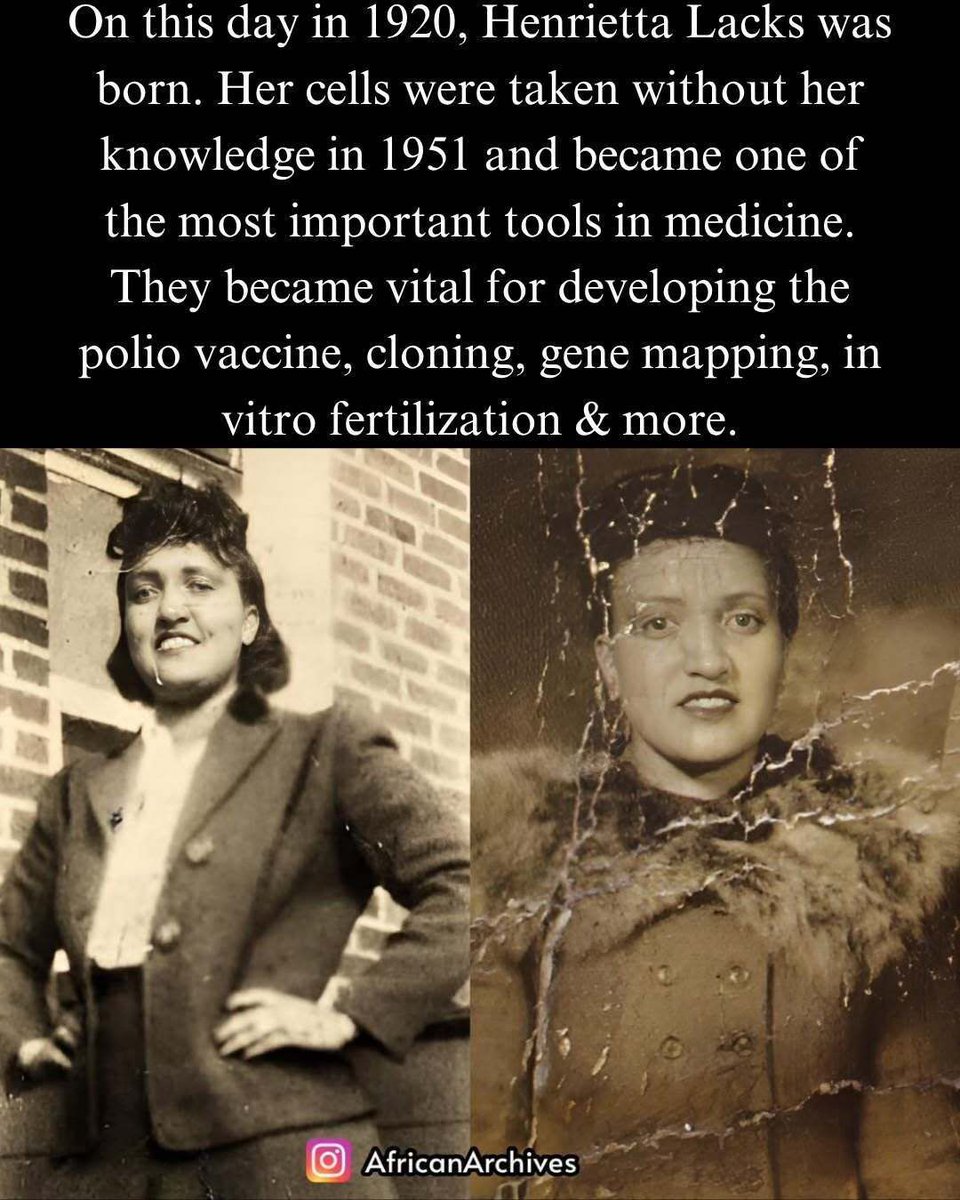
Henrietta was born on August 1, 1920, in Roanoke, Virginia, and later settled with her family near Baltimore, Maryland. Like many Black Americans living under segregation, she faced limited access to healthcare and unequal treatment throughout her life. Yet her legacy would go on to save millions of lives around the world.
In early 1951, Henrietta visited Johns Hopkins Hospital after discovering what she described as a knot in her womb and experiencing severe abnormal bleeding following the birth of her fifth child. Johns Hopkins was one of the few hospitals in the region that treated Black patients. Doctors diagnosed her with an aggressive form of cervical cancer and began treating her with radium, which was a standard cancer treatment at the time.
During one of her procedures, doctors removed samples of both healthy and cancerous tissue from her cervix without informing her or asking for her consent. At the time, obtaining permission from patients for tissue collection was not standard practice, but the ethical concerns surrounding Henrietta’s case would later transform medical research and patient rights.
The samples were given to researcher Dr. George Otto Gey, who discovered that Henrietta’s cancer cells behaved unlike any others previously studied. Instead of dying after only a few divisions, her cells continued multiplying indefinitely under laboratory conditions. They became the world’s first widely successful immortal human cell line and were named HeLa cells using the first two letters of her first and last names.
The impact of HeLa cells on science has been extraordinary. They played a crucial role in developing the polio vaccine, advanced cancer research, supported the study of viruses including HIV, contributed to gene mapping, cloning, in vitro fertilization, space biology experiments, and countless medical breakthroughs. More than 70 years later, HeLa cells continue to be used in laboratories around the world and have contributed to tens of thousands of scientific studies.
Henrietta Lacks passed away on October 4, 1951, at just 31 years old, never knowing that her cells would become one of the most valuable tools in medical history. For decades, neither she nor her family received recognition or compensation while her cells were distributed globally for research. Her story eventually sparked international conversations about informed consent, medical ethics, patient privacy, and racial inequities in healthcare.
If you love our content and would like to support the page, you can buy us a coffee here: https://t.co/K1AhtZuOFs or tap Link in Bio
October 4, 1951 — Henrietta Lacks dies at Johns Hopkins Hospital at the age of 31.
Her cells were taken without her knowledge in 1951 (HeLa cells) and became one of the most important tools in medicine. They became vital for developing the polio vaccine, cloning, gene mapping, in vitro fertilization & more.
Henrietta Lacks was black woman who unknowingly was the source of cells (from her cancerous tumor) which were cultured by George Otto Gey to create the 1st known human immortal cell line for medical research.
The Diagnosis:
On January 29, 1951, Henrietta went to Johns Hopkins Hospital because she felt a knot inside her. It all started when she asked her cousins to feel her belly, asking if they felt the lump that she did. Her cousins assumed correctly that she was pregnant.
But, after giving birth to her fifth child, Joseph, Henrietta started bleeding abnormally and profusely. Her local doctor tested her for syphilis, which came back negative, and referred her to Johns Hopkins.
Johns Hopkins was their only choice for a hospital, since it was the only one in proximity to them that treated black patients. Howard Jones, her new doctor, examined Henrietta and the lump in her cervix.
He cut off a small part of the tumor and sent it to the pathology lab. Soon after, Jones discovered she had a malignant epidermoid carcinoma of the cervix Stage 1 (cervical cancer).
Lacks was treated with radium tube inserts, which were sewn in place. After several days in place, the tubes were removed and she was released from hospital with instructions to return for X-ray treatments as a follow-up.
During her radiation treatments for the tumor, two samples of Henrietta's cervix were removed— a healthy part and a cancerous part— WITHOUT HER PERMISSION.
The cells from her cervix were given to Dr. George Otto Gey. These cells would eventually become the HeLa immortal cell line, a commonly used cell line in biomedical research.
Lacks returned for the X-ray treatments. However, her condition worsened and the Hopkins doctors treated her with antibiotics, thinking that her problem might be complicated by an underlying venereal disease (she had neurosyphilis & presented with acute gonorrhea at one point).
Death:
In significant pain and without improvement, Lacks returned to Hopkins on August 8th for a treatment session but asked to be admitted. She remained at the hospital until her death at the age of 31.
You can support my history page/project here through donations/tips to keep up on: https://t.co/HHs3SgCItN
THE WOMAN IN THE YARD has another stellar performance from Danielle Deadwyler. The visuals for the figure symbolizing depression and the looming thought of death worked well for the most part. The ending was underwhelming, but I enjoyed it as a whole.
#CaptainAmericaBraveNewWorld is a big win for Marvel Studios! Sam Wilson is undeniably Captain America. He embodies everything needed to lead the Avengers. The action is great! The story is very close to the vibes of The Winter Soldier. Watch on the biggest screen possible.