Chullin 41 - A Person Cannot Forbid Something That Is Not His
If an idolater performed a libation with a Jew's wine, but did it not in front of an idol, then Rabbi Yehudah ben Beteira and Rabbi Yehudah ben Bava say that the wine remains kosher, for two reasons: libations are normally done in front of an idol, and moreover, a person cannot forbid something that is not his. This point of view argues against what Rav Huna said about slaughter in front of idol.
This opinion also argues against the concept of kosher wine. According to it, if a Jew owns the wine, it never becomes non-kosher, even if touched or processed by non-Jews. However, it does not become law, and it was not mentioned in the whole tractate of Avodah Zarah.
One may not slaughter into a sea or into a river, because it may seem that he is slaughtering to the spirit of the sea or the river. One may slaughter into a pool of water, because blood mixed with water would never be used in idol worship.
If one slaughters a regular animal in the name of some free-will offering, then people may confuse it with an actual offering, and the shechitah is declared non-kosher.
Art: Carl Spitzweg - Still Life With A Jellyjar, A Carafe And A Bottle Of Wine
Don't understand a point? Ask https://t.co/aNZ5WqEvhm about it.
Chullin 40 - Slaughter Done for the Sake of a Mountain
If one slaughters an animal for the sake of mountains, for the sake of seas, for the sake of rivers, or for the sake of deserts, his slaughter is invalid.
Had he slaughtered for the sake of the spirit of the mountain, it would clearly be an idolatrous sacrifice, and would be forbidden for all benefit. That would be true regardless of the importance of the idol, be it the greatest angel Michael or the smallest worm with spiritual qualities ascribed to it. So by right, slaughtering for the sake of a mountain should be allowed - but the Sages made it forbidden because it is too close to an idolatrous sacrifice. However, they did not go so far as to prohibit it for all benefit.
Rav Huna gave the following rule: if someone else's animal was lying in front of an idol, and one started to slaughter it - once he cut one pipe, or even less, makes a small cut - he made it prohibited for use. Even thought normally one cannot prohibit something that is not his, in a case like this, where he did an action, even a small action suffices.
Art: Gustave Dore - Gorge In The Mountains
Don't understand a point? Ask https://t.co/aNZ5WqEvhm about it.
Chullin 39 - Shechitah for the Sake of an Idolater
If an idolater asks a Jew to perform shechitah to the idolater's animal, the shechitah is valid. Rabbi Eliezer declares the meat forbidden. According to Rabbi Eliezer, the unspoken thought of an idolater is to dedicate the animal for his idol. Therefore, even if he sells the animal to the Jew but keeps a small part for the himself, the complete animal is prohibited. Actually, the first teacher agrees that the intent of the idolater takes effect, only the first teacher requires that it be spoken, and according to Rabbi Eliezer, even the thought is sufficient, and we can even assume that thought.
Rabbi Yose disagrees and claims that the owner's thought has no effect at all. He argues thus. If in the Temple, where the kohen's intent is pervasive and makes or breaks a sacrifice, the owner's intent does not matter, then certainly in the case of regular food, the owner's intent is ineffective.
Rabbi Eliezer answers that firstly, when the Torah uses the term "one who brings the sacrifice," it means both the kohen and the owner. Secondly, just as in the Temple, the owner's idolatrous intent matters, so too it matters for regular shechitah outside the Temple.
Art: Jacob Willemsz de Wet the Elder - Figures Offering A Sacrifice In A Temple
Don't understand a point? Ask https://t.co/aNZ5WqEvhm about it.
Chullin 38 - Signs of Vitality
How do we know that an animal that is close to death is allowed to be eaten altogether? Since the Torah said "This is the animal ("chaya" meaning a live creature) that you may eat", then perhaps an animal that is close its death you may not eat?
No! That's can't be, because the Torah also said, "Do not eat nevelah, an animal that died by itself" which means that all the time that it is alive, you may slaughter and eat it. But perhaps nevelah and close to death are the same thing!? Rather, since Ezekiel said in his prayer "I never ate terefah or nevelah," we understand that he never ate the meat of an animal that was close to death, though normally this is allowed - for otherwise, what would be his special praise?
What is considered an animal close to death? One that cannot rise even when prompted to. Even if it gnaws on hard foods, this is done only out of desperation and in an attempt to escape death. If it lows with low mooing sounds, releases waste or wiggles its ear - it is alive.
Art: Frank Johnson - The Wounded Buffalo
Don't understand a point? Ask https://t.co/aNZ5WqEvhm about it.
Chullin 37 - An Animal that is Close to Its Death
Water and other liquids are not the only agents that prepare foods to accept ritual impurity. The "love" or the "esteem for the holy things" is another. This unusual concept works in the following way: even the frankincense and the wood, which are not edible at all, can accept impurity if they are part of a sacrifice, and certainly food. This is derived from an extra word "meat" in the phrase "and the meat, anybody who is pure can eat the meat."
If an animal is close to death, then we are afraid that perhaps it died before the shechitah. Therefore, for such an animal we need additional signs of vitality. Rabban Shimon ben Gamliel says that it needs to jerk its foreleg and its hind leg. Rabbi Eliezer says that it is sufficient for it to spout blood. The Sages say that it needs to jerk either a foreleg or a hind leg, or wag its tail. A small animal that merely extended its foreleg but did not retract it is not kosher, since this is just the spasm of the expiration of life.
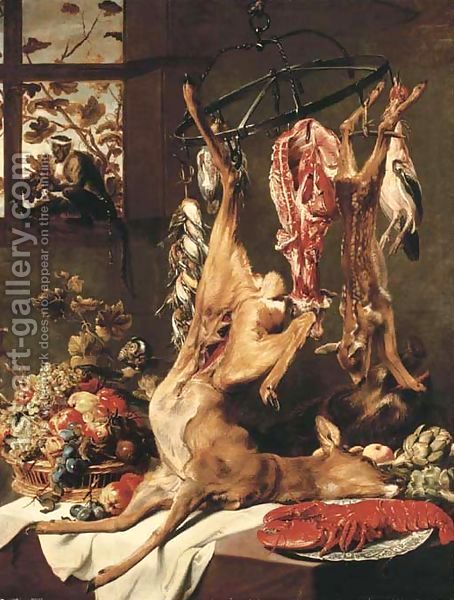
Art: Frans Snyders - A deer, a fawn and other dead game suspended on hooks
Don't understand a point? Ask https://t.co/aNZ5WqF36U about it.
Chullin 36 - Does the Blood of Shechitah Make Food Susceptible to Impurity?
To become susceptible to ritual impurity, food must come into contact with a liquid. The verse "and drinks the blood of its kill" indicates that blood is considered a "beverage," which can prepare food to become impure, but which kind of blood? Let's analyze the following rule. If one slaughtered an animal and the blood spattered on a nearby gourd, then Rabbi Yehudah the Prince says that the gourd can become impure, but his nephew Rabbi Chiya says that its state is in doubt.
When blood is let from an animal, it drips slowly at first, until, after a few drops, it begins to spurt. The initial spurt is bright, but as the blood continues to flow, it slows and darkens in color. Only this is called the "blood of its kill," when the animal dies. Rabbi Yehudah considers the complete act of slaughter as shechitah, with the "blood of its kill" being part of it, whereas Rabbi Chiya only considers the final moment as shechitah, thus at each stage it is only a doubt if a valid shechitah will result.
Art: Jan Lievens - Jacob Receiving the Blooded Tunic of Joseph
Don't understand a point? Ask https://t.co/aNZ5WqF36U about it.
Chullin 35 - Levels Of Purity, One Above the Other📷
If someone decides to keep himself on a certain level of ritual purity and to guard against contamination, he is still considered definitely impure for the next level. This is because in his mind he decided only on the given level, and a conscious effort is required for the next one. Thus, the clothing of an ignorant person is considered impure for those who conduct themselves in accordance to the laws of ritual purity, but their clothing in turn is considered impure for those to eat the kohen's portion. Those who eat the kohen's portion (priests and their family) are considered impure for those who eat sacrifices.
Earlier we said that if no blood flowed during the shechitah, the meat does not become susceptible to ritual impurity. Rabbi Shimon disagrees and says that the shechitah alone prepares the meat to become impure. According to him, the reason that wetting the food makes it susceptible to impurity is because this is the final step in food preparation. But the final step in meat preparation is the shechitah itself. The shechitah then takes the place of wetting the food, and thus makes the meat susceptible to impurity.
Art: Christoffel Lubieniecki - Food Lovers
Don't understand a point? Ask https://t.co/aNZ5WqEvhm about it.
Chullin 34 - People Who Eat The Food as of it Were a Sacrifice
Previously we quoted the rule that "if one slaughtered a domesticated animal, a wild kosher animal, or a bird, and blood did not come out of them, ... their meat may be eaten with unwashed hands." We also said that this rule cannot be talking about sacrifices, because wild animals were never brought as sacrifices in the Temple. Rather it was talking about the meat bought with the money of the second tithe.
However, there is a problem with this understanding. While it is true that one cannot eat the food of the second tithe while being impure, the mention of the hands implies that one cannot even touch the food - and that nobody ever said. Therefore, we must re-interpret the rule as talking about sacrifices after all. What about the argument that wild animals were never brought as sacrifices? That is true, and we have to further modify our understanding as talking about people who undertook to eat regular food with all the stringencies applicable to sacrificial meat. Such a diet could include venison. Game meat can be confused with regular meat, so game meat was also treated stringently.
Art: Evert Pieters - Preparing The Meal
Don't understand a point? Ask https://t.co/aNZ5WqEvhm about it.
Chullin 33 - Blood of Shechitah and Ritual Impurity
To become susceptible to ritual impurity, food must first become wet, as the Torah said, "any usual food that has [once] been wet with water shall become unclean". In addition, the owner of the food must be content with it becoming wet. Thus, washing the fruit would qualify, while the fruit falling into the water would not.
The slaughter of an animal produces blood, and the owner of the animal is content with it, thus blood prepared the animal to become ritually impure. However, we have a rule that states "if one slaughtered a domesticated animal, a wild kosher animal, or a bird, and blood did not come out of them, they are kosher. We do not assume that the animal died just prior to shechitah. It may be eaten with unwashed hands."
Unwashed hands are considered ritually impure. But why should this rule be true? It cannot be talking about sacrifices, because kosher wild animals, such as deer, are never brought as sacrifices. The only situation where this rule can be applicable is when animals were bought with the money of the second tithe.
Art: Jean-Baptiste Oudry - A Deer Chased by Dogs
Don't understand a point? Ask https://t.co/aNZ5WqEvhm about it.
Chullin 32 - Pause During Shechitah
If while one was doing the shechitah the knife fell from his hand, and then he picked it up and completed the shechitah, it is valid - if the pause was no longer than what it takes to make a shechitah. The same applies to a case where he had to sharpen the knife, or where he grew weak while doing the shechitah, and his companion finished it for him. Rabbi Shimon says, the pause should not be longer than what it takes to examine the knife.
If in doing the shechitah one properly severed the trachea, but tore the esophagus with a nicked knife, then Rabbi Yesheivav says that the animal becomes a nevelah - not slaughtered at all - and therefore carries ritual impurity. Rabbi Akiva says that the animal becomes a trefah: it is slaughtered, but considered to have an internal defect that would cause it to die within a year. Trefah cannot be eaten, but it does not carry ritual impurity.
Rabbi Yesheivav stated a rule: any animal that became unfit through slaughter becomes a nevelah, but if another incidental defect caused it to become unfit, it becomes trefah, and subsequently Rabbi Akiva agreed to it.
Art: Gerard Terborch - Woman Washing Hands
Don't understand a point? Ask https://t.co/aNZ5WqEvhm about it.
Chullin 31 - Shechitah Must Be Done With A Sawing Motion
If one chopped off the head of an animal, the shechitah is invalid because it must be done with a drawn-out, saw-like motion. Therefore, if he cut the head off with one motion, it is valid - provided that the knife was twice as long as the neck, so that he can accomplish the cut without going back and forth. If he used the back-and-forth motion, it is valid, and then the knife can be as small as a scalpel. If he cut off two animal heads in one motion, it is valid, provided that the knife is thrice as long as one neck. Two people can do a shechitah together, as long as they don't press.
Rava examined an arrow for Rav Yonah, found it smooth, and then Rav Yonah slaughtered with it a bird in flight. But perhaps the arrow entered the side of the neck and burrowed between the pipes? - They saw that the feathers around the neck were sliced. But they need to cover the blood of the bird both below and above? - They plowed the whole field over which the bird was flying, and thus the loose earth served for covering below.
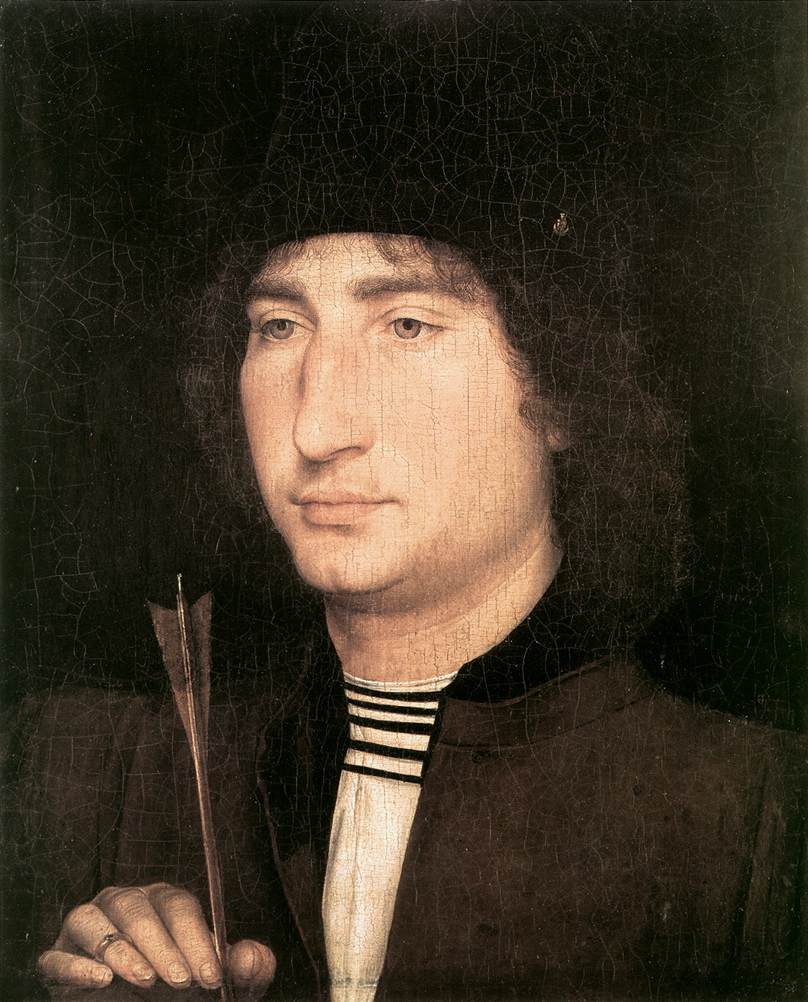
Art: Hans Memling - Portrait of a Man with an Arrow
Don't understand a point? Ask https://t.co/aNZ5WqF36U about it.
Chullin 30 - The Process or the Result of Shechitah?
Resh Lakish said in the name of Levi the Elder, "The act of shechitah counts at the end," but Rabbi Yochanan said that the complete process of the cut, from the beginning untill end end, is called shechitah. For example, if someone started the shechitah while outside the Temple and completed it inside, then according to Rabbi Yochanan he is liable for bringing sacrifices outside the Temple, since from the beginning of the cut he was already doing the shechitah. According to Resh Lakish, he is not liable, since only the end of shechitah is significant, and that happened inside.
Rav Yehudah said in the name of Rav, "If one severs the pipe in two or three places, his slaughter is valid." But when he repeated this teaching in front of Shmuel, Shmuel said it was invalid. A defense for Rav: as we will learn later, two people can hold a knife and together make a shechitah to an animal. This proves that you can make two cuts! Answers Shmuel, "No! They are holding the same knife together and cutting. We need a clearly visible single cut."
Art: Caspar David Friedrich - Two men at moonrise by the sea
Don't understand a point? Ask https://t.co/aNZ5WqF36U about it.
Chullin 29 - Can One Divide Exactly In Two Halves?
If in doing the shechitah one cuts exactly half of the pipe's circumference, Rav says that it is valid, because God told Moses not to leave over more than half uncut, and Rav Kahana says that it is invalid, because God told Moses to but the greater part when slaughtering.
An objection against Rav comes from the laws of purity. If one split a ritually impure earthenware oven into two pieces, ostensibly of the same size - they both remain impure, because it is impossible to be precise in anything, and any of the two pieces might be the larger one. However, if it were possible to be precise, the pieces would be pure! But, according to Rav, exactly half is considered like more than half, and thus the pieces should remain impure, which proves that Rav is wrong! Said Rav Pappa in Rav's defense, in an oven both pieces cannot be the larger ones, but in slaughter we care only about the part that is cut.
In the end the Rav's point of view is revised as untenable, and instead we say that the argument is not about shechitah, but about half of all Jews being impure on Passover.
Art: Pieter Harmansz Verelst - A young boy reclining, eating from an earthenware bowl
Don't understand a point? Ask https://t.co/aNZ5WqEvhm about it.
Chullin 28 - Is Shechitah Required for Birds?
📷
Rav Yehudah said in the name of Rabbi Yitzchak ben Pinchas, "There is no requirement for kosher slaughter of birds in the Torah." Rather, it was instituted by the Sages. Granted, if the bird dies by itself or from a blow to a part of its body, it does become a nevelah and may not be eaten. However, one can kill the bird by tearing or piercing its pipes, and that would be sufficient. The hint to this in the Torah is found in the requirement to cover the blood of a killed bird, - meaning, covering the blood is all that is required.
Objection to the statement of Rabbi Yitzchak! We learned a rule that "If one was doing the shechitah, and inadvertently rendered it a nevelah, or if he pierces or tears the creature's pipes, he does not have to cover the blood. We see from here that piercing is not considered shechitah, to the extent that even blood covering is not required! What will Rabbi Yitzchak answer? He says that this rule is only about a wild animal - since covering the blood is also required for a wild animal - and not about a bird.
Art: Jan Fyt - A cat stalking dead songbirds on a ledge
Don't understand a point? Ask https://t.co/aNZ5WqEvhm about it.
Chullin 27 - Must Shechitah Be Done From The Neck?
Shechitah is done from the neck: one cuts more than half of the windpipe and the food pipe for an animal, and one pipe is enough for a bird.
Why from the neck? Said Rav Kahana, the word "shechitah" says it: "shach" means something that bends, that is the neck, and "chat" means to prepare. But the tail also bends, so perhaps we should cut from the tail? - No, the tail is already bent, and we need something that bends occasionally. But perhaps we should cut from the ear, because it sometimes bends? - No, we need the lifeblood, and it does not go from the ear. Still, how would we know the five disqualifications of the shechitah, which are pausing, pressing, burrowing, cutting beyond and tearing? - We are forced to conclude that cutting from the neck was taught to Moses on Sinai and is not based on a word in the Torah.
Rav Yeimar said, the word slaughter, "zavach" means to cut where it (the blood) flows ("zav"). But perhaps we should cut from the nose, from which mucus flows? - No, mucus always flows, and blood - only when cut.
Art: Thomas Wade - Man Tickling a Woman's Nose with a Feather
Don't understand a point? Ask https://t.co/aNZ5WqEvhm about it.
Chullin 26 - Different Stages of Development
Two strands of almonds were cultivated in Israel: one, the "bitter almond," whose fruit became bitter as it grew larger; and the other, the "sweet almond," whose fruit became sweeter as it grew larger. What is subject to tithing in the case of bitter almonds (when they are small and sweet) is exempt in the case of sweet almonds (when they are still bitter), and vice versa.
Soaked grape-seeds - before they ferment are like water and cannot be bought with second tithe money, after they ferment, they are food (wine) and can be bought with with second tithe money. The brothers whose father died - before they divide the estate they have the law of a single person (father) and have to separate animal tithe; after they divided it, even if they continue together, are like partners and do not have to separate animal tithe.
A girl who is a minor - her father can sell her as a maidservant, but there is no fine for seduction; once she grows up, her father can't sell her, and there is a penalty for rape or seduction. The Sages disagree and say that there is always a penalty.
Art: Artemisia Gentileschi - Judith and Her Maidservant
Don't understand a point? Ask https://t.co/aNZ5WqEvhm about it.
Chullin 25 - What is Fit for One is Unfit for Another
What is pure in the case of earthenware utensils is impure in the case of all other utensils, and vice versa. If a dead lizard is inside a clay pot, even not touching it, the pot is impure, but if it touches the outside, the pot remains pure. The opposite is true of other utensils.
How do we know this highly unusual law of earthenware utensils? The Torah said, "an earthenware utensil into whose interior one of the eight dead reptiles will fall … will become impure" - even if the reptile does not touch it. It also said,"any open utensil under the same roof with a dead body, if it does not have a cover, will become impure", to teach that if it does have a cover, it remains pure and protects from impurity - even if it is touched from the outside.
What is pure in the case of wooden utensils is impure in the case of metal utensils, and vice versa. Wooden utensils can be used before they are fully finished, and are thus susceptible to impurity. However, if they lack a hollow of any kind, they remain pure. The reverse is true of metal utensils.
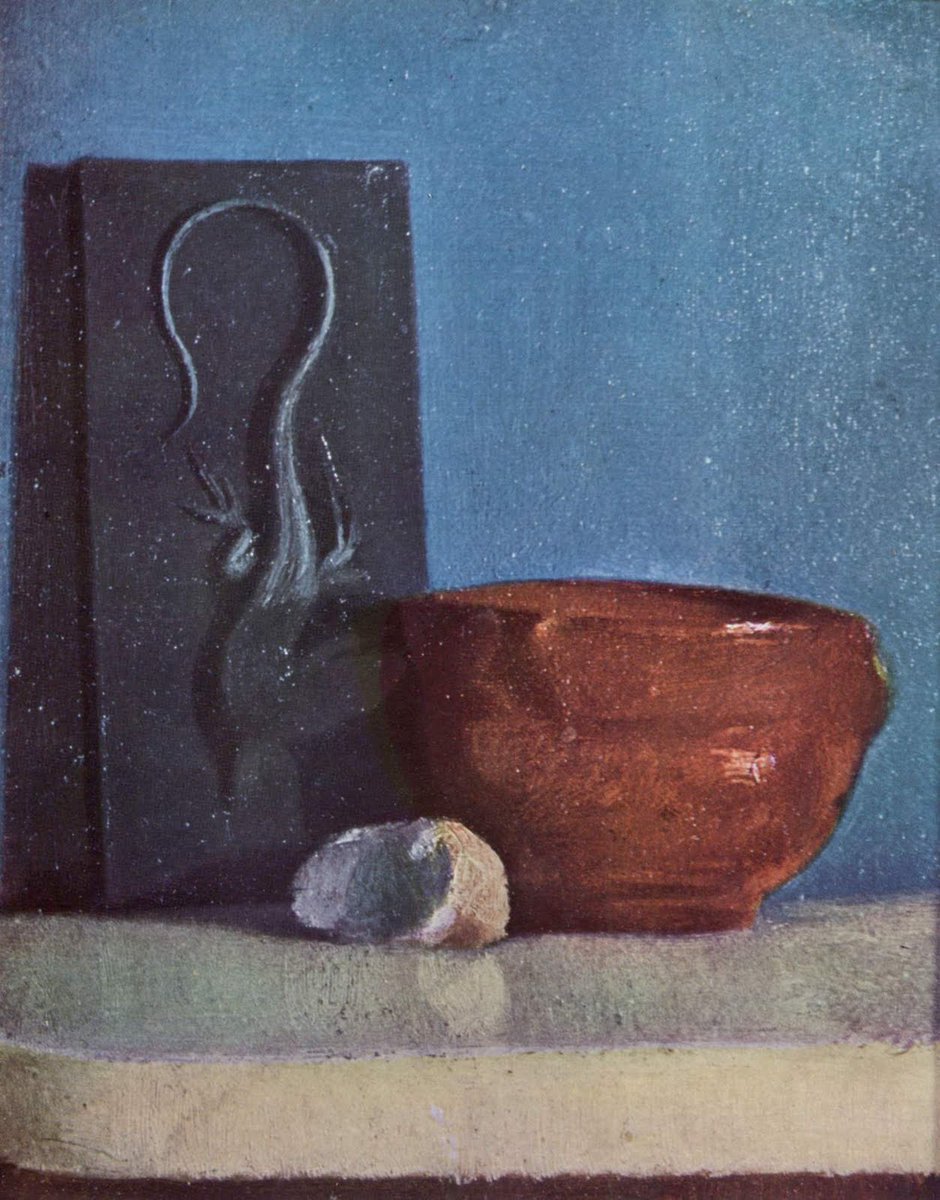
Art: Edgar Degas - Still Life With Lizard
Don't understand a point? Ask https://t.co/aNZ5WqEvhm about it.
Chullin 24 - Five Years for Success in Study
A red heifer was slaughtered by shechitah from the front of the neck, and its ashes were used to remove ritual impurity. The decapitated calf was a needed when a dead body was found in the Land of Israel: the Sages of the nearby town would kill the calf by breaking its neck from the back. Therefore we have a rule: "What is valid for the red heifer is invalid for the decapitated calf, and vice versa."
What is fit for the kohanim is unfit for the Leviim, and vice versa. The kohanim were disqualified by blemishes, but they could serve at any age. In contrast, the Leviim were not disqualified by blemishes, but they had age limitations: they would start studies at 25 and continue on to service at 30. They retired at 50.
The service of the Leviim included guarding the gates, singing in the Temple choir and playing in the Temple orchestra. From them we have a rule that any student who does not see success in the first five years of his studies will never see it. Some say that at this point he should try Kabbalah.
Art: Emil Jacobs - Young Student
Don't understand a point? Ask https://t.co/aNZ5WqEvhm about it.
Chullin 23 - Intermediate Stages of Birds, Lambs, and Dough
If the feathers of a turtledove or a pigeon started yellowing, the turtledove can't be sacrificed because it is too young, and the pigeon - because it is too old. Rabbi Zeira asked, "Is this for sure or out of doubt?" Meaning, if one promised a bird burnt offering and then brought a turtledove and a pigeon with yellowing feathers, is at least one of them valid, or, because it is a bird in a class by itself, neither is valid?
Try this answer: the Torah said "sacrifices … from birds," and this means that some birds are excluded. Which ones? Isn't it ones with yellowing feathers? - No! Excluded are birds that were sodomized or worshiped, and Rabbi Zeira does not get an answer.
He asked a similar question about sheep. A sheep younger than twelve months is a lamb, one older than thirteen is a ram, what is its status in between? Does it require libations like either a lamb or a ram, or is it a separate creature with no libations? Again, no answer. He also asked about dough in intermediate stages of leavening, can it be brought as part of a thanksgiving offering.
Art: Antonio Paoletti - Feeding The Pigeons At Piazza St. Marco, Venice
Don't understand a point? Ask https://t.co/aNZ5WqEvhm about it.




![TalmudTweets's tweet photo. Chullin 33 - Blood of Shechitah and Ritual Impurity
To become susceptible to ritual impurity, food must first become wet, as the Torah said, "any usual food that has [once] been wet with water shall become unclean". In addition, the owner of the food must be content with it becoming wet. Thus, washing the fruit would qualify, while the fruit falling into the water would not.
The slaughter of an animal produces blood, and the owner of the animal is content with it, thus blood prepared the animal to become ritually impure. However, we have a rule that states "if one slaughtered a domesticated animal, a wild kosher animal, or a bird, and blood did not come out of them, they are kosher. We do not assume that the animal died just prior to shechitah. It may be eaten with unwashed hands."
Unwashed hands are considered ritually impure. But why should this rule be true? It cannot be talking about sacrifices, because kosher wild animals, such as deer, are never brought as sacrifices. The only situation where this rule can be applicable is when animals were bought with the money of the second tithe.
Art: Jean-Baptiste Oudry - A Deer Chased by Dogs
Don't understand a point? Ask https://t.co/aNZ5WqEvhm about it.](https://pbs.twimg.com/media/HJ0aucDWgAAzBrH.jpg)