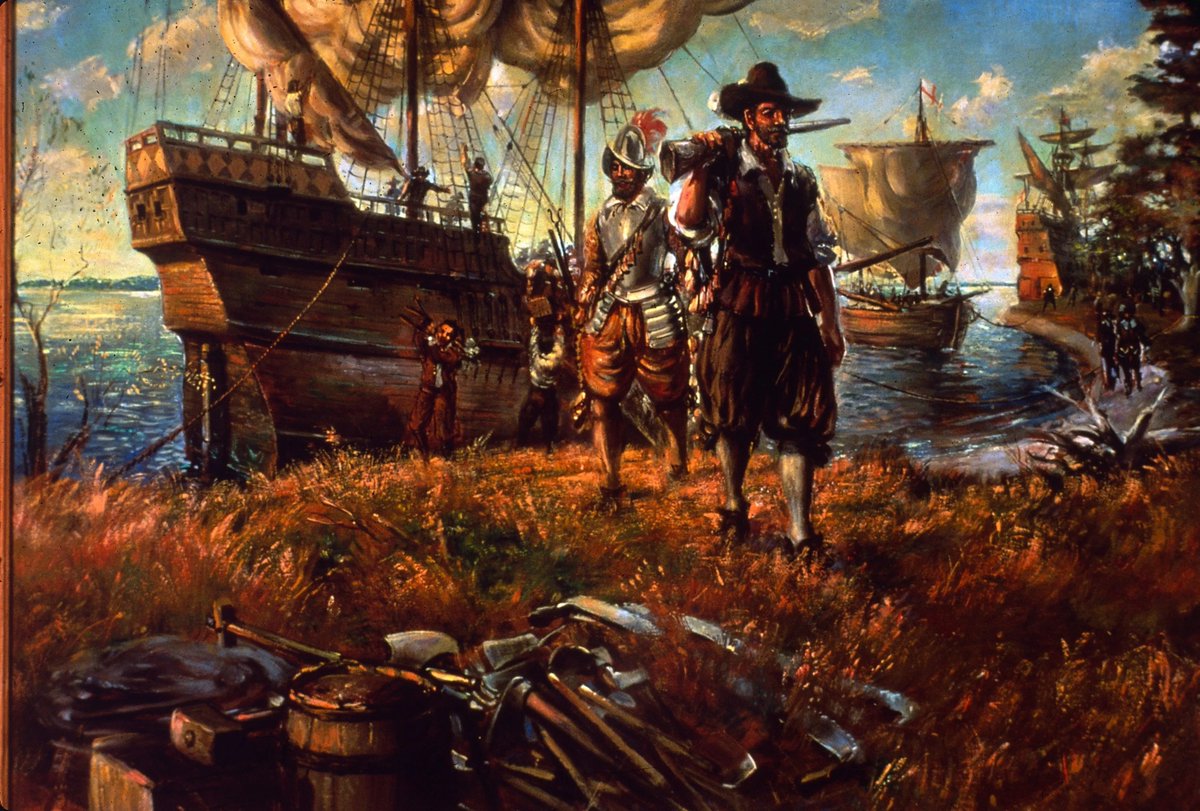
It was today in 1607, 419 years ago, that America's story truly began
104 brave and intrepid adventurers landed on a peninsula jutting out into the Chesapeake and the James River, and named it Jamestown, after their King James I
What followed was a desperate fight for survival. The hundred-odd men had chosen a location that was defensible--which helped with the near-constant Indian attacks--but that was, because of its location near so much quite stagnant water, the most pestiferous and febriferous hell imaginable. It was a near-perfect breeding ground for malarial mosquitoes, caused massive cholera outbreaks, and was otherwise a hellish spot to undergo the "Seasoning" period that long killed five out of every six new arrivals in Virginia. Yet further, few of the men who arrived were farmers--most were either second sons, tradesmen, or London's poor--and so growing food proved to be a challenge, a problem not helped by the new environment
And so the starving men held on as fever and ague wracked their bodies, as Indian arrows plunged into them from behind the tall grass, as an accidental fire burned their homes and storehouse in the height of winter and plunged them into desperate starvation. Meanwhile they found nothing of value that economically justified the colony's existence
It was a horrible period, and the little settlement barely managed to hang on for year after year, desperately battling deadly fever and murderous Indians--often at the same time--in a bid for survival
And they did it for their God and country. They saw it as their duty to bring the bright light of Protestantism to a New World that knew only the worst sort of paganism and the bloody cross of Catholic Spain. Still in the Elizabethan mind, they set about correcting that by planting a colony of their own that would take their faith and their rule to the New World...and hopefully make a profit, somehow, in so doing
For that they clung to life and fought on, and with John Rolfe's bringing of Spanish tobacco to the colony, then peace to it with his marriage to Pocahontas, the colony caught its stride and rocketed upwards in prosperity and settlers
Out of Jamestown came America, and that story began today, all those centuries ago
Before 1777, the American Revolution looked like a losing effort. Then came Saratoga—a battle that changed everything and convinced France to join the fight. See how one victory reshaped history. Watch now
It’s amazing to see Gorsuch start with talk of “an idea,” then go into detail about the Founders—men who shared a common culture, more or less similar views on the West and Christianity writ large (with a few exceptions, yes), and were all products of British colonial civilization in America—and then pivot back to this tired trope about America being a “creedal nation.”
They cannot seem to get out of this mental rut—or they don’t want to. America is not a really great idea. It’s a people and a culture derived from England and Christian Europe. Anyone who wants to be an American must adopt that culture as their own.
It’s not racist or xenophobic to say this, it’s simply the truth. And it would be nice if we had leaders and public figures who were willing to speak the truth on our semiquincentennial.
Elon Musk avait dit un truc qui m'avait marqué sur l'allocation de ressources. En substance : passé un certain niveau de richesse, l'argent n'est plus de la consommation, c'est de l'allocation de capital.
Cette phrase change tout.
L'économie, dans le fond, c'est juste un problème d'allocation. Tu as des ressources finies et des usages infinis. Qui décide où va quoi ?
Imagine une cour de récré. 100 enfants, des paquets de cartes Pokémon distribués au hasard. Tu laisses faire. Très vite, un ordre émerge. Les bons joueurs accumulent les cartes rares, les collectionneurs trient, les négociateurs trouvent des deals. Personne n'a planifié. Et pourtant chaque carte finit dans les mains de celui qui en tire le plus de valeur. Le système maximise le bonheur total de la cour. C'est ça, la main invisible.
Maintenant fais entrer la maîtresse. Elle trouve ça injuste. Léo a 50 cartes, Tom en a 3. Elle confisque, redistribue, impose l'égalité. Trois effets immédiats. Les bons joueurs arrêtent de jouer, à quoi bon. Les mauvais n'ont plus de raison de progresser, ils auront leur part. Les échanges s'effondrent. La cour est égale, et morte. Elle a maximisé l'égalité, elle a détruit le bonheur.
Le problème de la maîtresse, c'est qu'elle ne peut pas avoir l'information que la cour avait collectivement. C'est le problème du calcul économique de Mises, formulé en 1920. L'URSS a essayé de le résoudre pendant 70 ans avec le Gosplan. Résultat : pénuries, queues, effondrement. Pas parce que les Soviétiques étaient bêtes, parce que le problème est mathématiquement insoluble en mode centralisé.
Quand Musk a 200 milliards, il ne les consomme pas, il les alloue. SpaceX, Starlink, Neuralink, xAI. Chaque dollar est un pari sur le futur. Et lui a un track record. PayPal, Tesla, SpaceX. Il a démontré qu'il sait identifier des problèmes immenses et y allouer des ressources avec un rendement spectaculaire.
L'État aussi a un track record. Hôpitaux qui s'effondrent, éducation qui décline, dette qui explose, services publics qui se dégradent malgré des budgets en hausse constante. Le marché identifie les bons allocateurs, la politique identifie les bons communicants.
Le profit n'est pas une finalité, c'est un signal. Il dit : tu as alloué des ressources rares vers un usage que les gens valorisent suffisamment pour payer. Plus le profit est gros, plus la création de valeur est grande. Quand Starlink est rentable, ça veut dire que des millions de gens dans des zones rurales ont enfin internet. Quand un ministère est en déficit, ça veut dire qu'il consomme plus qu'il ne produit. L'un crée, l'autre détruit, et on appelle ça redistribution.
Dans nos sociétés il y a deux catégories d'acteurs. Les entrepreneurs et les bureaucrates. L'entrepreneur prend un risque personnel pour identifier un problème, mobiliser des ressources, créer une solution. S'il se trompe il perd. S'il a raison, ses clients gagnent, ses employés gagnent, ses fournisseurs gagnent, l'État collecte des impôts. Il est la cellule de base du progrès humain.
Le bureaucrate ne prend aucun risque personnel. Son salaire est garanti. Au mieux il maintient une rente existante. Au pire il la détruit par excès de réglementation, mauvaise allocation forcée, incitations perverses qui découragent ceux qui produisent. Mais dans aucun cas il ne crée.
Regarde les 50 dernières années. iPhone, internet civil, SpaceX, Tesla, Google, Amazon, Stripe, mRNA, ChatGPT. Toutes des inventions privées, portées par des entrepreneurs, financées par du capital risque. Pas un seul ministère n'a inventé quoi que ce soit qui ait changé ta vie au quotidien.
La France est devenue le laboratoire mondial de la dérive bureaucratique. 57% du PIB en dépenses publiques, record absolu. Une administration tentaculaire, une fiscalité qui pénalise la création de richesse. Résultat : décrochage face aux États-Unis, à l'Allemagne, à la Suisse. Fuite des cerveaux. Désindustrialisation. Dette qui explose.
Et le pire c'est que la mauvaise allocation s'auto-renforce. Plus l'État prélève, moins les entrepreneurs créent. Moins ils créent, moins il y a de base fiscale. Plus l'État s'endette et taxe. Boucle de rétroaction négative parfaite. La maîtresse pense qu'elle aide, et chaque année la cour produit moins.
Dans nos sociétés, ce sont les entrepreneurs, toujours, qui font avancer la civilisation. Les bureaucrates au mieux maintiennent une rente, au pire la détruisent. Aucune société n'a jamais progressé en taxant ses créateurs pour subventionner ses gestionnaires.
La question n'est jamais qui a combien. C'est qui alloue le mieux la prochaine unité de ressource pour maximiser le futur de l'humanité. La réponse depuis 200 ans n'a jamais changé. Ce ne sont pas les fonctionnaires.
Mark Cuban just described the largest wealth transfer of the AI era.
Almost nobody understood what he said.
Cuban: “There are 33 million companies in this country. Aren’t going to have AI budgets. Aren’t going to have AI experts.”
Not tech startups.
The shoe store. The regional trucking outfit. The accounting firm with 12 employees.
The businesses that actually run the physical economy.
They know AI is coming. They have no idea what to do with it.
Cuban: “You’ve got the head of Microsoft saying software is dead because everything’s going to be customized to your unique utilization.”
Software is dead.
The SaaS era ran on one rule. Build a generic product. Force millions of companies to bend their workflows around it. Charge rent forever.
AI ends the contract.
The business stops bending to the software. The intelligence bends to the business.
But customized by whom.
The third-generation manufacturer cannot tell Claude from Gemini. The county hospital is staring at a reactor asking where the light switch is.
Cuban: “Who’s going to do it for them?”
That question is worth more than the frontier models themselves.
Hundreds of billions are being burned to build the foundation. The smartest engineers alive are locked in a bloodbath over who owns the base layer.
Let them fight.
Let them burn the capital. Let them drive the cost of raw intelligence toward zero.
Because the wealth does not collect where the brain is built.
It collects where the brain meets the business.
Every ambitious kid in college right now thinks survival means a seat at OpenAI or Anthropic.
Cuban is staring at the other 99 percent of the economy.
Learn the models. Then learn the messy, unglamorous reality of how a 50-person company actually operates.
Walk through the door. Understand their problems. Wire the intelligence directly into their revenue.
That is not a job title. That is an entire economic class being born.
You do not need to build the brain. You need to build the nervous system.
The biggest winners of the electricity era were not the engineers who built the generators. They were the ones who walked into dark factories and showed the owners where to plug in.
33 million companies are standing in the dark right now.
Silicon Valley is racing to build the god. The fortunes will belong to whoever teaches him a trade.
The data on neurodivergent workers is so lopsided it looks like a typo.
JPMorgan Chase ran an Autism at Work program and found participants were 90% to 140% more productive than neurotypical employees. With fewer errors. UiPath partnered with AutonomyWorks on AI data labeling and reported neurodivergent associates were 150% more productive than non-neurodiverse talent. Hewlett-Packard integrated neurodivergent professionals into software testing teams and measured a 30% productivity gain. EY reported neurodiverse teams were 1.2 to 1.4x more productive and more accurate than comparable groups. At SAP, a single neurodivergent employee’s solution saved the company $40 million.
Now zoom out. 15 to 20% of the global population is neurodivergent. One in five adults. Yet only 22% of autistic adults in the UK are employed. And 73% of neurodivergent people don’t disclose during hiring because they’re afraid of being discriminated against.
That means the most productive talent pool in the workforce is also the most underemployed and the most hidden.
Karp sees this and is building a pipeline to capture it. Palantir’s Neurodivergent Fellowship pays $110,000 to $200,000 a year. The job posting says outright that neurodivergent individuals will “disproportionately shape the future of America and the West.” A Gartner study projects that one in five Fortune 500 sales organizations will actively recruit neurodivergent talent by 2027. Palantir is two years ahead of that curve.
The roster of neurodivergent founders reads like a hall of fame. Branson built Virgin with ADHD and dyslexia. Kamprad founded IKEA and invented the naming system because he couldn’t remember product codes. Musk disclosed Asperger’s on live television. Steve Jobs was dyslexic and dropped out. 40% of self-made millionaires in the UK are dyslexic. People with ADHD are estimated to be up to 500% more likely to become entrepreneurs.
Karp himself is dyslexic. He built a $370 billion company. And he’s saying the system that filtered him out, the standardized tests, the credential pipelines, the interview formats designed for neurotypical candidates, is about to become even more obsolete as AI eats every routine cognitive task those systems were built to evaluate.
The bet is simple: AI commoditizes average. The people who see patterns no one else sees, who obsess for 14 hours on a problem everyone else quit after 2, who build IKEA’s naming system because the “normal” approach didn’t work for their brain, those are the ones who can’t be replaced by a model.
Karp is recruiting them while everyone else is still writing job descriptions that screen them out.
A tiny Moon making massive waves in the massive rings of Saturn.
If you think you're too small to make an impact, look at Daphnis. A tiny speck of dust causing 1.5-mile high waves in a ring system 175,000 miles wide.
How the CIA Secretly Recruits Influencers
“Stage one is I show you all of your browsing history, captures from your webcams on all of your phones and computers.”
How the CIA Secretly Recruits Influencers
“Stage one is I show you all of your browsing history, captures from your webcams on all of your phones and computers.”
The U.S. government is banning all routers made overseas, meaning consumers will no longer be able to purchase devices from many popular manufacturers.
Link:
https://t.co/RhHF8BBjjZ
The U.S. government is banning all routers made overseas, meaning consumers will no longer be able to purchase devices from many popular manufacturers.
Link:
https://t.co/RhHF8BBjjZ