Check our new paper! The quantum lattice gates we designed for bosonic codes are both experimentally feasible and much faster to implement. This is a powerful new approach we’ve developed. Huge thanks to all collaborators!
@QuantumLeiDu@GuoLingzhen.
https://t.co/m8JE4w8a0I
Every December since 2017, I've delivered a keynote at Q2B Silicon Valley, commenting on recent progress in quantum computing. Here is what I said this time. It's been a good year for quantum.
https://t.co/NcZqWV0dDV
My first PRL paper is now online! Grateful for the amazing journey—delving into interesting problems alongside outstanding collaborators. A big thank you to everyone involved, including the reviewers for their constructive feedback. @PhysRevLett
Link: https://t.co/qiYNEqNH9U
New preprint out today with Tangyou Huang, Akshay Gaikwad, Sorin Paraoanu, Giovanna Tancredi, and many others in the experimental and theory teams @wacqt_sweden@chalmersuniv and @AaltoUniversity: ”Quantum Process Tomography with Digital Twins of Error Matrices” (1/3)
In this preprint, we introduce a new and universal framework for building robust quantum-error-correctable codes for bosonic systems, by a new set of quantum operations, called “quantum lattice gates”! @GuoLingzhen @QuantumLeiDu https://t.co/xLaubuVTkL
One of the major error in this method now can be analytically mitigated by perturbative framework published in https://t.co/NV46R0vIgQ and see highlights at https://t.co/gnLIOhLoDr
A superconducting transmon operating at 72 GHz is the highest-frequency qubit measured to date, enabling quantum experiments near 1 K and thus more accessible, high-energy superconducting quantum technologies.
https://t.co/0QVHs3E9JJ
arXiv -> alphaXiv
Students at Stanford have built alphaXiv, an open discussion forum for arXiv papers. @askalphaxiv
You can post questions and comments directly on top of any arXiv paper by changing arXiv to alphaXiv in any URL!
Next in the PRL series of forward-looking Essays (see https://t.co/wsyUaRRUnC), Jun Ye and Peter Zoller envision exciting research paths at the intersection of AMO physics, quantum technologies, and fundamental physics #OpenAccess https://t.co/qot1Xv8fvc
The digital twin of a quantum sensor is capable to capture the sensing behavior of observable and noise interference. And one can realize it by a deep generative model (see training process in GIF ).
How to enhance the performance of quantum sensing by information processing ? Check out our new article at https://t.co/J30vbVeH5x. We propose a generative model to significantly improve the sensitivity of atomic force sensing. @CommsPhys
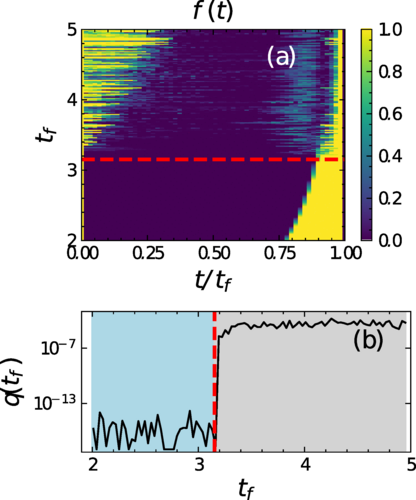
Time-optimal control of driven oscillators by variational circuit learning, Tangyou Huang, Yongcheng Ding, Léonce Dupays, Yue Ban, Man-Hong Yung, Adolfo del Campo, and Xi Chen #QuantumInformation https://t.co/VPLCMtoaM7
Time-optimal control of driven oscillators by variational circuit learning. Authors: Tangyou Huang, Yongcheng Ding, Léonce Dupays, Yue Ban, Man-Hong Yung, Adolfo del Campo, and Xi Chen. Learn more in Physical Review Research: https://t.co/Pt8CjU5lIg. #QuantumInformation