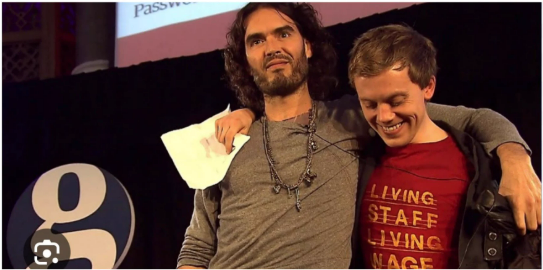
@SnafuAB@LBC@BenKentish I don’t have a son, but my nephews (blood and defacto) have all been taught the importance of consent by their families. Families who are responsible and level-headed, not rancid, racist, ‘Christians’ (in name not nature). Stick to wearing your tin hat in Canada.
@reillyusa Indeed. @GWR as bad. Can’t even make a call at some points. Recent Italy, Moldova, Armenia, France, Poland rail travel showed just how much the U.K. lags behind. Mind you, connectivity beyond trains an utter joke. Heidi Alexander or Lisa Nandy asleep at wheel.
This is very important to understand and was crucial rape myth busted by trial. Contrary to so many other women (sisters?!) posting, consent to one form of sex does not mean someone gets to alternatively anally rape you. Next fight for us all is teaching our boys and girls this
On Thursday I wrote about the 2014 injunction Russell Brand obtained against a woman who accused him of assault.
I've now obtained the final order. It's breathtaking.
She had no lawyer. No trial. Yet she was silenced for life - even barred from speaking to the police.
🧵:
It makes sense that #RussellBrand has been the darling of both the Left, the Right and the religious
Misogyny is everywhere, shape-shifting, surviving and thriving, ubiquitous and adaptable
In religion, political groups and all the spaces in between
It’s worse than I first thought —
Not only have they not had a fee RISE, they had a fee CUT during that time.
So pay is now LOWER than 1996 - not just in real terms, but the number is lower.
@sophwilkinson Brava Rosamund. Some of us NEVER fell for the public/media/celebrity adoration of Brand. His millions of apologists laughed along at rape ‘bantz’. The Venn diagram of Brand apologists is beyond cluttered, but shout out to Jonathan Ross, and kudos to Bob Geldof.
@BBCNews In my experience O2 has all but given up providing a service in parts of London an elsewhere. No redress. Virgin O2 has top spot in my my Enshittification chart.
Non-engagement is often a symptom, not a choice.
Over 15 years in the NHS, I saw a clear shift in how we respond to people who don't attend.
When someone at risk missed appointments or didn't answer calls, we used to go to them. A home treatment or CMHT nurse would visit, check they were safe and try to bring them into treatment.
As an on-call registrar, I assessed many people who had said they were suicidal but couldn't come to clinic or had missed appointments. The team was worried, so we made the effort to reach them many times during the night or at weekends.
In recent years, I have seen people discharged despite high risk, simply because they don't engage. This is often based on an assumption that they have capacity, without a proper capacity assessment.
The same happens to people with severe anxiety or agoraphobia. Some cannot leave home, yet they receive a letter, miss the appointment and are discharged without ever being seen.
I have seen people deteriorate after this, in the NHS, in A&E and in private practice.
We have moved from trying to engage people who are unwell to discharging them for not engaging, even when that is part of their illness.
If someone can't come to us because of their illness, the answer shouldn't be a discharge letter.