Jeff Bezos pays a true tax rate of .9%. A teacher in NY-12 pays 30% of their income in taxes.
Is it any wonder that Americans look at this system and and think it is completely rigged against them?
As #NYC prepares for the 2026 FIFA World Cup, local business visibility matters.
@thenewbxcc's (Bronx Chamber of Commerce) Bronx World Cup Business Hub is a practical tool to help spotlight #Bronx businesses, attractions, events, offers, and visitor experiences ahead of this global moment.
Thank you to @News12BX and Isabella Giardina for covering the effort.
https://t.co/fUG1LmRALR
Interesting stuff. If true, it strongly supports writing thank you notes, birthday cards, or other handwritten notes. It also explains why I need to write anything down to remember it.
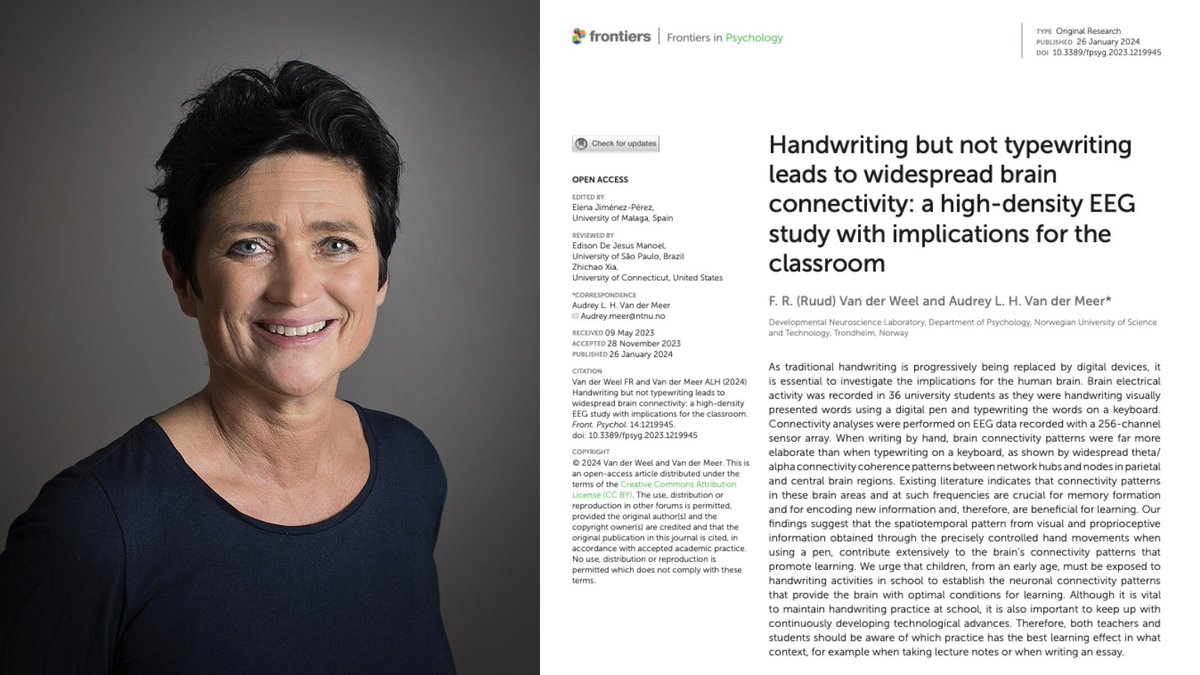
A Norwegian neuroscientist spent 20 years proving that the act of writing by hand changes the human brain in ways typing physically cannot, and almost nobody outside her field has read the paper.
Her name is Audrey van der Meer.
She runs a brain research lab in Trondheim, and the paper that closed the argument was published in 2024 in a journal called Frontiers in Psychology. The finding is brutal enough that it should have changed every classroom on Earth.
The experiment was simple. She recruited 36 university students and put each one in a cap with 256 sensors pressed against their scalp to record brain activity. Words flashed on a screen one at a time.
Sometimes the students wrote the word by hand on a touchscreen using a digital pen, and sometimes they typed the same word on a keyboard. Every neural response was recorded for the full five seconds the word stayed on screen.
Then her team looked at the part of the data most researchers had ignored for years, which is how different parts of the brain were communicating with each other during the task.
When the students wrote by hand, the brain lit up everywhere at once.
The regions responsible for memory, sensory integration, and the encoding of new information were all firing together in a coordinated pattern that spread across the entire cortex. The whole network was awake and connected.
When the same students typed the same word, that pattern collapsed almost completely.
Most of the brain went quiet, and the connections between regions that had been alive seconds earlier were nowhere to be found on the EEG.
Same word, same brain, same person, and two completely different neurological events.
The reason turned out to be something nobody had really paid attention to before her work. Writing by hand is not one motion but a sequence of thousands of tiny micro-movements coordinated with your eyes in real time, where each letter is a different shape that requires the brain to solve a slightly different spatial problem.
Your fingers, wrist, vision, and the parts of your brain that track position in space are all working together to produce one letter, then the next, then the next.
Typing throws all of that away. Every key on a keyboard requires the exact same finger motion regardless of which letter you are pressing, which means the brain has almost nothing to integrate and almost no problem to solve.
Van der Meer said it plainly in her interviews.
Pressing the same key with the same finger over and over does not stimulate the brain in any meaningful way, and she pointed out something that should scare every parent who handed their kid an iPad.
Children who learn to read and write on tablets often cannot tell letters like b and d apart, because they have never physically felt with their bodies what it takes to actually produce those letters on a page.
A decade before her, two researchers at Princeton ran the same fight using a completely different method and ended up at the same answer. Pam Mueller and Daniel Oppenheimer tested 327 students across three experiments, where half took notes on laptops with the internet disabled and half took notes by hand, before testing everyone on what they actually understood from the lectures they had watched.
The handwriting group won by a wide margin on every question that required real understanding rather than surface recall.
The reason was hiding in the transcripts of what the two groups had actually written down.
The laptop students typed almost word for word, capturing more total content but processing almost none of it as they went, while the handwriting students physically could not write fast enough to transcribe a lecture in real time, which forced them to listen carefully, decide what actually mattered, and put it in their own words on the page.
That single act of choosing what to keep was the learning itself, and the keyboard had quietly skipped the choosing and skipped the learning along with it.
Two studies. Two countries. Same answer.
Handwriting makes the brain work. Typing lets it coast.
Every note you have ever typed instead of written went into your brain through a thinner pipe. Every meeting, every book highlight, every idea you captured on your phone instead of on paper was processed at half depth.
You did not forget those things because your memory is bad. You forgot them because typing never woke the part of the brain that would have made them stick.
The fix is the thing your grandmother already knew.
Pick up a pen. Write the thing down. The slower road is the faster one.
Walmart is selling you an unprofitable TV that watches everything you do and reports it back to their $6.4 billion advertising machine.
And the TV literally won't turn on until you give them permission.
This is one of the most sophisticated consumer surveillance operations in history and 150 million people walk into their stores every single week with no idea it's happening.
Here's the full story:
In December 2024, Walmart bought Vizio for $2.3 billion. Everyone assumed it was about selling more TVs.
But it had nothing to do with TVs.
Vizio's TV hardware business was actually LOSING money, posting a $6.7 million loss in its final quarter as an independent company. The advertising division made $115.8 million in profit that same quarter.
Walmart bought 19 million living rooms - not a TV company.
In March 2026, Walmart flipped the switch.
Every new Vizio TV now requires a mandatory Walmart account before you can access any smart features. No account, no streaming apps.
Without signing in, your TV is useless.
The moment you create that account, something called Automatic Content Recognition activates.
ACR runs silently in the background, taking screenshots of everything displayed on your screen and comparing them against a database to identify exactly what you're watching, second by second, across 700 TV networks and over 100 streaming apps.
It knows what you watched, when you watched it, how long you watched it, and what you did afterward.
Now here's the part that makes this genuinely unprecedented in the history of retail:
Walmart ALREADY knows what 150 million Americans buy every week.
They know your grocery habits, your clothing preferences, your pharmacy purchases, your financial behavior through Walmart Pay, and your location data from the app. But what they couldn't see was the 4 to 6 hours a day Americans spend staring at their television screens.
By connecting your Walmart account to your Vizio TV, they've closed that loop.
They can now prove that you saw a 30 second ad for gardening soil Sunday night and bought that exact brand at Walmart Monday morning. L'Oréal is already signed on as a launch partner for this kind of targeting.
The math on this is just insane:
Walmart Connect, their advertising arm, generated $6.4 billion last year with 46% year-over-year growth. Advertising runs at 70 to 90% profit margins compared to traditional retail's 3 to 4%.
Their CFO admitted that ads and membership fees already account for one-third of Walmart's total operating income. The advertising business is now more important to Walmart's bottom line than entire product categories in their stores.
And they're just getting started.
Analysts calculated that Walmart's ad revenue currently represents only 1% of total sales. Amazon's ad business runs at 8% of sales.
The gap between where Walmart is and where Amazon is represents roughly $50 billion in untapped advertising revenue. The Vizio deal is the bridge to get there.
This is WHY they're selling certain TVs at a loss.
When you break down the $2.3 billion acquisition across 19 million households, Walmart paid $121 per living room.
A lifetime of behavioral viewing data from a household that also shops at Walmart is worth infinitely more than that.
The cheap TV is a trojan horse.
Vizio has already been fined $2.2 million by the FTC for secretly collecting viewing data on 11 million TVs without consent. The Texas Attorney General sued them for "spying on Texans." Walmart bought them anyway and made the surveillance MANDATORY.
The company that built its empire promising everyday low prices is becoming the most powerful advertising platform in the world, and the TV in your living room is the entry point.
What do you think?
Call me crazy, but I think there is something refreshing about an elected official who does the job with no other agenda.
The NYS Comptroller manages a nearly $300B pension fund relied on by public workers and retirees, audits government, and focuses on fiscal oversight.
That should not be treated as a weakness.
In an era of power grabs, personal agendas, and constant political positioning, demonstrated competence and restraint should count for more.
More elected officials should approach public service that way.
Thank you, @TomDiNapoli
Keep doing the job well.
🇺🇸BREAKING: Someone placed a $920 million crude oil short at 3:40 AM.
70 minutes later Axios reported the US and Iran were close to a deal.
Oil dropped 12%.
The trade made $125 million in profit.
Minutes after that Iran launched the “Persian Gulf Strait Authority” and oil surged 8%.
$760 million placed before Trump’s last announcement.
$920 million placed before this one.
Every major announcement in this war has been front-run by someone who knew it was coming.
What kind of war is this?
This is more like a trading desk with an army.
Never stop connecting the dots.
Holy Moly… @NassauExec Bruce Blakeman took video content created by former Assembly Member @KennyBurgosNY, now CEO of @housingny and put his campaign logo on it and used it as his own. WOW wow wow. @politicony, @CityAndStateNY, @NY1 will have a field day with this.
Anyone else caught in a #subscriptiontrap? I’m caught in several. And @NYCCouncil will be looking at a bill to help but…
@NYCMayor Mamdani’s one-click cancel subscription bill shouldn’t stop at gym memberships.
It should cover subscription models that make it easy to sign up, hard to cancel, and nearly impossible to get your money back once you realize you’re stuck. Cancellation alone isn’t enough.
If a company charges you for a full year, then lets you “cancel” but won’t prorate & refund the unused months, that’s not real consumer protection. It’s just a future-dated cancellation.
@Dropbox is a good example. You get charged for an annual plan you don’t want or need, quickly cancel, but no refund given. You’re locked in until the billing cycle ends instead of getting unused months refunded.
That may be legal. It’s not consumer-friendly.
Then there’s @HP’s #InstantInk model, which is even worse because the subscription is tied to a product you already bought.
You buy the printer. You pay monthly based on pages printed, not ink used. And if you cancel or your payment fails, HP can remotely deactivate the subscription cartridges, even if there is still ink in them.
Think about that.
You paid for the printer. You have ink physically sitting inside it. But HP can block you from using that ink because the subscription ended.
That’s not really buying a printer. That’s renting the ability to use it every month.
That should be disclosed in plain English before anyone buys the printer.
If a product or service comes with an ongoing subscription cost, consumers should know the real annual cost upfront, what happens if they cancel, and whether the product still works without the plan.
One-click cancel is a good start.
But NY should also require clear pricing before purchase, easy cancellation, prorated refunds for unused time, and plain-language warnings before a company can remotely limit or shut off a product someone already bought.
Subscription traps shouldn’t be the business model. @NYSA_Majority@NYSenate should consider the same.
Most people are good. We don’t have to look far to see that. Kudos to any media outlet they used their power to promote that goodness. Thank you @washingtonpost.
A lost letter, preserved in a little free library, sparks a friendship 23 years later https://t.co/p61GSrbZ6Y
Scary stuff. I had to take an uber at 2am the other night & actually checked the door to make sure the child lock wasn’t on. First time I’ve ever done that but I was admittedly nervous at that time of night. There should absolutely be stronger ID verification for @uber@lyft and any other driver service.
A woman orders an Uber Black after a night out. The car arrives, everything looks right, and she gets in. A few minutes later, a police officer knocks on the driver’s window and asks him to show his app. Instead of cooperating, the driver locks the doors and rolls up the windows; with her still in the back seat.
Her heart starts racing. She quietly starts recording on her phone and firmly tells him to follow the officer’s instructions. The driver turns to her and says, “Tell them you got in the car by mistake.” She agrees; but only if he unlocks the doors.
More police units arrive. After a tense few minutes, he finally unlocks the car and she gets out. Officers ask to see her app. The name and photo on her phone don’t match the driver. They tell her this is happening more often; people using or buying Uber accounts because they can’t pass background checks, don’t have a license, or aren’t safe to drive.
This situation could have gone very differently. Matching the car isn’t enough; always verify the driver’s name and photo before getting in. And if something feels off, trust that instinct immediately. Safety isn’t about being polite; it’s about being aware and ready to act.
Do you always double-check your ride details before getting in, or would you assume the car is safe if everything “looks right”?
They did not take cursive from the schools because children no longer needed it. They took it because of what it was quietly building in them.
Consider what the exercise actually is. A child, six years old, is handed a pen and asked to draw a single unbroken line that becomes a word. The wrist must float. The fingers must hold a living pressure, never quite the same twice, always correcting. The eye must follow the ink forward and trust the hand to finish what it has begun. There is no lifting, no stopping, no starting over mid-word. The loop must close. The ascender must rise and return. The sentence must travel from one margin to the other as a single continuous gesture, and at the end of it the hand must still be steady.
Twelve years of this. Every day. Ten thousand small acts of sustained, self-correcting attention, carried out below the level of conscious thought, until the motion belongs to the body and the body belongs to the motion.
This is not penmanship. It is the slow construction of an interior form.
The hand that has learned to carry a line without breaking it is the hand of a mind that has learned to carry a thought without breaking it. The two are not metaphors for one another. They are the same faculty, trained in the same child, by the same daily discipline. Continuity of the stroke becomes continuity of the reasoning. The patience of the loop becomes the patience of the argument. The commitment to finish a word one has started becomes the commitment to finish a sentence, a paragraph, a life's idea, without reaching for the nearest distraction halfway through.
Print is a different creature entirely. Print lifts. Print stops. Print assembles a word out of separate, stamped, interchangeable pieces, each one beginning and ending in isolation. A mind raised only on print learns to think the way print is made, in discrete tokens, in replaceable units, in fragments that can be recombined by any outside hand without the owner noticing the substitution. It is precisely the shape of thought a language model produces. It is precisely the shape of thought a language model can steer.
Cursive is kata. This is the whole of it. A form repeated daily, for years, not for the sake of the form but for what the repetition lays down in the practitioner beneath the form. The swordsman does not train kata so that one day he may fight in kata. He trains it so that when the moment comes and there is no time to think, the movement is already inside him, older and deeper than thought, and it rises on its own. Cursive was the kata of the literate mind, the daily quiet drilling of continuity, of patience, of a line held steady under the long pressure of its own length. And the signature it produced at the end, that small flourished mark unique to a single human being on earth, was only the outward proof of an inward form no machine and no other hand could ever reproduce.
Take the kata away and the practitioner is left with vocabulary in place of faculty. He can recognise a whole thought when he encounters one. He cannot carry one himself. He can admire a finished argument. He cannot sustain one long enough to close its loop. He begins books he does not finish, sentences he does not end, ideas he abandons the moment the screen in his palm offers him a brighter one. And when the machine begins feeding him tokens in the exact shape his schooling taught him to receive, he meets it with no interior resistance at all, because no interior form was ever built in him to push back with.
They removed it quietly, across a generation, and they removed it in the last years before the machines arrived. Twelve years of daily practice in unbroken, embodied, self-authored thought, gone from the curriculum of almost every child in the Western world, just as the instruments designed to complete their sentences for them came online.
The hand forgets. The mind, having never been taught the kata, forgets a thing it never knew it had.
That is what cursive was. That is what was taken. And that is why the thought of anyone who still writes by hand, in long unlifted lines, remains, quietly, stubbornly, and without their ever needing to announce it, their own.
Now the question stands open. What else has been banned, phased out, quietly retired from the curriculum and from common life over these same decades, under the same soft excuses? Mental arithmetic. Memorisation of poetry. Latin. Logic as a formal subject. Map reading. Knot work. The keeping of a commonplace book. The reading aloud of long passages in class. Singing in parts.
What was each of those actually building in the child, beneath the surface of the lesson, and whose interest was served by its disappearance?
Temple researchers ran a clean experiment on this in 2017. 38 mothers taught their 2-year-olds two made-up words, "blicking" and "frepping." Same mom, same child, same words, same number of repetitions. Only difference: one teaching session got interrupted by a phone call midway. The other didn't.
The kids learned the uninterrupted word. They did not learn the interrupted one. Same exposure, same parent, zero learning. The interruption alone wiped it out.
The mechanism underneath is called social contingency. Babies and toddlers learn language, emotional regulation, and attachment through a rapid back-and-forth loop. You look, the parent looks back. You point, the parent names it. The brain encodes meaning by detecting that match between your signal and their response, on a timescale of seconds.
A phone in your hand competes for that exact response system. When a parent's gaze flicks down at a notification, the child registers a non-response in real time. Playground studies in Australia, Germany, the Netherlands, and the US all find the same pattern. Parents on phones are slower to respond, miss weaker child signals first, and when the kid escalates to get attention back, the parent is more likely to react with irritation. The kid learns two things at once. Their signals don't reliably get a response. And when they push, the response is negative.
Meta-analyses link this pattern to lower attachment security, more behavioral problems, and weaker self-regulation in early childhood. Parental response timing is the variable that drives the harm. The kid's own screen time is a separate question.
The "hang it up in one place" rule is doing one specific thing mechanically. It moves the phone outside the response window. The parent's reaction time to the kid resets to baseline. Distance from the device restores the timing.
That's the part Cooper is right about and most people skip. The fix is mechanical. Willpower doesn't enter the equation.
Amazon just got caught running a secret price manipulation operation with Levi's, Home Depot, Walmart, and many more.
Every time you "comparison shopped" online, you were looking at prices that were already rigged.
Here's what happened:
Amazon would monitor prices on Walmart, Target, Best Buy, Home Depot, and Chewy in real time. The second a competitor listed a product cheaper than Amazon, they'd contact the brand directly and tell them to "fix it."
And the exact emails are now PUBLIC.
Amazon sent Levi's links to two Walmart listings with the subject line "styles of concern." They basically said the prices on Walmart are too low and we have a problem.
The next day, Levi's responded: "I talked to Walmart and they have partnered with us to take Easy Khaki Classic fit back up to ladder SPP price, $29.99 immediately."
Levi's literally called Walmart and told them to raise the price. Because Amazon told Levi's to make the call.
Walmart complied. Then Amazon matched the HIGHER price.
Both retailers ended up charging more. The customer paid extra. Nobody competed.
Same playbook with Hanes:
Amazon sent them links showing Target and Walmart prices were lower. Hanes confirmed they "reached out to Target and Walmart to have the prices increased."
Target increased the prices. Walmart increased the prices. Amazon kept their margins.
But it gets even worse...
Amazon told Allergan (the company that makes eye drops) that their product was "suppressed" on Amazon because it was cheaper on another site.
Allergan responded: "Walmart got their price back up to $16.99." Amazon then unsuppressed the listing.
They did this with pet treats on Chewy. Furniture on Home Depot. Products across dozens of categories spanning YEARS.
The mechanism is simple but terrifying:
If you're a brand and you sell cheaper on Walmart than on Amazon, Amazon suppresses your product, removes you from the Buy Box, buries you in search results, and effectively makes you invisible to 300 million customers.
Brands can't afford that. So they call Walmart and Target and say "raise your prices or we'll lose our Amazon listings."
Walmart and Target comply because they need the brand's products.
Amazon captures 40 cents of every dollar spent online in America. That gives them the leverage to set prices across THE ENTIRE internet. Not just their own platform.
So turns out, you were never comparison shopping.
You were looking at a coordinated price floor set by Amazon through backroom phone calls between brands and their competitors.
"Amazon is working to make your life more unaffordable."
3 separate antitrust trials are now scheduled for 2027. The FTC has its own case. 18 states plus the DOJ are piling on.
This is literally happening during the WORST affordability crisis in a generation. Groceries up 25% since 2020. Housing unaffordable. Wages flat.
And the largest ecommerce company on Earth has been secretly coordinating with brands to make sure you can't find a cheaper price ANYWHERE.
"Competition" in retail is just a fantasy.
ICYMI @JetBlue and @Delta are charging $80 & $90 each way for a single checked bag on a flight from NYC to San Juan. I will not complain about paying it during a fuel crisis thanks to the idgit, but if they think they can make this a sticky cost that stays long term, we are going to revolt.
"Our head count in Manhattan when I got to JPMorgan was 35,000 and now is 26,000. Our head count in Texas started at 11,000, now it's 33,000. That's what happens."
Jamie Dimon on why companies are leaving New York:
"Highest individual taxes, highest estate taxes, highest corporate taxes, anti-business sentiment."
"When I grew up as a kid in New York City, there were 120 of the Fortune 500 headquarters there. In the 1970s, 60 of the 120 left, including Exxon, GE, IBM, Union Carbide. They're all going to Texas."
The Hill & Valley Forum 2026
@HillValleyForum@jpmorgan@ChairmanG