Life AI shows how AI is transforming healthcare and daily life. From smarter daily choices to early disease detection and personalized care, it moves healthcare from reactive to proactive, connecting your life data to create a healthier, smarter future.
#LifeAI@LifeNetwork_AI
More than 57 million people worldwide are living with dementia.
The latest WHO guidelines estimate that up to 45% of dementia risk could be prevented or delayed by addressing modifiable risk factors across the life course.
That changes how we should think about brain health.
Dementia develops over decades through measurable signals including blood pressure, metabolic health, physical activity, hearing, smoking, alcohol use, and social connection.
The greatest impact comes from identifying these signals early and building the infrastructure to help people protect their brain health before cognitive decline begins.
Brain health starts long before diagnosis.
If healthcare ever confused you, stressed you, or inspired you, talk about it.
Your perspective can guide what comes next.
Join me on @LifeNetwork_AI: https://t.co/RLnMBsuSpk
Code: R3EW2E0
#LifeAITestnet#HealthcareAI
🌐 Community Question: With soaring investment and valuations in AI, is the AI bubble real or a myth?
Viewpoint A: The AI Bubble Is a Myth
Supporters argue that AI reflects a fundamental shift in computing. Demand for AI infrastructure continues to grow rapidly as industries adopt AI across areas such as healthcare, robotics, and digital biology. They also point to falling compute costs, improving reasoning capabilities, and expanding real-world applications as evidence that the growth is driven by genuine technological progress rather than speculation.
Viewpoint B: The AI Bubble Is Real
Critics warn that AI valuations and investment could be driven by hype and expectations of rapid breakthroughs. They argue that spending on infrastructure and startups could outpace real revenue and adoption, creating risks of market correction similar to the Dot-com Bubble.
👇 Drop A or B and share your perspective
🌐 Community Question: With soaring investment and valuations in AI, is the AI bubble real or a myth?
Viewpoint A: The AI Bubble Is a Myth
Supporters argue that AI reflects a fundamental shift in computing. Demand for AI infrastructure continues to grow rapidly as industries adopt AI across areas such as healthcare, robotics, and digital biology. They also point to falling compute costs, improving reasoning capabilities, and expanding real-world applications as evidence that the growth is driven by genuine technological progress rather than speculation.
Viewpoint B: The AI Bubble Is Real
Critics warn that AI valuations and investment could be driven by hype and expectations of rapid breakthroughs. They argue that spending on infrastructure and startups could outpace real revenue and adoption, creating risks of market correction similar to the Dot-com Bubble.
👇 Drop A or B and share your perspective
Share your insight and earn.
Is healthcare built for real health or just to treat sickness?
Join me on @LifeNetwork_AI Testnet: https://t.co/RLnMBsuSpk
Code: R3EW2E0
#LifeAITestnet#HealthcareAI
🩺 Community Question
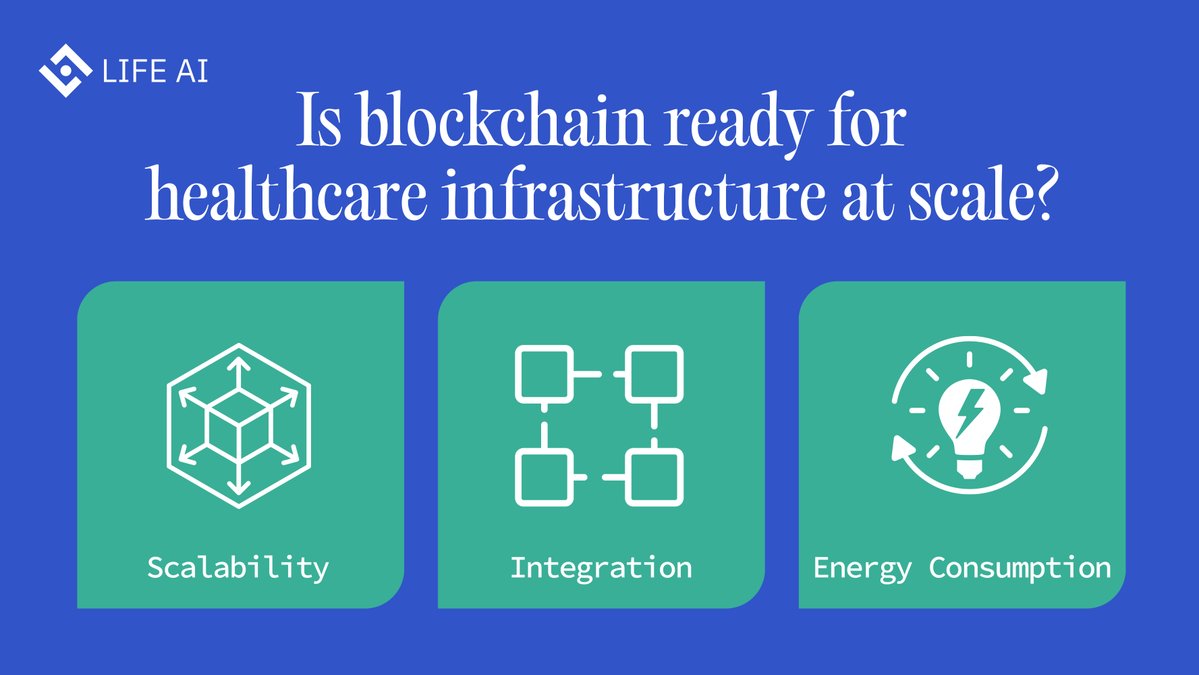
Is blockchain ready for healthcare infrastructure at scale?
Viewpoint A: Structural barriers remain.
Blockchain still struggles with scalability for large health datasets, integration with legacy hospital systems, and regulatory compliance. Operational adoption remains limited, with most initiatives still at the pilot stage.
Viewpoint B: The technology is maturing.
New blockchain architectures are improving speed, efficiency, and scalability. Hybrid models are advancing interoperability with existing healthcare systems. Early pilots also show progress toward secure, patient controlled data sharing.
👇 Comment A or B and share your perspective.
AI is beginning to extend specialist-level expertise beyond traditional centers of excellence.
Today, AI influences less than 15% of global healthcare activity. By 2030, that share is projected to exceed 30%, spanning diagnostics, R&D, and clinical decision support (Source: PwC Strategy & Analysis).
As its role expands, expertise can move beyond leading hospitals and research hubs into more everyday care settings.
In a healthcare system projected to approach ~$30T by 2030, how capability is distributed may matter as much as how much is spent.
Will AI make high-quality care more widely available?
🩺 Community Question
Should preventive healthcare justify large-scale investment and widespread adoption?
Viewpoint A:
Preventive care involves significant upfront costs and carries risks of overdiagnosis and overtreatment, potentially increasing anxiety and spending without clear mortality gains.
Viewpoint B:
Prevention through screening and lifestyle interventions can reduce disease burden, hospitalizations, and long-term costs, while improving life expectancy and quality of life.
Is prevention a cost-effective long-term strategy or an overextended approach with uncertain net benefit?
👇 Drop A, B, or share your perspective.
🩺 Community Question
Should preventive healthcare justify large-scale investment and widespread adoption?
Viewpoint A:
Preventive care involves significant upfront costs and carries risks of overdiagnosis and overtreatment, potentially increasing anxiety and spending without clear mortality gains.
Viewpoint B:
Prevention through screening and lifestyle interventions can reduce disease burden, hospitalizations, and long-term costs, while improving life expectancy and quality of life.
Is prevention a cost-effective long-term strategy or an overextended approach with uncertain net benefit?
👇 Drop A, B, or share your perspective.
If healthcare ever confused you, stressed you, or inspired you, talk about it.
Your perspective can guide what comes next.
Join me on @LifeNetwork_AI: https://t.co/RLnMBsuSpk
Code: R3EW2E0
#LifeAITestnet#HealthcareAI
🩺 Community Question:
Elon Musk recently said that, based on current human constraints, AI-powered robotics could become better surgeons than the best human surgeons within three years at scale.
Do you agree with him?
Viewpoint A:
Agree. With few great surgeons, slow and costly human training, and unavoidable human error, AI and robotics could learn faster and scale surgical skill beyond human limits.
Viewpoint B:
Disagree. Even acknowledging the human constraints Elon Musk points out, surgery is not only about speed, scale, or error reduction. It also depends on judgment, responsibility, and trust in high-stakes situations, which remain difficult to validate and deploy safely at scale.
Is this a near-term breakthrough or a vision that overestimates how quickly surgical autonomy can be safely scaled?
👇 Drop A, B, or share your perspective.
💊 Community Question:
Can AI help discover and develop new medicines much faster and cheaper than traditional methods?
Viewpoint A:
Yes. AI can rapidly test millions of drug ideas, cut early research time and costs dramatically, and in some cases bring medicines to patients years faster.
Viewpoint B:
Not fully. AI helps at the start, but human trials are still slow, expensive, and unpredictable, keeping overall drug development costly and time-consuming.
If AI is expected to change how medicines are made, is the impact already real or mostly promise?
👇 Drop A, B, or share your perspective.