🚨 THE solana:dog1viwbb2vWDpER5FrJ4YFG6gq6XuyFohUe9TXN65u ETF DEMAND STARTS NOW.
If you want @CorgiInvest and @UseCorgi to file a solana:dog1viwbb2vWDpER5FrJ4YFG6gq6XuyFohUe9TXN65u (Bitcoin) ETF, this is your chance to make your voice heard.
VOTE NOW: ❤️ LIKE | 🔁 REPOST | 💬 COMMENT
Let’s put the demand on the record. 👀🔥
@elonmusk, curious where you land on the debate happening inside Bitcoin right now.
Bitcoin is supposed to be censorship-resistant and permissionless. Yet there’s a growing push to filter transactions that some believe don’t belong.
Ordinals and Runes are valid Bitcoin transactions. They create demand for blockspace and generate fees for miners, something that becomes increasingly important as the block subsidy declines.
So who decides what belongs on Bitcoin?
Developers? Node operators? Miners?
Or the free market through decentralized consensus?
Neutrality is the point.
Someone has already created a tool that will let you extract your Ordinals and Runes "padding" sats
An estimated ~$25M will be "airdropped" back to Ordinals and Runes holders once $DOG Mode is live!
To those who believe, to those who fight with all their might: our time will come, and we will fight with all our vigor.
The $LOBO and the sky —
but only for those who truly believe.
@solana@SolgunGG#runes
Dog Memecoin Builds Bitcoin Client For Faster Transactions
DOG community account, Leonidas (@LeonidasNFT), announced a new open source Bitcoin client dubbed $DOG Mode.
Right now, small transactions have to include extra, unusable Bitcoin just to get accepted. DOG Mode would remove that requirement, freeing up an estimated $25 million in Bitcoin that's currently locked in place.
Unlike some other proposed fixes, DOG Mode does not require Bitcoin to split into a new version. It only changes how transactions are relayed, not the core rules that govern the Bitcoin network.
I am very excited to announce the launch of a new open source Bitcoin client called Bitcoin $DOG Mode.
Bitcoin Core and Bitcoin Knots have spent years enforcing rules that Bitcoin itself does not have.
A transaction can be fully valid under consensus and still be blocked from normal relay because it is “non-standard”. This has resulted in the creation of a private “black market” for Bitcoin transactions where insiders with connections to miners get do things that ordinary Bitcoin users cannot.
The $DOG Army has already gotten around this system twice.
First we went directly to miners to execute the largest transaction in Bitcoin’s history because Bitcoin Core would not relay it. Then we did it again for the largest airdrop in Bitcoin’s history because of Core’s arbitrary 83-byte OP_RETURN limit.
Around the same time, the Runes Protocol had grown so popular that memecoin activity accounted for the majority of transactions on the Bitcoin network. Many of these transactions also went directly to miners to bypass Core’s minimum relay fee.
Core realized it had been outmaneuvered and in response they released Core v30 which removed the OP_RETURN limit and lowered the default minimum relay fee to 0.1 sat/vB.
This revealed a clear pattern. The $DOG Army could route our “non-standard” transactions around Core, miners would accept them, and then Core was eventually forced to give in.
The $DOG Army is done asking for permission. It is time to remove even more of these frivolous restrictions.
That is why we are starting an open source initiative to develop our own Bitcoin client called $DOG Mode.
When using Bitcoin in $DOG Mode:
1. The maximum standard transaction size will be increased from 400,000 WU to 3,900,000 WU. This will give everyone equal access to do “four meggers” while leaving a generous 100,000 WU of space for the coinbase transaction and block overhead.
2. The global dust limit will be lowered from 294-546 sats (depending on output type) to 1 sat. Ordinals inscriptions and Runes UTXOs are currently forced to carry hundreds of unnecessary sats to appease Bitcoin Core. This will remove the need for “padding” and effectively airdrop ~$25M in locked up sats back to the Ordinals and Runes ecosystem.
Unlike Bitcoin Knots, which deviates significantly from Bitcoin Core and introduces substantial risk to node runners, Bitcoin $DOG Mode aims to only change the absolute minimum code necessary to remove these two restrictions.
And unlike BIP-110, which attempts to change Bitcoin consensus through a network fork, $DOG Mode operates entirely within Bitcoin’s existing consensus rules and does not require a fork.
This ensures that $DOG Mode can be successful from day one.
Over time the economic incentives will drive $DOG Mode’s adoption and force Bitcoin Core to stop gatekeeping and allow these completely valid transactions. The result will be a more open, fair, and transparent Bitcoin network.
If you are a Bitcoin developer who is interested in contributing to the initial $DOG Mode release, please reach out to me.
If you are a Bitcoin miner who is interested in increasing your revenue by adding support for $DOG Mode transactions, please reach out to me.
If you are a normal Bitcoin user who wants to support $DOG Mode quote post this with: “I will run Bitcoin in $DOG Mode”
Charles Schwab, Real Vision and Morgan Creek Capital are talking about #Runes.
Wall Street is learning about $DOG, #1 Bitcoin Rune / Memecoin / Fungible Token.
Let that sink in.
Bitcoiners should be rooting for anything that brings more attention, builders, and users into the Bitcoin ecosystem.
$DOG has the potential to do exactly that.
For years the conversation has been, Build on Bitcoin.
Now people are building on Bitcoin, and instead of supporting them, some are trying to push them away.
That doesn’t grow the ecosystem.
Whether you personally like memes or not, if they introduce new people to Bitcoin, they have value.
🚨JUST IN: @marshallmixing and @katemparkman discuss why the BIP110 filtering proposals targeting #Ordinals will not pass based on the current state of Bitcoin consensus.
Full Video: https://t.co/Xk5vL4jSfE
🚨JUST IN: During @BTCsessions podcast, sentiment analyst @SullyMichaelvan reveals pro-BIP110 conviction has been "extremely low" since October 2025 and still declining, while anti-BIP110 conviction keeps growing.
Full Video: https://t.co/bq5EadzvWd
There are 110 things more dangerous to Bitcoin than spam.
BIP 110 turns a spam dispute into a consensus change that would invalidate some currently valid, fee-paying transactions.
That precedent is the danger. We should save our energy for threats that really matter. $BTC
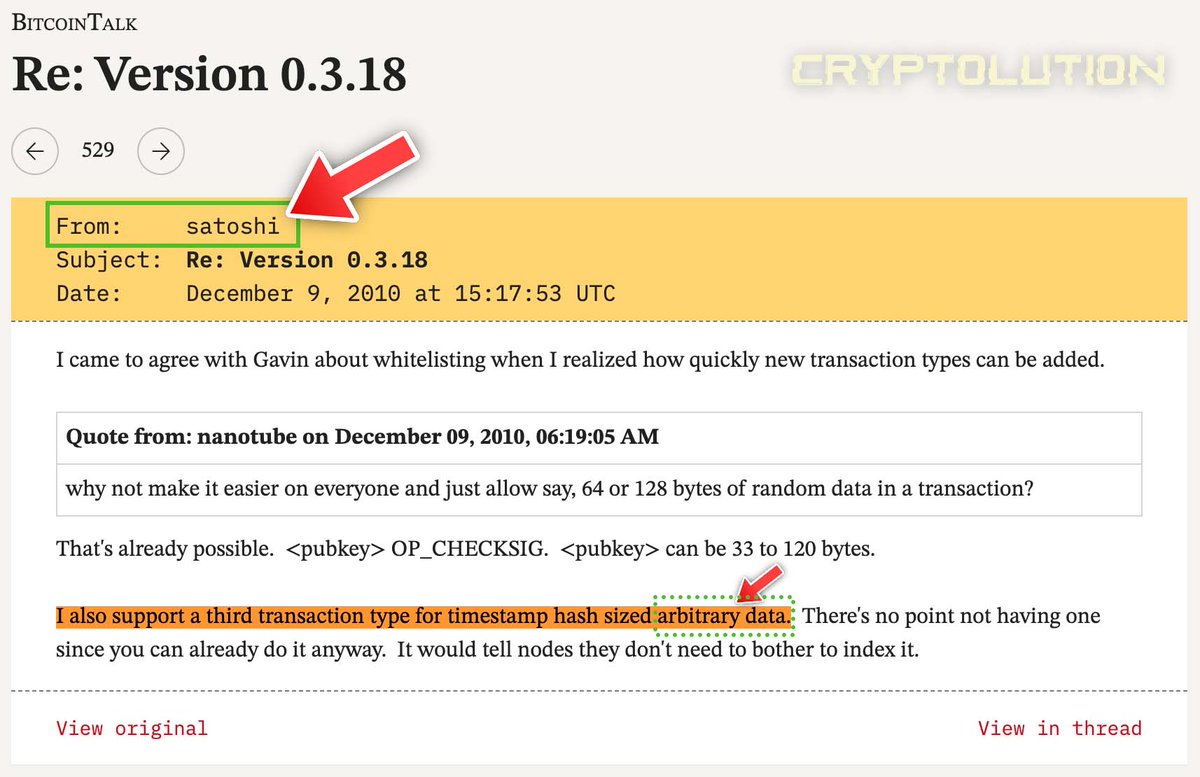
December 9, 2010. A user asks Satoshi Nakamoto why Bitcoin shouldn't just allow 64 or 128 bytes of "arbitrary data" in a transaction.
His answer, verbatim:
"I also support a third transaction type for timestamp hash sized arbitrary data. There's no point not having one since you can already do it anyway. It would tell nodes they don't need to bother to index it."
Read the design spec inside that answer. Small. Standardized. Not indexed by nodes.
Bitcoin Core shipped that exact spec in March 2014. It's called OP_RETURN.
#Runes lives entirely inside OP_RETURN. One runestone per transaction, prunable, zero UTXO bloat, full market fees. #Ordinals pays the same toll through witness space. The only gatekeeper Satoshi ever wrote into the system was the fee. Both pay it.
Now read BIP110. It proposes to reject the exact transaction class Satoshi said he supports, from the channel built to his own spec.
That is not enforcing Satoshi's design. That is reversing it.
And we already ran this experiment. In this same December 2010 thread, miners holding double digit hashrate publicly refused to filter non-standard transactions. Satoshi's response was not a crackdown. It was the quote above.
Fees settled this in 2010. Fees are settling it again in 2026.
Source: https://t.co/5zygotHxDK