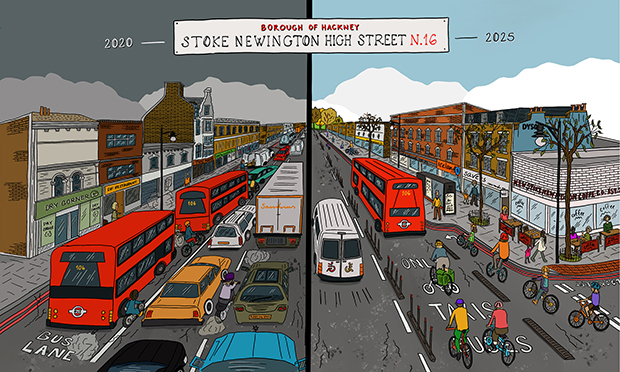
70% of households in Hackney don't own a car, and 90% of visits to the shops are made by public transport, walking, and cycling. Yet, for decades the needs of these people have been overlooked. Make sure you vote for people who'll follow the evidence, not those who shout loudest.
I’m one of these lockdown cycling 🚴♀️ converts and it’s changed not only my life, but my kids now have bikes and we cycle to/from school, plus my husband now commutes to work every day by bike, is super fit and hasn’t bought fuel for several months 🚴♂️🚴♀️
Air pollution is a public health emergency in London. Professor Stephen Holgate tells Nick Ferrari why it’s so serious and what we can do to improve air quality in the capital. #LetLondonBreathe@TfL
For those complaining about traffic in Dulwich and surrounding areas and blaming it on the LTNs, here is Wandsworth, where the LTNs were removed and the traffic is still gridlocked. The cause is too many people driving! This is unsustainable! @RoseCllr
Today @LondonAssembly questioned the London Ambulance Service on their response to the pandemic - they did amazingly well 👏. I asked about introduction of LTNs - ‘We’re happy that we were fully engaged’ and response times have not been affected.
Council facing demand to repay £313k wasted on axed cycle lanes... as opposition petition signatories revealed to be from the US, India, Venezuela and Nigeria. https://t.co/vM5RptPerH
Today is #EqualPayDay: the day in the year when women effectively, on average, stop earning relative to men. #Flexibleworking has a proven, direct impact on reducing the #GenderPayGap - come join us in campaigning for organisations to be #FlexibleFirst: https://t.co/CnPVVcFYc2
@RachelAldred@Active_ATA@ersilia_v@_wearepossible And it means that the next time someone tells you that supporting LTNs means disadvantaging London's most vulnerable, you should send them this report -- so they can learn the facts https://t.co/uKEjOLeKBR
@RachelAldred@Active_ATA@ersilia_v@_wearepossible It means if you're someone who cares about equity between disabled and non-disabled, between the young and the elderly, between the rich and the rest, and between people of all ethnicities -- then you should feel good about supporting LTNs. Because they are a step towards equity.
@RachelAldred@Active_ATA@ersilia_v@_wearepossible So, what does this mean?
It means that poor and vulnerable people are no more likely to live on main roads than residential roads.
It means that, while we need to reduce car use EVERYWHERE -- starting with the residential roads where 90% of Londoners live makes the most sense.
@RachelAldred@Active_ATA@ersilia_v@_wearepossible Overall, 87% or more of Londoners from each age, ethnic, disability, car ownership, and income group live on residential streets.
So schemes that improve residential streets, improve life for all these folkds.
@RachelAldred@Active_ATA@ersilia_v@_wearepossible The report also found that, probably due to the difficulties in storing them or their better access to public transport, folks living on main roads and high streets are less likely to have access to a car than those living on residential roads.
@RachelAldred@Active_ATA@ersilia_v@_wearepossible But the conclusion was this: patterns may vary by local area, but across Inner
London as a whole there are few differences in LTN benefits by age group,
income group, ethnic group, or disability status.
@RachelAldred@Active_ATA@ersilia_v@_wearepossible When it comes to the equity problems focusing on residential roads over main roads, the report found *very small* benefits for:
- disabled over non-disabled people
- children over adults
- middle income over low or high income earners
- white, black and asian people over others
@RachelAldred@Active_ATA@ersilia_v@_wearepossible First off -- the study found that 90% of Londoners live on residential streets, whereas 5% live on main roads and 5% live on high streets. Given those numbers, it makes sense that residential roads are where the government is intervening first.
@RachelAldred@Active_ATA@ersilia_v@_wearepossible Enter Dr Aldred, Ersilia Verlinghieri and the Possible team.
Instead of continuing to spread an idea that had no factual backing (like so many had been doing) they decided to find our for themselves: was it true?
Here's what they found.
@RachelAldred@Active_ATA@ersilia_v@_wearepossible It *sounds* intuitive. But is it true?
Turns out, no one knew. We asked journalists, academics, experts, government officials AND proponents of the arguments themselves.
Not one of them could produce the data to back it up.
@RachelAldred@Active_ATA@ersilia_v@_wearepossible If you've delved at all into the murky waters of the low traffic neighbourhoods debate, you'll undoubtedly have come across this claim: poor, vulnerable people live on main roads and are disadvantaged by low traffic neighbourhoods.