The Asian American Pioneer Medal Symposium and Ceremony returns in July 2025. We join together to celebrate the transformative contributions made by Asian American pioneers and provide a platform for intellectual exchange and inspiration.
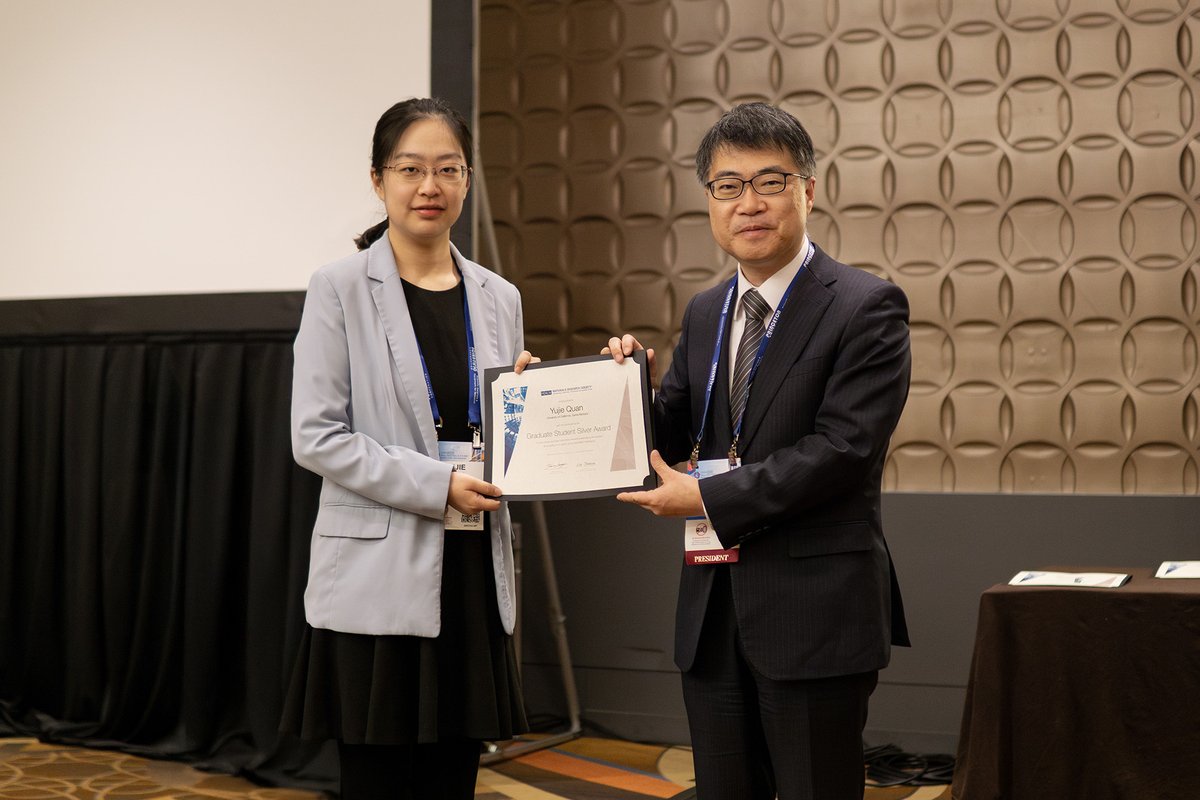
Three PhD defenses and one student award: Congratulations to Yubi Chen, Runqing Yang, and Yujie Quan for successfully defending their PhD theses this month on three wide-ranging topics (charge density waves, Li-ion battery monitoring, and coupled electron-phonon transport). Yujie also won the MRS Graduate Student Silver Award at the 2024 MRS Fall Meeting held earlier this month at Boston!
In JACS, we report a high-throughput computational search for materials with strong intrinsic photostriction, non-thermal strain induced by light illumination. While direct calculation of photostriction is difficult, we apply a simple thermodynamic Maxwell equation to convert photostriction coefficients into bandgap pressure/stress coefficients that are cheap to evaluate with DFT. Using this thermodynamic descriptor, we screened over 4700 semiconductors in the Materials Project database and discovered new photostrictive materials with two orders of magnitude stronger photostriction than silicon. Based on this large dataset, we also analyze the relationship between band edge orbital interactions and the photostriction coefficients.
https://t.co/d2MIqf5F6m
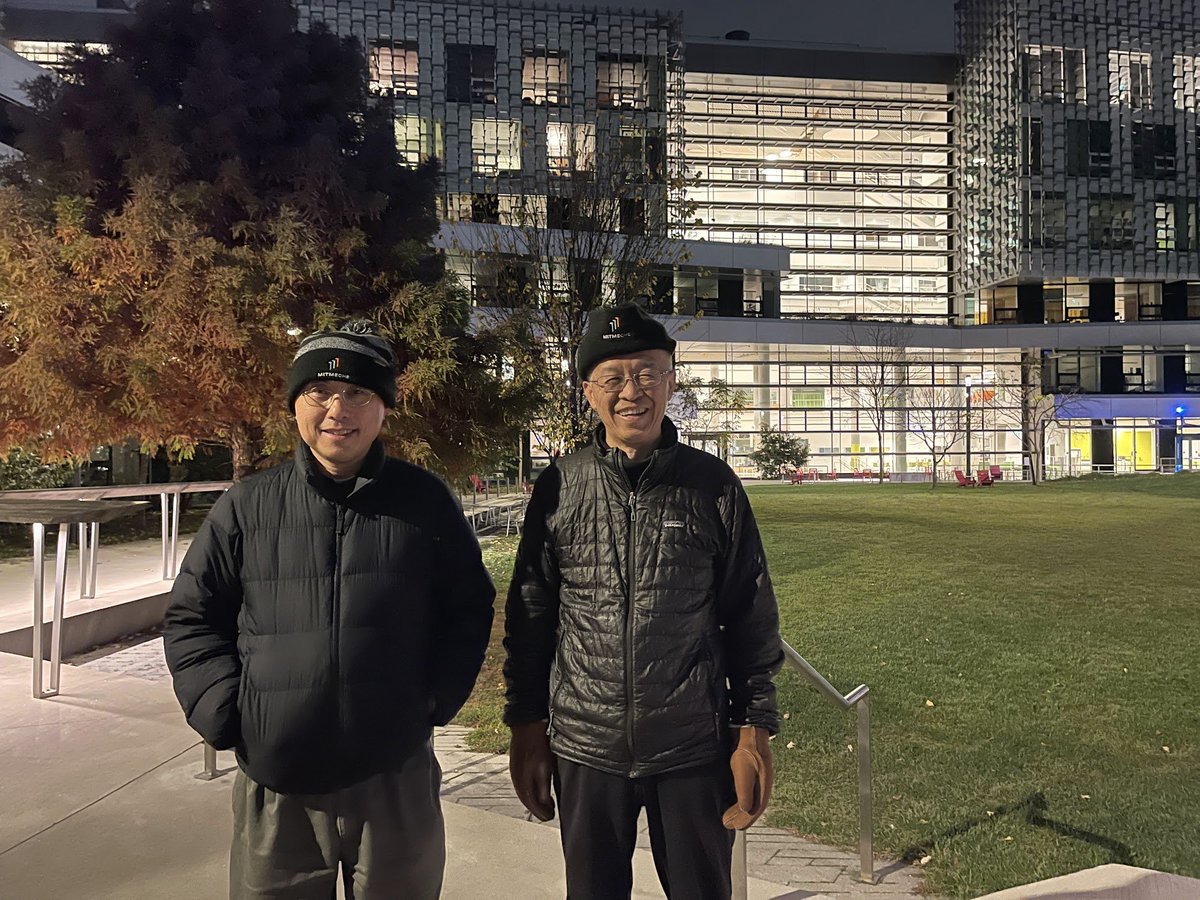
On 1 December 2024, I'll give a talk at a symposium in honor of Professor Gang Chen on the occasion of his 60th birthday. The title of my talk is
Conversations with Gang Chen on the Basic Algorithm of Thermodynamics (BAT)
I sent him an abbreviated title:
BAT Gang Chen
😀
Researchers at @TeaLab_UCSB have created the first-ever "movie" of electric charges moving between two semiconductor materials. This development offers new insights into semiconductor technology, which powers computers, electric vehicles, and more. 🔋 https://t.co/0N0aTro9Uy
In @PNASNews, we report direct time-resolved electron imaging of photoexcited hot carriers transfer across a semiconductor heterojunction using our scanning ultrafast electron microscope (SUEM). With SUEM, we took movies (with picosecond time resolution) of photocarriers migrating across a Si/Ge heterojunction and examined how the heterojunction potentials and band offsets interplay with the migration process. We found that, with the band alignment in the junction we studied, the junction potential leads to charge trapping and significantly slows down hot photocarrier diffusion. Our findings suggest that heterojunctions need to be carefully designed to facilitate hot carrier transport in hot-carrier-based photovoltaics, photosensing, and photocatalysis. We gratefully acknowledge our collaborator Prof. Mark Goorsky at UCLA, who provided the high-quality samples for this study. https://t.co/Na2Uws2riQ
We asked ChatGPT to read 8000 paper abstracts and establish a database for magnetocaloric materials, which we then used to train a machine learning model to predict new magnetocaloric materials. With this approach we discovered 11 new materials, including one with the best performance for hydrogen liquefaction temperature: https://t.co/fBX2XNjlPr
Go inside @UCSantaBarbara’s Nanofab Facility, our state-of-the-art cleanroom with more than $60 million in equipment. 🔬
Hear about how the Nanofab enables cutting-edge technology and will play a pivotal role in boosting the country’s semiconductor industry.
"A federal district court in New York has ruled that U.S. border agents must obtain a warrant before searching the electronic devices of Americans and international travelers crossing the U.S. border."
https://t.co/HwRTA9DEqW
What makes @ucsantabarbara's College of Engineering so great? Check out this short promotional video to see why we annually rank among the best in the nation 💡
#UCSBEngineers
Professor James Speck is the 5th COE faculty member to receive a prestigious Vannevar Bush Faculty Fellowship. He joins Susanne Stemmer, Tresa Pollock, Chris Van de Walle, and Chris Palmstrom as VBFF Fellows. In fact, UCSB ranks #2 among all public universities in VBFF recipients
Humans produce significant amounts of heat, which is difficult to utilize efficiently. However, @UCSBmece's Bolin Liao (@TeaLab_UCSB) has examined cadmium arsenide thin films, which could be useful in enhancing energy efficiency.
Learn More: https://t.co/GGgKJk8ESa
In our new paper published in Advanced Materials @AdvSciNews, we found significantly enhanced Seebeck coefficient and thermoelectric power factor in thin films of topological Dirac semimetals, which we attributed to the topological surface states. https://t.co/Bx86DR6KBS
In @NanoLetters, we report that nonequilibrium coupling between electrons and phonons ("electron drag") can significantly affect thermal transport in 2D semiconductors, in sharp contrast to 3D. Important impact on thermal management of 2D electronics: https://t.co/nAMBZEkKNI
In our new paper published in Advanced Materials @AdvSciNews, we found significantly enhanced Seebeck coefficient and thermoelectric power factor in thin films of topological Dirac semimetals, which we attributed to the topological surface states. https://t.co/Bx86DR6KBS
Jiaoyue Yuan has successfully defended her PhD thesis on high-throughput computational search for new energy materials. She will join @Google in April. Congratulations Dr. Yuan and good luck!
Usama Choudhry has successfully defended his PhD thesis on probing photocarrier dynamics using scanning ultrafast electron microscopy. Congratulations Dr. Choudhry!
UCSB MechE virtual open house for potential graduate applicants will be held on Zoom on Nov. 14 4-5pm PT. Faculty and students will discuss ongoing research and graduate experience at UCSB as well as graduate admission Q&A. @UCSBengineering
Registration: https://t.co/qx4UCf1XNK