Driven by a culture of innovation and collaboration, the college is consistently ranked among the world's best. Stay updated on our news, events & discoveries.
A UCSB breakthrough is still shaping computer graphics.
In 2015, Pradeep Sen, Nima Kalantari & Steve Bako developed a machine-learning approach to denoise CG images. Now used in film and beyond, the work has earned ACM SIGGRAPH’s Test of Time Award. 👏
What happens after you build a microchip? UCSB’s new Protofab is helping researchers bridge the gap from chip to prototype, with advanced packaging tools for quantum photonics, electronics, biomaterials and more.
Click here to read more: https://t.co/aMMHTIeY50
Researchers from UC Santa Barbara and collaborating institutions have shown that artificial intelligence can make future visual prostheses, like a bionic eye, more precise, personalized and responsive to each individual.
Read more: https://t.co/r8e7NoYvuk
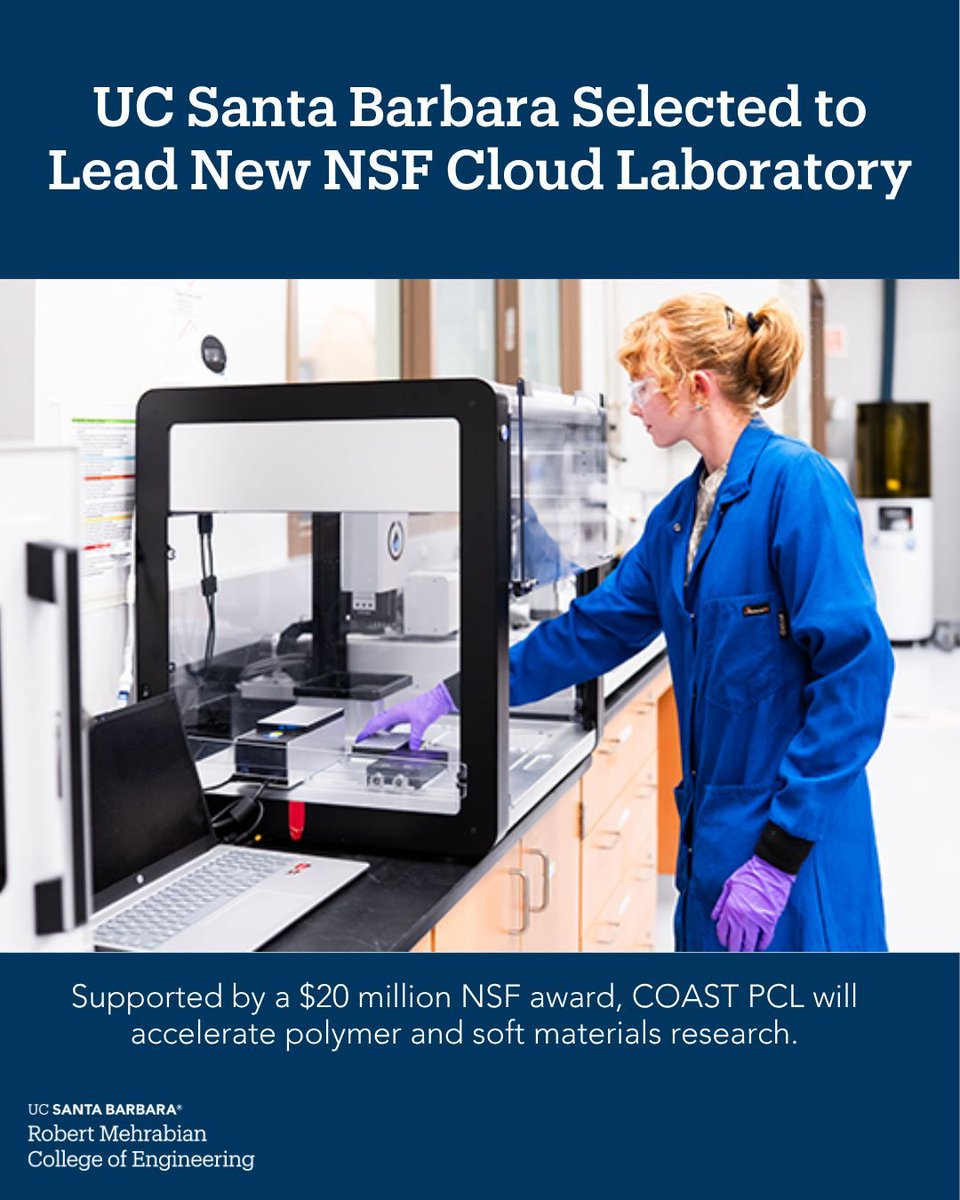
UC Santa Barbara has been selected to lead the NSF's new COAST PCL, backed by a $20 million award. The cloud laboratory will help researchers remotely design AI-powered materials experiments. Read more: https://t.co/UqOMLDnAXW
We are proud to announce that Professor Michelle O'Malley has received Phase I support through @ENERGY's inaugural Genesis Mission.
Read more: https://t.co/XdVt6ygCBW
@ENERGY@ScienceUnderSec
Exciting News! 🎓✨
Our new online professional master’s program—the Master of Engineering and Technology Leadership (METL)—is launching in Fall 2026:
We Are Hiring its Executive Director!
Join us in building the future of engineering @ucsantabarbara : https://t.co/ojmlQ7iMj2
Excited to share our new paper in @PNASNews https://t.co/lxBWbeg9Ae! Ice cubes often appear cloudy because, as water freezes, air bubbles get trapped and scatter light. But how does freezing rate affect the shape of the bubbles? @UMDResearch@UCSBengineering @PMMH_lab @poftwente
Congratulations to @UCSBChE Professor M. Scott Shell for being elected a Fellow of the AIChE, @ChEnected! This honor recognizes his groundbreaking work in multiscale modeling, revolutionizing how scientists study complex molecular systems. 🧪🥼
https://t.co/1sideZdp29
"I was born on a bitter cold morning... When my father went out to visit his wife and newborn first son, his car would not start. He walked to the hospital; his ears were frostbitten on the way."
Read chemistry laureate Alan Heeger's biography: https://t.co/6vlw43a0wK
"I was born on a bitter cold morning... When my father went out to visit his wife and newborn first son, his car would not start. He walked to the hospital; his ears were frostbitten on the way."
Read chemistry laureate Alan Heeger's biography: https://t.co/6vlw43a0wK
Join us for Gauchos In Tech 3.0: Your Future Career in Tech!👩💻
Gain insights, connect with professionals, and explore career opportunities in tech. The event will include a networking lunch reception.
Register here: https://t.co/jmyaLUN03d
We are extremely proud of the fact that we innovate for social impact in UCSB’s College of Engineering. One prime example of this is the decades of research in the domain of gallium nitride, or GaN.💡
Since its inception 25 years ago, UCSB’s SSLEEC has generated leading-edge results through sustained collaborations. Breakthrough advancements include an increase in LED efficiency, the development of MicroLEDs, and novel applications in high-electron-mobility transistors.
@UCSBBioE@AmericanCancer@NIH Stowers and his co-principal investigator, Beth Pruitt, a mechanical engineering professor and chair of @ucsbbioe, also recently received a grant from @nih_nhlbi. The pair will receive nearly $430,000 over 2 years to gain insight into cardiomyopathy.🫀
Ryan Stowers, an assistant professor in the departments of @ucsbbioe and Mechanical Engineering, recently received a boost of nearly $600,000 in combined funding from the @AmericanCancer Society and the @NIH for his work in mechanobiology.👏
Read more: https://t.co/r2h98I8mmg
Emilie Dressaire, assistant professor in the @UCSantaBarbara Mechanical Engineering Department, sent nine experiments to the International Space Station (ISS) last year to research the use of surfactant replacement therapy (SRT) in treating respiratory distress syndrome (RDS).🚀