When ChatGPT launched in late 2022, the consensus inside China’s AI industry was that domestic labs were roughly two years behind on models, while export controls would leave China’s AI stack woefully incomplete.
Three and a half years later, that framing looks ... outdated.
DeepSeek and GLM forced a rethink of what was possible on the model building and also inference side. Meituan LongCat raises the same question for training.
None of this means China has caught up. Nvidia still has a massive manufacturing advantage, and US labs continue to lead in enterprise adoption, developer ecosystems and revenue.
But we do think the burden of proof has shifted.
The question is no longer simply whether China can build a frontier AI stack on domestic infrastructure. It’s how quickly that stack improves from here.
Baidu's AI revenue passes half its total, stock still sinks
Baidu's AI revenue topped 53% of the total for the first time. The stock hit a new low anyway, on investor worry that Baidu is mostly subsidizing compute costs.
We'd be careful with the mix number on its own. If compute bills eat most of that AI revenue, passing half changes what Baidu is on paper rather than what it earns. The milestone is a cost line moving up the income statement.
Huawei Cloud opens its first embodied world model
Huawei Cloud released CloudRobo-WM1.2 on November 16, its first Ascend-native embodied world model. It says it will open the weights, post-training code and pretraining recipes on November 30. The model tops RoboTwin 2.0 and LiberoPro 2.0. Huawei also claims 80% of Chinese embodied-AI companies use Ascend Cloud, a self-reported ecosystem penetration figure, not third-party revenue share.
The design detail worth keeping is DualAct: one world-model brain with two action paths, a fast reflex route and a slower expert route. Customers can also pick among four inference modes, trading compute and latency against each other. We doubt the benchmark wins are what sells this. The elastic modes are the pitch, because they admit deployment cost, not model quality, is what gates industrial scale, and open weights are how Huawei buys developers for Ascend.
H/t @Chinazhidx
A few earlier TBC pieces are useful context:
- Alibaba's May 13 earnings for the March 2026 quarter offered a useful look at the econo (Jun 2026)
https://t.co/PGF8rLOSB0
- Baidu has just streamlined its job classification system, merging technical and managem (Apr 2026)
https://t.co/Y0XolZx0Q7
- The five TBC posts that traveled furthest this week all circled the same hard question (Aug 2026)
https://t.co/AvkTPwpckK
Alibaba's May 13 earnings for the March 2026 quarter offered a useful look at the economics of the AI transition.
Cloud revenue grew 38% year-on-year, while AI-related product revenue posted its eleventh consecutive quarter of triple-digit growth. Alibaba says its AI business is now approaching an annualized revenue run rate of RMB 40 billion.
What's equally notable is the cost side. Capital expenditures have risen to roughly RMB 120 billion, while profits have come under pressure. At least for now, Alibaba's AI business looks less like a traditional software business with expanding margins and more like an infrastructure business requiring sustained investment.
When we wrote about China's AI chip market earlier this year, one observation was that the competitive focus had shifted from peak benchmark performance to delivery continuity, ecosystem depth, and long-term control of the stack. Alibaba's recent results suggest it is pursuing exactly that strategy: developing in-house chips through Pingtouge, building a large model ecosystem around Tongyi Qianwen, and leveraging an enterprise footprint that reportedly reaches around 63% of China's A-share listed companies.
The strategic value may not be the model itself, but the infrastructure layer underneath it. Once an enterprise fine-tunes models, builds workflows, and deploys applications on Alibaba's platform, future iterations, scaling, and optimization become increasingly tied to Alibaba's cloud and AI services.
One way to interpret the revenue growth is that enterprises are moving from buying software licenses to purchasing AI capabilities and compute consumption. If that trend continues, the companies that own the underlying infrastructure may capture a disproportionate share of the value created by AI adoption.
$BABA
Baidu's AI cloud is now half its core revenue
Baidu's Q3 revenue fell 1% year over year to RMB 30.8 billion. AI-driven business brought in RMB 13.2 billion, or 53% of general business revenue, the third straight quarter above 50%. AI cloud infrastructure did most of the work: RMB 8.2 billion, up 94% year over year, with GPU cloud revenue up 191%.
Traditional search and feed advertising fell 24% to RMB 9.4 billion. AI native marketing services dropped 15% to RMB 2.4 billion, which Baidu attributes to prioritizing user experience over monetization during its AI search transition. AI application revenue was flat at RMB 2.6 billion.
We doubt the 53% AI share means the application layer is carrying the company yet. Baidu is converting GPU demand into revenue, but the three largest GPU cloud customers renewed multi-year contracts, the longest at six years, which tells you where the recurring money sits. CEO Robin Li also said Kunlunxin secretly filed for an IPO earlier this year.
$9888.HK
h/t @Chinazhidx
Tencent's executive office is telling managers to get out of the way of AI-driven org change.
Earlier TBC coverage framed this one: that is not normal.
Tencent's Executive Office Says AI Should Thin the Ranks
Tencent's executive office (总办) is arguing that AI-driven reorganization means fewer management roles are needed. It warns that middle managers who guard territory and resist change will block progress.
We doubt the warning is aimed at Tencent's own layers alone. A company that expects AI to flatten its org chart is also telling the managers who would have to carry out that flattening that they are the obstacle.
Earlier TBC coverage frames this one.
The archive has a few angles on this story:
- ByteDance raised the internal repurchase price of employee-held “Doubao shares” from $1 (Jun 2026)
https://t.co/OYpWtfgBpP
- ByteDance is negotiating a roughly $20 billion overseas loan, the largest offshore fina (Jun 2026)
https://t.co/1K9fs8VJai
ByteDance raised the internal repurchase price of employee-held “Doubao shares” from $13.08 to $14.85 in just two months, a gain of 13.5% and 48.5% above the original $10 grant price. Over the same period, ByteDance’s broader employee stock buyback price increased only 2.63%, from $229.5 to $235.5. The gap suggests ByteDance is increasingly treating Doubao as a standalone business with its own performance incentives and talent retention strategy.
Doubao’s paid plans are now public: 68 RMB/month ($9) for Basic, 200 RMB/month ($28) for Enhanced, and 500 RMB/month ($70) for Pro, with annual plans reaching 5,088 RMB ($708). But subscriptions alone are unlikely to move the needle. Based on previously disclosed figures, Doubao generates less than $1 million in daily revenue while incurring more than $10 million in daily costs.
The bigger story is infrastructure spending. ByteDance reportedly increased its 2026 AI capex budget from 150 billion RMB ($20.9 billion) to 200 billion RMB ($27.8 billion), with some reports later referencing as much as $70 billion in total AI infrastructure investment. The company is also said to be pre-purchasing more than $50 billion worth of domestic AI chips, including Huawei Ascend and Cambricon hardware, alongside 50,000 inference chips from Tianshu Zhixin. This is a scale strategy, not a subscription business strategy.
The paid tiers appear less about immediate monetization and more about user segmentation. Free users help build habit and distribution, while paid plans target developers, researchers, and other power users who need stronger models and larger usage quotas. With its infrastructure budget, ByteDance can afford to subsidize premium AI services at a level many competitors cannot.
The separate “Doubao shares” program also gives employees a direct stake in Doubao’s performance rather than ByteDance’s overall results, increasing internal pressure to improve the product.
The challenge is that Doubao still trails competitors such as DeepSeek, Kimi, and Zhipu in reputation, particularly for coding. ByteDance is betting that scale, distribution, and investment can narrow that gap before rivals build enough paid-user loyalty to make switching difficult. Whether that works will depend on how quickly Doubao’s capabilities improve.
h/t @TMTPostGlobal
ByteDance Puts a $400B Price on Its Own Stock
ByteDance told investors it plans a new $6 billion share buyback at $241.35 a share. That price implies a $400 billion valuation, 20% above its buyback a year earlier, per The Information via Bloomberg on November 13.
The same letter pushes the deadline for an IPO, or a right for outside shareholders to sell their full stakes, out four years to December 11, 2030. The buyback hands staff and early holders cash without a listing. The new deadline keeps ByteDance, not investors, in charge of when anyone can exit.
It also describes a plan to grant AI staff 300 million shares tied to the value of the AI business. That pays frontier-lab money without repricing the whole company. Our read: the retention tool becomes the thing employees are stuck holding if the internal mark stops climbing 20% a year.
Baidu's ERNIE 5.5 Flash Preview took first on two of eight benchmarks on November 11, ahead of Claude Opus 5.5 on AutomationBench and SpreadsheetBench V2. Those are Baidu's own scores, and Baidu calls it a mid-training version that may still have gaps.
The price is the sharper number: RMB 2 (~$0.28) per million input tokens and RMB 8 (~$1) output at busy hours, currently half off. Weights go out under Apache 2.0 by November 25, which reverses Li Yanhong's 2024 line that open models would fall behind. Baidu is buying its way back into the first tier with price and open weights, not a clear capability lead. We would be careful about reading two self-reported wins as a durable position.
$9888.HK
h/t @TMTPostGlobal
We've been circling this from a few angles:
- The Month China Closed the AI Stack (Jul 2026)
https://t.co/kqtecU0asR
- Tencent's AI Bet Is Not a Chatbot. It Is WeChat as an Action Layer (Jun 2026)
https://t.co/FHuIVu8pE8
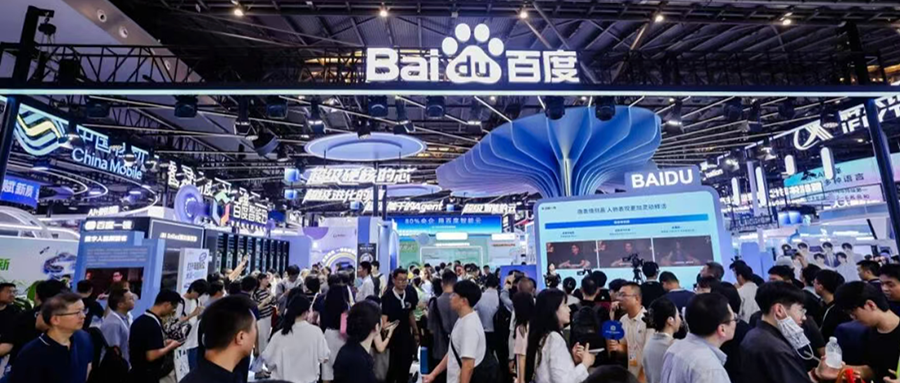
Baidu says its internal agent count went from 5,000 to 37,000 in a year, and effective weekly work tasks from 84,000 to over 1 million. Li Yanhong put those numbers on screen at Baidu World on November 12. His argument: AI's next phase is the "intelligent organization," agents and digital employees inside real business processes rather than chat windows.
The model news got the headlines. ERNIE 5.5 Flash Preview has 280B total parameters, 14B active, and a million-token context, and Baidu also released an 800B-parameter deep-reasoning application model that previously served Baidu Search. Sun Tianxiang, the post-95 head of Baidu's foundation model unit, presented them in his first public appearance. The demo was a 116-second 2D short, written from scratch in Python, of a pelican on a bicycle riding through 20 art styles.
The parameter count is not the number to watch. It's the 88.2% first-pass acceptance rate Baidu reports for Baidu Dazi on long multi-system tasks over 15 steps, up from 67.6%, which decides whether agents save labor or just create review work. Baidu also cited a materials firm that cut weekly procurement from 10 people and 100 hours to 2 people under an hour.
The hardware is being sized for that load. Baidu's Tianchi 1024-card supernode, shipping next year, is built for 5-trillion-parameter training, with Baidu claiming 3x inference performance and 90% lower first-token latency on cache-hit multi-turn chats. Kunlunxin's M-architecture chips arrive this year and next, N-architecture in 2028.
We doubt the constraint on the intelligent organization is model capability now. It's whether enterprises can absorb 37,000 agents without drowning in them, and Li's answer that jobs converge into builders and sellers is a cleaner story than a plan.
$9888.HK
h/t @Chinazhidx
Tencent Yuanbao's search lead, Li Ruizhang, sat for an interview on whether web search still has a place in the AI era and how AI-native search gets built.
We doubt the interesting question is whether search survives. It's who owns retrieval once answers replace links, and a search lead doing this interview suggests Tencent wants that layer inside Yuanbao rather than handed to a partner.
Tencent launched Yuanbao Search on November 11 as a standalone consumer product, reachable through its own site and a QQ Browser entry. The retrieval stack behind it was opened to enterprises and developers on October 20 via API, MCP and Skill. Tencent describes that base as a hundred-billion-scale index with 157 authoritative sources across 13 verticals. Consumer and enterprise products share it but are sold separately.
The WeChat channel is the most concrete differentiator. In Zhidx's hands-on test, a search for Tianjin civil service exam surfaced a 2027 recruitment notice posted that same day in the official-account channel. The video channel's first screen was all clips labeled a year old, with some off-platform content mixed in. Zhidx also found official-account links that would not open and a slow-updating content library, so the ecosystem advantage is real but uneven across formats.
Product lead Li Ruizhang said Yuanbao Search is not opposed to advertising, and will rely on clear ad labeling, limited formats, a collapse button and tighter relevance. In testing, commercial keywords like omeprazole returned no obvious ad slots; an ad appeared on the civil service query, small and collapsible. Li also said the product will keep adding features but will not evolve into an AI assistant.
We doubt Tencent is trying to win search on index size, where it is late. It is trying to win on source trust and WeChat exclusivity. The ad restraint is the price of training users to treat this as a reference tool rather than a shopping entry. That works only if the freshness gap between official accounts and video closes, because otherwise the authority pitch is undercut by the product's own results page.
H/t @Chinazhidx
Lingchuan Technology (凌川科技) spun out of Kuaishou in March 2024 and just closed a RMB 1 billion Series B. Yizhuang Guotou's Yitang Shenghe fund, Qiming Venture Partners and Zhaohui Capital co-led. The money goes to next-generation chip R&D, mass production and overseas expansion. Its 3D-stacked chip taped out in April, has come back from the fab, and should ship at volume next year.
The commercial base is not a slide. The SL200 video SoC has sold nearly 100,000 units and sits inside Kuaishou, Alibaba Cloud, Baidu Cloud and Bilibili, covering 99.7% of Kuaishou's livestream transcoding. That is a captive anchor customer plus a few cloud tenants, enough to prove the silicon works, not yet enough to prove it wins on the open market.
The pitch is a deterministic-latency DiPU architecture on RISC-V, a 3D near-memory design using hybrid bonding, and a software stack called LUCAS. That stack has a CUDA compatibility layer and ports for Qwen, Hunyuan Video and MiniMax. The target is AI video generation, where COO Zhang Wenjing argues general GPUs leave too much TCO on the table for content shops running AI shorts and ads.
We doubt the architecture is what decides this. The 3D near-memory bet attacks the memory bandwidth wall that actually binds video inference rather than FLOPS, which is the more interesting part. But a CUDA compatibility layer and a 2027 volume date put Lingchuan in a crowded queue of Chinese inference chip makers all promising lower TCO. The 99.7% Kuaishou figure is a moat inside one customer, and the next 100,000 units have to come from somewhere else.
$9888.HK
Meituan open-sources a 1.6T-parameter model under MIT
Meituan's LongCat team released LongCat-2.5, a 1.6 trillion-parameter native multimodal model, under the MIT license. Developers can run it commercially, deploy it and fine-tune it without asking for extra permission. The weights and a W4A4 quantized version are on Hugging Face, and Meituan included NPU deployment notes for domestic accelerators. On those chips the quantized build lifts prefill and decode throughput 43.3% and 42.77% over a W8A8 INT8 baseline.
On OpenCode, which made it free for two weeks, it has logged about 109 billion cumulative tokens, 4,700 unique users and 50,000 sessions. Against nine models including Claude Opus 5 and GPT-5.6-Sol, it ranks first on four of 31 benchmarks: BrowseComp at 91.9, ALE v1.1 at 38.5, ResearchRubrics at 81.0 and 3DCodeBench at 55.4. It activates about 48 billion parameters per token and supports a 1 million token context.
The API is RMB 2 per million input tokens and RMB 8 per million output, well under the four overseas models in that comparison. Against domestic rivals the gap narrows. DeepSeek-V4.1-Flash beats LongCat-2.5 on 14 of 26 comparable tests, and its Flash-1017 update matches Meituan's peak price while costing half as much off-peak. We doubt the MIT license alone moves many teams. What it does is remove the licensing conversation for anyone who wants to self-host on domestic chips, which is where Meituan's deployment notes do more work than the benchmark table.
$MPNGY
h/t @Chinazhidx